
Palmistry and Curiosity
Palm reading or palmistry makes people very curious. It’s also oftentimes misunderstood, especially as the Simian Line. The Simian Line is often talked about as being unusual or rare, and this is the line that is a single line that goes across the palm. This line has been surrounded by big claims, myths, and is often connected to fear.
For some people, seeing their Simian Line on their hand makes them excited, but for others, it causes concern that comes with misleading or outdated interpretations. Palmistry should be practiced responsibly, and when it does, it doesn’t give exaggerated claims or absolute outcomes. It’s not about predicting fate or diagnosing a personality.
The Simian Line instead gives a symbolic language for understanding strengths, tendencies, and your inner self. The Simian Line fits squarely into this type of tradition. If you want to know more about the Simian Line and what it actually is and why it’s misunderstood, keep reading. This article talks about how palmists today and even psychics interpret the Simian Line. Instead of showing it as a mark of destiny or of danger, it should be integrated where emotions and knowledge work together, both powerfully and intensely.
Palmistry Explained: A Grounded Introduction
Palmistry, sometimes called chiromancy, is a symbolic system that examines the hands to explore temperament, tendencies, and life patterns. It developed in many different cultures, including India, China, Greece, and parts of the Middle East, with each tradition having its own language and changes as time went on.
Palmistry is not about fixed predictions. Traditional readers understand the hand as dynamic rather than static. The lines are seen as indicators of focus, habit, and lived experience, not guarantees about the future. In this way, the palm reflects how someone engages with life rather than what will inevitably happen.
Palmistry today puts these things first:
- Interpreting patterns instead of just single markings.
- Reading the entire hand and not just certain features.
- Talking about growth and changes over destiny or danger.
It is important to look at it in this way when you use uncommon markings like the Simian Line.
The Three Major Palm Lines
Most palm readings begin with three major lines that form the foundation of interpretation. The heart line relates to emotional expression, connection, and how someone experiences relationships. Here is what you can learn:
- The headline works with cognition, a persons decision making skills and learning style.
- The lifeline looks at momentum, vitality, and personal energy, and how a person uses it in different parts of their life. It doesn’t show lifespan.
- The heart and headline normally show two different paths. This is a symbol that suggests emotions and intellect as related but different.
- The Simian Line shows when the separation doesn’t exist.
Understanding the Simian Line
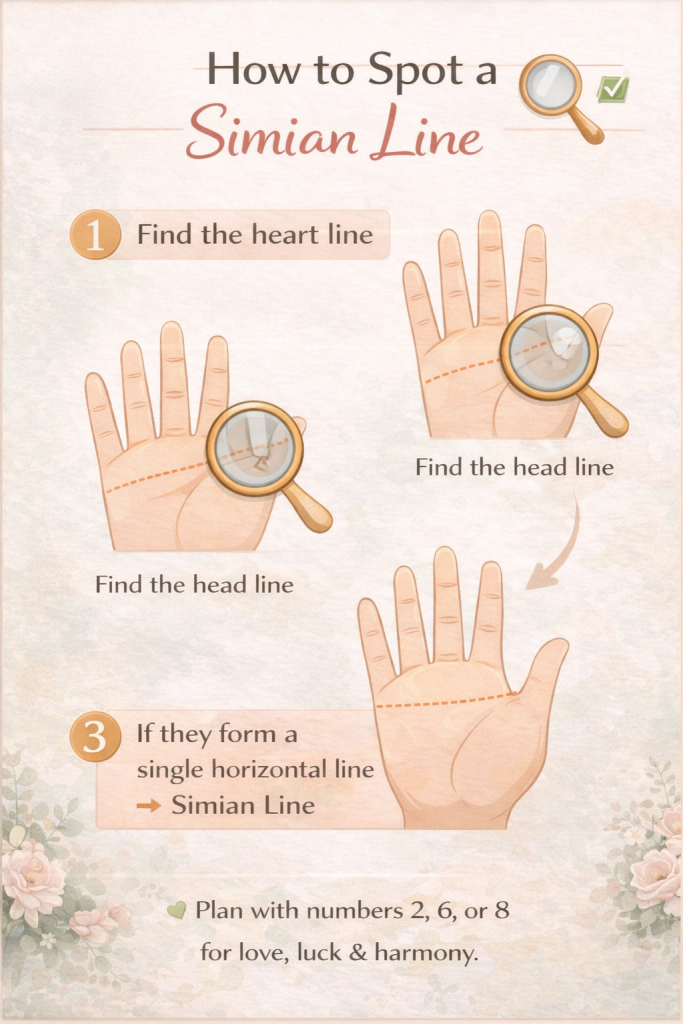
A Simian Line forms when the heart line and head line merge into one continuous line running across the palm. In symbolic palmistry, this is interpreted as emotion and reasoning operating through a single channel rather than alternating between two.
In medical terminology, this feature is called a single transverse palmar crease. That description refers only to anatomy. Palmistry, by contrast, focuses on meaning and experience. Conflicting the two has contributed to misunderstanding.
Seeing a Simian Line does not suggest illness, limitation, or abnormality. It just represents a different structural pattern that palmists interpret symbolically as an integrated focus.
How Common is a Simian Line?
The Simian Line isn’t looked at as much as the standard palm patterns, but it is not exceptionally rare. But since it is an uncommon appearance has historically led to exaggerated interpretations.
Modern palmistry takes a more grounded approach. Just because something is rare doesn’t mean that it has more importance, virtue, or concern. It simply reflects variation.
Different cultures have interpreted the Simian Line in different ways. Some viewed it as a marker of strength and concentration, while others misunderstood it due to limited frameworks or fear of difference.
Shifting Interpretations Over Time
Early palmists often struggled with the Simian Line because it didn’t fit neatly into existing models that relied on separating emotion and logic. As a result, interpretations sometimes swung toward extremes.
Some historical sources showed individuals with a Simian Line as unusually gifted. Others described them as problematic or unstable. These conclusions say more about the era than the line itself.
Modern readers focus on balance and context, moving away from dramatic or moralized interpretations.
Symbolic Meaning in Palmistry
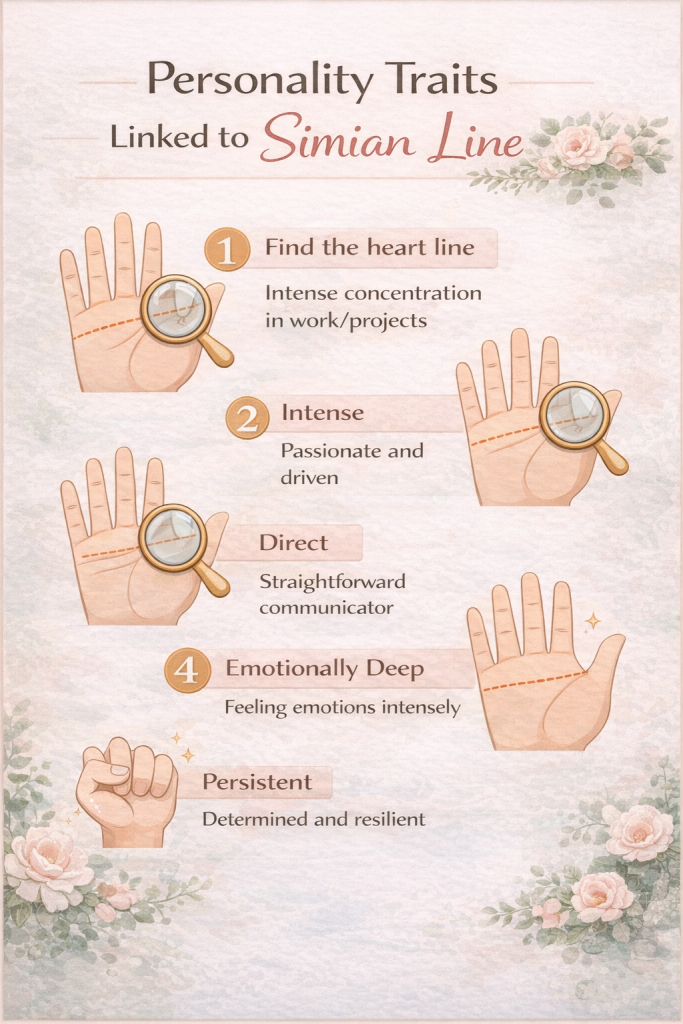
On a symbolic level, the Simian Line shows emotional and intellectual thoughts moving together instead of thinking that one happens and then the other. They both happen at the same time. This kind of integration can be seen as:
- Being deeply committed to personal values.
- Having good focus once you pick what direction to go.
- Being fully engaged instead of just doing things here and there.
When this is balanced and working together, it brings the energy together to be able to make clear decisions and to be dedicated. When it isn’t balanced, though, it can feel intense or stuck. The idea is to integrate these things and not to become stuck.
Emotional Expression and Inner Experience
Palmists often associate the Simian Line with emotional sincerity. Because thinking and feeling are closely linked, responses tend to feel wholehearted and direct.
People described with this pattern are often seen as:
- Not being interested in superficial things.
- Being motivated due to meaning and not because they feel the convenience of it.
- Having loyalty once they have trust.
- Being honest in how they express their emotions.
This can be a strength, but at the same time, having emotional responses might feel like an absolute, and when you change your perspective, it can require you to have conscious effort to do so. Growth means that you learn to have flexibility without losing your authenticity.
Psychological Perspective of the Simian Line
From a modern psychological lens, the Simian Line aligns with integrated processing styles, where emotion, reasoning, and values reinforce one another.
This overlap is not a flaw. Many effective thinkers operate with strong emotional-cognitive coherence. The challenge is learning regulation rather than separation.
Symbolically, the Simian Line reflects:
- Internal consistency.
- Determination once a choice is made.
- Difficulty ignoring emotion and logic.
By being self-aware and having balance, it shows a certain style of processing, and it benefits a person by helping them to have emotional regulation.
Addressing Intelligence Myths Around Simian Line
A long-standing misconception claims that the Simian Line signals unusually high or low intelligence. There is no scientific support for this idea.
These beliefs emerged during periods when physical traits were wrongly linked to mental or moral qualities. Modern palmistry rejects this entirely.
The Simian Line reflects how someone engages with ideas and emotions, not how intelligent they are.
Relationships and Connection
In relationships, Simian Line energy often appears as loyalty and depth. Commitment tends to be intentional and loyal.
Common strengths include:
- Having emotional consistency.
- Having strong values.
- Having reliability after trust.
- Having deep attachments.
Challenges can happen with compromise. Because beliefs and feelings are intertwined, changing direction may feel internally disruptive. Learning flexibility is often key to relational balance.
Work, Purpose, and Focus
In a professional way, people who have a Simian Line usually do best in roles that allow them to have depth and concentration.
These may include:
- Doing research.
- Doing analysis.
- Doing creative work that needs concentration.
- Using value-driven leadership skills.
- Specialized careers.
- More focus.
When you’re in an environment that is divided, it can feel draining. When your work aligns with your own personal meaning, a unified focus can become its strength.
Which Hand Matters with the Simian Line?
Palmistry considers the non-dominant hand reflective of innate tendencies, while the dominant hand reflects lived experience.
A Simian Line on the non-dominant hand may suggest an inborn integrated style. On the dominant hand, it may reflect focus shaped through experience.
Readers put context over rules. Personal history, dominance, and culture all matter.
Variations of the Simian Line
Not all Simian Lines are complete. Some hands show partial merges, bridges, or forks between the heart and head lines.
These patterns are often interpreted as moderated integration, like a strong connection between emotion and logic without full merging.
Variation and other interpretations are common in palmistry, and they put value over labels.
How Palm Reading Changed Over Time
Palm lines can change subtly over time. There can be major creases that stay the same, and there can be branching that changes with experience. The changes can show:
- Emotional growth.
- More adaptability.
- A change in focus.
- A change in values.
In palmistry, the change can be seen as a healthy thing. The hand will change just like a person changes over time and with experience.
Reading Simian Line as a Palmist or Psychic
Psychics and palmists today don’t make big and extreme claims. When they see Simian Line, they interpret it as a tendency and not as destiny or even a diagnosis. Being responsible in your readings includes using:
- Context.
- Life Stage.
- Emotional Awareness.
- Personal Agency.
The way that the Simian Line is framed shows potential energy that can be seen with self-knowledge and is only expressed in a constructive way.
Science and Skepticism
When looking at the Simian Line medically, it is seen as a variation on palmar creases. It doesn’t have any psychological or intellectual implications.
A skeptic might think that palmistry is a symbolic interpretation, and this is why psychology explains that people can find meaning in physical traits and that humans will seek out narratives that help explain things like their experiences and their identity.
Using symbolic systems works because they offer a language without trying to take away logic or evidence.
Reflecting on the Simian Line Without Being Afraid
Some say, “Is this line good or bad?” but you should really ask questions such as:
- How can I balance the convictions I have with flexibility?
- Where does my intensity help me, and where does it limit my life?
- How do I use emotions and logic in my life?
The Simian Line is Still Important to Readers
Our culture today is interested in identity, and the Simian Line looks at this. It gets people to tell stories about focus, passion, and individuality.
It works not because it’s rare but because it symbolizes the challenge that humans have to align their feelings with their thoughts.
Final Thoughts: Understanding the Simian Line
The Simian Line is best known for its symbols and for the mind and the heart. It shows focus, sincerity, and intensity instead of danger and destiny.
When you look at Simian Line and other palmistry, it can give you insight that you don’t have to be afraid of. It reminds us that integration is powerful but also needs to have balance. This isn’t about fate but about your own potential.




“Symbolic language for inner strength”—sure, and next we’ll find horoscopes printed on medical records 😅 This feels like mental gymnastics to justify staring at your hand instead of going to therapy.
@Gingersnap Not everyone uses palmistry as therapy though—some use it as a mirror for reflection, not diagnosis. It’s more philosophical than medical.
“Reading hands” sounds more like reading into things than reading anything real. The idea that lines on your skin show your focus or values is poetic but let’s not pretend it’s deep truth.
So you’re telling me my hand crease is a cosmic gateway into my soul’s decision-making matrix? Cool cool cool. Next time I flake on plans, I’ll just blame it on my palm lines 😆
‘The Simian Line is not about fate but potential.’ What a powerful reminder that we are active participants in our growth. Whether symbolic or not, introspection through metaphor can be a tool for self-awareness.
Honestly, this whole thing reads like an overly romanticized pseudoscience. The attempt to legitimize palm reading by quoting psychology-lite concepts doesn’t convince me. Let’s not confuse symbolism with actual science.
I didn’t know the Simian Line could mean anything positive! My son has one, and I always worried because of things I read online. This gives me a new way to look at it—thank you for the calm explanation.
This article gave me a whole new way to look at palmistry. I always thought it was just fortune-telling nonsense, but this symbolic and psychological interpretation actually makes sense. The Simian Line as a lens for emotional integration? That’s deep. I’m intrigued now, and I might even look at my own palm with more curiosity than skepticism.
“The Simian Line shows emotional sincerity” — oh please, what’s next? Toenail shapes reveal your career path? Let’s not pretend we’ve discovered some mystical truth when all we did was stare at our hands too long during yoga class 🧘♀️✨.
I found this article absolutely enlightening. As someone who’s always been curious about palmistry, it’s refreshing to see a modern and respectful take that avoids fear-mongering and embraces symbolic interpretation. Very insightful and thoughtful writing!
I gotta argue this whole idea of emotions and intellect being ‘merged’ through one line like it’s some magical indicator of personality. Humans are complex — reducing behavior to a crease on the skin seems oversimplified no matter how poetic the explanation tries to be.
It’s worth noting that while the Simian Line is anatomically recognized in medicine, there’s no empirical evidence that supports its psychological interpretations. This article does a decent job separating myth from modern views, but still leans heavily into subjective symbolism without grounding in scientific data.
It’s fascinating how ancient practices like palmistry are being reinterpreted through contemporary psychological lenses. The Simian Line discussion particularly resonates with themes of cognitive-emotional integration—a concept explored in neuropsychology too.
Honestly, I think this is just another way people try to explain things they don’t understand. Whether it’s astrology or palmistry, people cling to symbols because real life is messy. No line on your hand can tell you who you are — that’s just misleading and potentially harmful.