
Quick answer: Calculate your Soul Urge Number from the vowels in your birth name and explore symbolic meanings for 1–9 and master numbers without treating numerology as a personality test.
What Is a Soul Urge Number?
For the wider system behind Soul Urge, Life Path, Expression and Personal Year calculations, see Psychic Numerology Readings: Numbers, Methods and Limits. You can also compare this with Birthday Number Meaning: Numerology Guide for Days 1–31 and Hidden Passion Numbers: How to Calculate and Interpret Them.
In modern numerology—which Britannica describes as using numbers to interpret character or divine the future—the Soul Urge Number, also called the Heart’s Desire Number, is calculated from the vowels in a person’s birth name. Numerologists use it as a symbolic way to reflect on motivations, preferences and emotional themes.
Numerology is an interpretive spiritual system, not a scientifically validated personality or mental-health test. The American Psychiatric Association explains that mental-health diagnoses use clinical criteria evaluated by trained professionals. A Soul Urge Number cannot diagnose attachment style, anxiety, depression, relationship patterns, career fit or a person’s “soul mission.”
How to Calculate Your Soul Urge Number
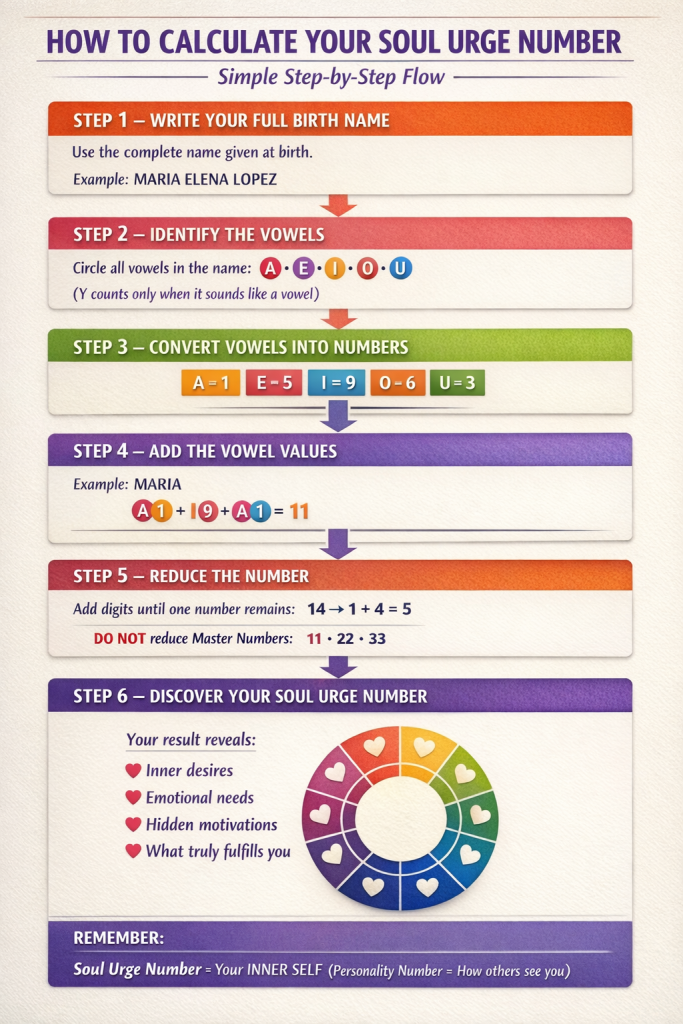
1. Use Your Full Birth Name
Use the name given at birth if you are following the common Pythagorean numerology method.
2. Keep the Vowels
Use A, E, I, O and U. Some numerology traditions treat Y as a vowel when it functions as a vowel sound; practices vary.
3. Assign the Numerology Values
- A = 1
- E = 5
- I = 9
- O = 6
- U = 3
If your chosen system uses Y as a vowel, it is commonly assigned 7.
4. Add and Reduce
For the example name Sophia Renee Carter, the vowels are O, I, A, E, E, A, E. Their values total 32, which reduces to 5 because 3 + 2 = 5.
Many modern numerologists keep 11, 22 and 33 as “master numbers” rather than reducing them further.
Soul Urge Number Meanings
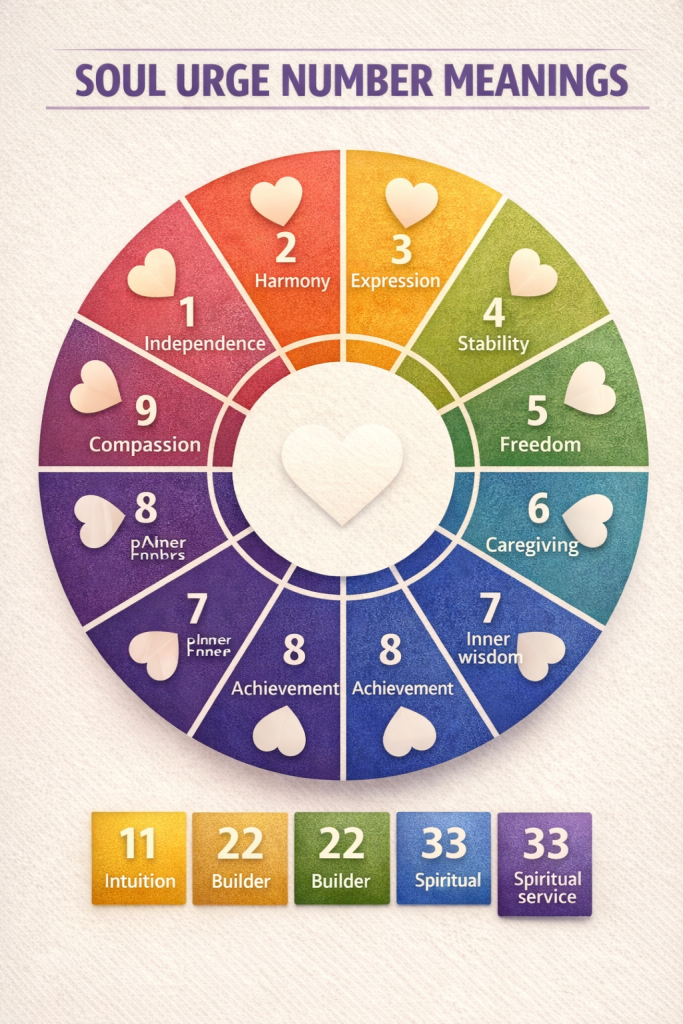
Use the meanings below as reflection prompts rather than fixed descriptions.
Soul Urge 1: Independence
Traditional themes: autonomy, initiative, self-direction and recognition.
Reflection: Where do you want more freedom, and where would cooperation help?
Soul Urge 2: Connection
Traditional themes: partnership, cooperation, sensitivity and belonging.
Reflection: What helps you feel supported without giving up your boundaries?
Soul Urge 3: Expression
Traditional themes: creativity, communication, playfulness and visibility.
Reflection: Where do you want more room to create or express yourself?
Soul Urge 4: Stability
Traditional themes: structure, reliability, order and long-term building.
Reflection: Which routines support you, and which have become too rigid?
Soul Urge 5: Variety
Traditional themes: freedom, curiosity, change and experience.
Reflection: Where would healthy novelty help, and where do you need more consistency?
Soul Urge 6: Care
Traditional themes: responsibility, family, service and harmony.
Reflection: How can you care for others without taking responsibility for everything?
Soul Urge 7: Reflection
Traditional themes: study, solitude, spirituality and analysis.
Reflection: What deserves deeper thought, and when does solitude become isolation?
Soul Urge 8: Achievement
Traditional themes: ambition, management, material goals and influence.
Reflection: What does success mean to you beyond status or money?
Soul Urge 9: Compassion
Traditional themes: service, broad perspective, creativity and completion.
Reflection: Where can compassion coexist with practical limits?
Master Numbers 11, 22 and 33
Some modern numerology systems give special meanings to 11, 22 and 33. These numbers are not objectively more powerful or spiritually advanced than other numbers.
Soul Urge 11
Traditional themes: inspiration, sensitivity and intuition.
Soul Urge 22
Traditional themes: organization, long-range building and practical ambition.
Soul Urge 33
Traditional themes: compassion, teaching and service.
Do not use a master number to explain anxiety, burnout, unusual perceptions or a duty to heal other people.
Soul Urge Numbers and Relationships
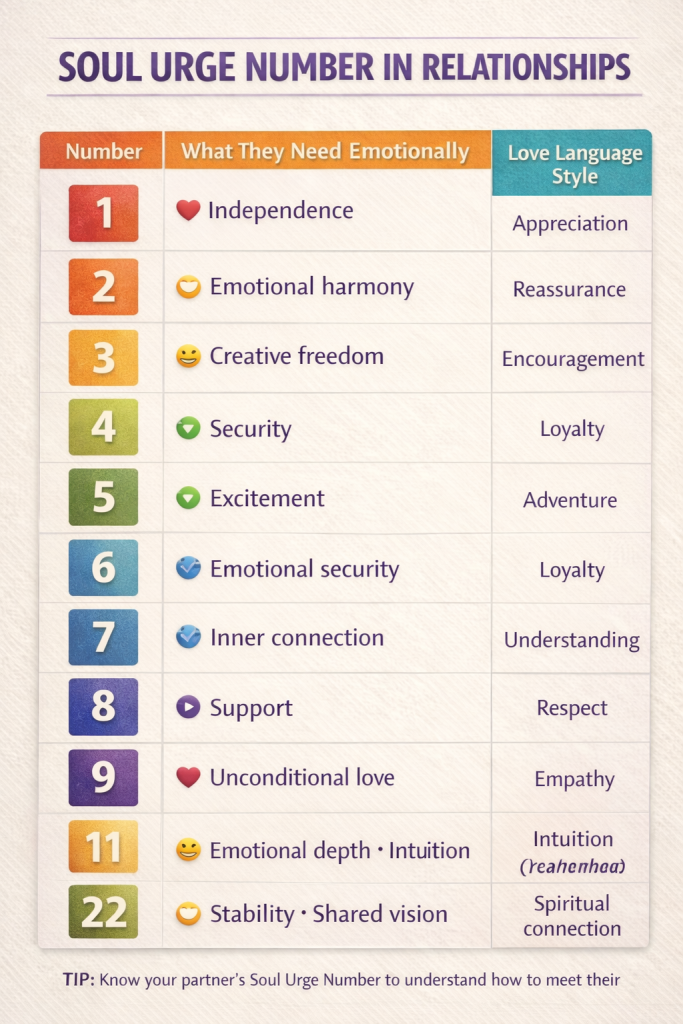
Numerology can give couples vocabulary for preferences, but it cannot establish compatibility, attachment style or whether a relationship is “addictive.”
Instead of saying “Soul Urge 2 needs reassurance” as a fact, ask whether reassurance matters to the actual person. Instead of assuming an 8 needs admiration or a 5 fears commitment, discuss the behavior you can observe.
Real relationship compatibility depends on factors such as communication, consent, values, reliability, money, family goals and emotional safety.
Soul Urge Numbers and Career
A Soul Urge Number does not identify a best career. Use the themes to generate questions rather than occupational prescriptions.
- 1: Would I prefer more autonomy?
- 2: Do I enjoy collaborative work?
- 3: Do I want more creative expression?
- 4: Do I value structure and predictability?
- 5: Do I prefer variety and movement?
- 6: Is service or community important to me?
- 7: Do I enjoy research or deep-focus work?
- 8: Do I want more responsibility or business growth?
- 9: Does mission-driven work matter to me?
Then compare those preferences with your actual skills, salary needs, job market and working conditions. See Career Journey: Map Your Next Professional Move.
What the Soul Urge Number Cannot Tell You
It cannot reliably tell you:
- why you feel anxious or depressed;
- whether you have an attachment disorder;
- which partner is right for you;
- which career you should choose;
- whether you are an “old soul” or healer;
- whether a spiritual calling is real;
- what future events will happen.
Useful Journal Prompts
- Which traditional theme resonates, and which does not?
- What do I value most right now?
- Where am I making assumptions about myself because of a label?
- What relationship need can I communicate directly?
- What career preference can I test in the real world?
Final Thoughts
The Soul Urge Number can be a simple numerology reflection exercise. Its value comes from the questions it prompts, not from proving what your soul, personality, relationships or career must be.
Keep the calculation for symbolism and let your lived experience provide the evidence.
Soul Urge Number FAQ
1. What is a Soul Urge Number?
In modern numerology, it is a symbolic number calculated mainly from the vowels in a full birth name and interpreted as a reflection on inner motives or preferences.
2. How do you calculate a Soul Urge Number?
Write the full birth name, assign the chosen numerology values to its vowels, add them, and reduce the total according to one stated method.
3. Is a Soul Urge Number the same as a Heart’s Desire Number?
Usually. Many modern numerology systems use the two labels for the same calculation, though individual practitioners may define them differently.
4. Should I use my birth name or married name?
Most systems start with the full name recorded at birth. You can compare a later name as a separate reflection, but state clearly which method you used.
5. Does the letter Y count as a vowel?
Methods vary. A practical rule is to count Y when it functions as a vowel sound and to apply that rule consistently.
6. Should I reduce 11, 22 or 33?
Many systems retain these as master numbers, while others reduce them. Either approach is interpretive, so name the convention instead of presenting one as objectively correct.
7. Can a Soul Urge Number predict my relationship or career?
No. It cannot verify compatibility, diagnose personality or determine a career outcome. Use direct communication, evidence and real-world testing for those decisions.
8. What is the best way to use the result?
Treat it as a journal prompt: compare the traditional theme with your actual values, choices and experience, keeping what is useful and discarding what is not.
For the broader history and limits of the practice, see Britannica’s overview of numerology. Compare this calculation with the numerology systems and calculations hub.