

Loneliness Doesn’t Mean Being Single
Even though a lot of times people are single, and they think that this means loneliness, which doesn’t necessarily mean the truth. One of the most confusing kinds of loneliness happens inside a relationship. Some women feel emotionally isolated even when they share their bed, home, and life with a partner. On the outside, everything looks great, but on the inside, something is missing.
This kind of loneliness is harder to give a name to because it goes against expectations. You aren’t alone, so why do you feel so lonely? You are loved, at least it seems to be that way, so why does this connection feel so unaligned? For some women, this disconnection makes them feel ashamed. They feel ungrateful because they are lonely even though they have a partner.
If you want to understand why relationship loneliness is a common thing, what the psychological and relational dynamics cause it, and how to look at it head-on without trying to get attention or to stop loving yourself, keep reading. This article isn’t about blaming someone but about having dignity, clarity, and self-trust.
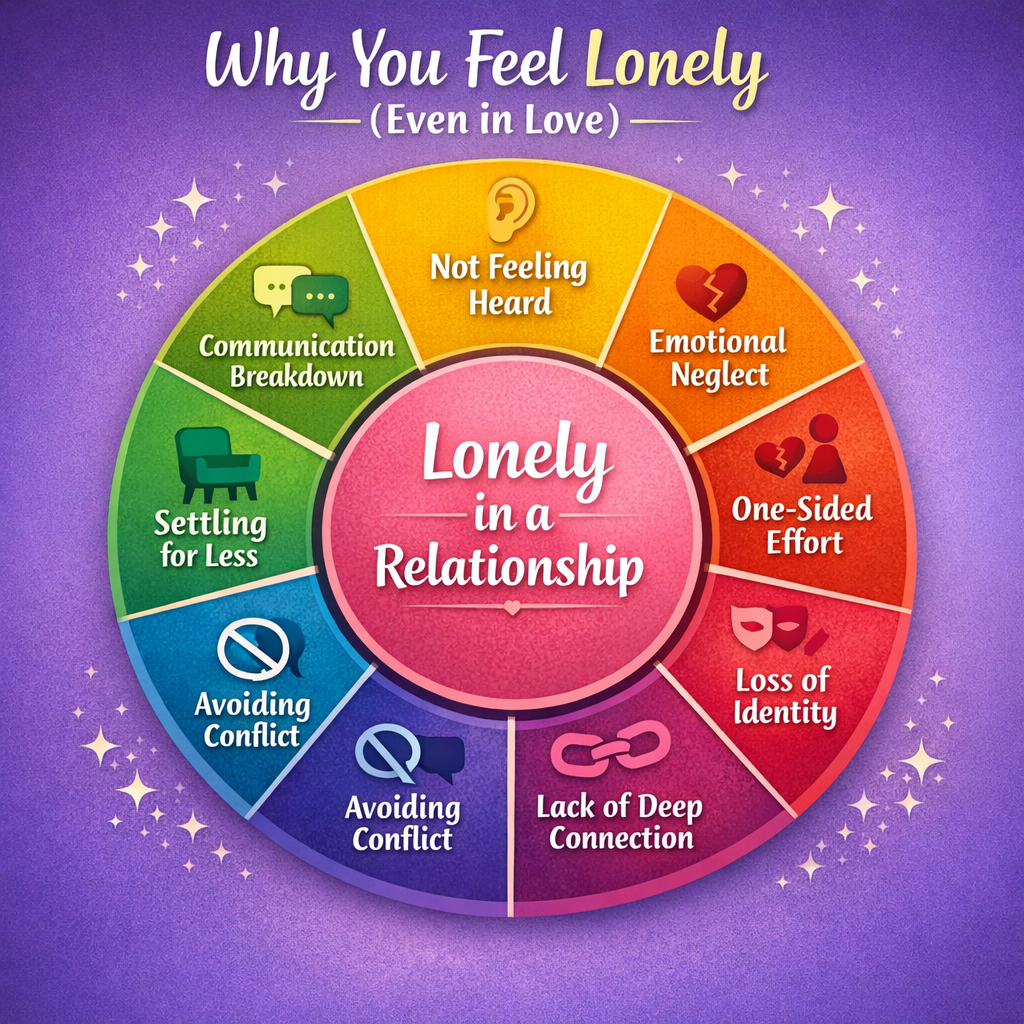
Understanding Relationship Loneliness
Relationship loneliness doesn’t mean you don’t have a partner, but it means that there isn’t an emotional presence. It happens when the connection is one-sided, conditional, or even inconsistent. This can happen even when the relationship seems strong.
Emotional loneliness isn’t physical solitude, but it’s about being surrounded by people but still feeling alone. If you don’t have curiosity, care, or responsiveness in your relationship, it can mean that your conversations are practical, but the affection doesn’t feel real, and emotions aren’t handled.
According to the American Psychological Association, psychology shows us that loneliness isn’t about the size of the connection but about the quality of it. They show us that people feel lonely sometimes, even in close relationships, when their emotional needs are unmet.
This is why some women talk about not feeling alone but feeling invisible. The pain doesn’t come because they are without a partner or person, but because their emotions are being ignored.
This article explores why relationship loneliness is so common among women, what psychological and relational dynamics contribute to it, and how to address it without pleading for attention or shrinking yourself to be loved. The goal is not to assign blame, but to restore clarity, dignity, and emotional self-trust.
Why Women Struggle with Loneliness
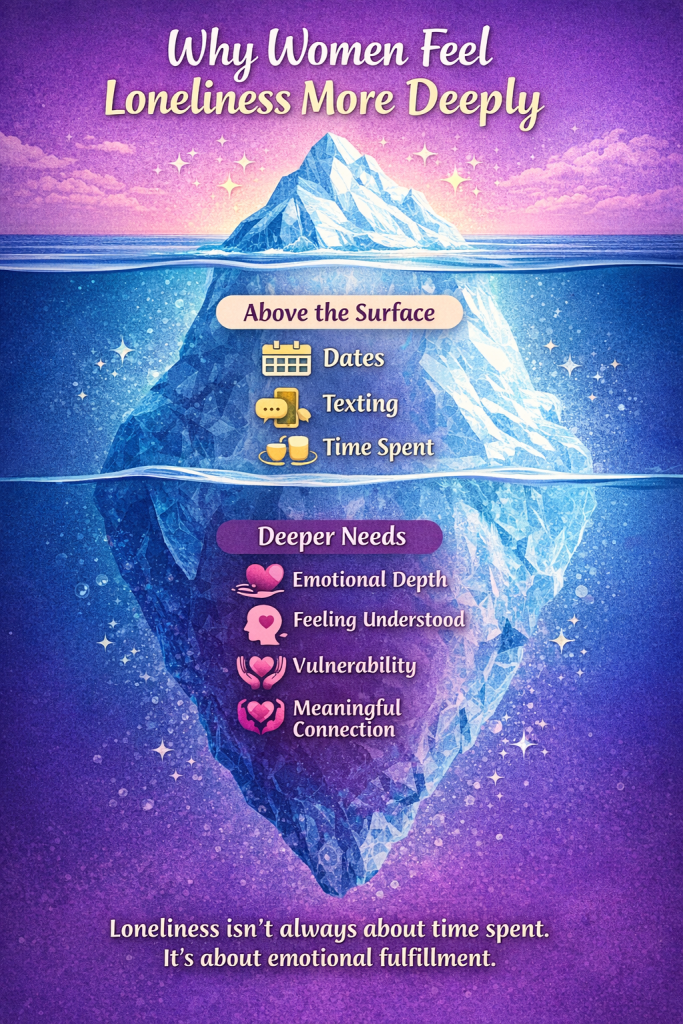
Many women are raised to be the emotional caretakers of relationships. From a young age, they learn to notice shifts in mood, smooth tension, anticipate needs, and keep connections intact. Over time, this kind of emotional responsibility becomes normal, even expected.
In adult relationships, this often shows up as women taking on the role of emotional organizer. They start the conversations, remember what matters, notice when something feels off, and try to repair distance when it appears. When that effort isn’t met halfway, loneliness begins to grow quietly.
Harvard Health Publishing describes emotional labor as the unseen work of managing emotions, both your own and other people’s, to keep relationships running. When one partner carries most of that load, exhaustion and isolation often follow.
A common example is the woman who plans time together, initiates intimacy, and checks in emotionally, while her partner responds but doesn’t lead. She isn’t lacking love. She’s lacking partnership.
Begging for Love Can Make More Loneliness
When loneliness sets in, many women try to fix it by asking for more. More affection. More reassurance. More closeness. On the surface, this feels reasonable. In reality, it often deepens the ache.
Repeatedly asking for love can shift the dynamic from shared desire to obligation. A partner may comply, but the connection no longer feels freely given. Over time, the woman asking may start to feel needy or ashamed, even though her needs are valid.
There’s an important difference between expressing a need and seeking reassurance from depletion. Needs expressed from self-trust invite connection. Requests made from emotional exhaustion often seek relief.
Saying “I miss feeling close to you” opens space. Repeatedly asking “Why don’t you want me?” usually closes it. The problem isn’t wanting a connection. It’s what happens when asking turns into self-abandonment after needs have gone unmet for too long.
Emotional Availability and Emotional Presence
One of the most confusing parts of relationship loneliness is that a partner can be there without being present.
Someone may show up physically, help with daily life, and stay committed, yet feel emotionally distant. Conversations become practical. Affection becomes routine. Curiosity fades.
The Gottman Institute emphasizes that emotional attunement, not proximity, sustains connection. Emotional attunement means noticing bids for connection and responding with interest, care, or engagement.
When emotional presence fades, many women feel like they’re speaking into empty space. They’re heard but not felt. Spending more time together doesn’t fix this kind of loneliness because the issue isn’t time. It’s a connection.
Attachment Patterns and Loneliness
Attachment dynamics often play a role in relationship loneliness. In many relationships, one person seeks closeness while the other manages distance.
Women are more likely to turn that distance inward. When a partner withdraws, they often assume they are asking for too much or being unreasonable. That belief deepens loneliness and self-doubt.
Ongoing relational stress can also intensify attachment responses. The National Institute of Mental Health notes that stress can disrupt emotional regulation, making people more sensitive to disconnection or perceived rejection.
In these dynamics, loneliness isn’t caused by a lack of love. It’s caused by emotional rhythms that never quite align.
Loneliness Doesn’t Mean Failure
Loneliness inside a relationship is often something women try to silence. They tell themselves to be grateful. To be patient. To stop being so sensitive. Over time, this self-silencing doesn’t solve the pain. It just turns it numb.
Loneliness isn’t a flaw. It’s information. It tells you that emotional needs aren’t being met in a way that can last. Ignoring that signal doesn’t make it disappear. It just dulls awareness.
A familiar pattern is hurt turning into confusion, then resignation. Eventually, some women stop asking altogether. The relationship looks calmer, but the loneliness deepens. Listening to loneliness early protects self-respect. Dismissing it slowly erodes it.
Losing Yourself to be Chosen
When loneliness continues, many women adapt. They become easier. Quieter. Less demanding. This usually isn’t intentional. It starts as hope.
You stop bringing things up to avoid tension. You lower your expectations to avoid disappointment. You tell yourself you’re being flexible and mature. Over time, flexibility becomes self-erasure.
Being “low maintenance” is often praised, but it comes with a cost. When needs are minimized again and again, connection doesn’t deepen. It thins.
A common example is saying “it’s fine” when it isn’t or agreeing when you feel unsure. From the outside, everything looks smooth. Inside, there’s a growing distance between you and your partner. This loneliness isn’t about a lack of love. It’s about losing authenticity.
Having an Emotional Connection
Emotional connection isn’t just about communication. It’s also about nervous system safety.
When someone feels emotionally safe, their nervous system stays regulated enough to remain open and engaged. Under chronic stress, emotional presence often shrinks. People shut down, distract themselves, or pull back without fully understanding why.
The Cleveland Clinic explains that ongoing stress can push the nervous system into a state of alert or shutdown, reducing emotional responsiveness.
In relationships, this can look like one partner craving closeness while the other feels overwhelmed by it. Neither response is wrong. But without awareness, the mismatch creates loneliness.
Understanding this helps remove blame. Emotional distance isn’t always rejection. Sometimes it’s dysregulation.
Seeing the Signals of Intuition
Many women feel emotional disconnection long before they can explain it. It shows up as a heaviness in conversations. A sense of reaching without landing. A sadness that lingers even during good moments. This is intuition in a grounded form. It doesn’t shout. It nudges.
Women are often taught to distrust these signals, especially when they can’t explain them logically. They tell themselves they’re overthinking or being too sensitive. Over time, ignoring intuition deepens loneliness because it disconnects them from their own emotional truth.
Anxiety is urgent and loud. Intuition is steady. Listening doesn’t require immediate action. It requires acknowledgment. Often, loneliness begins to ease the moment these inner signals are taken seriously.
Don’t Beg for Love
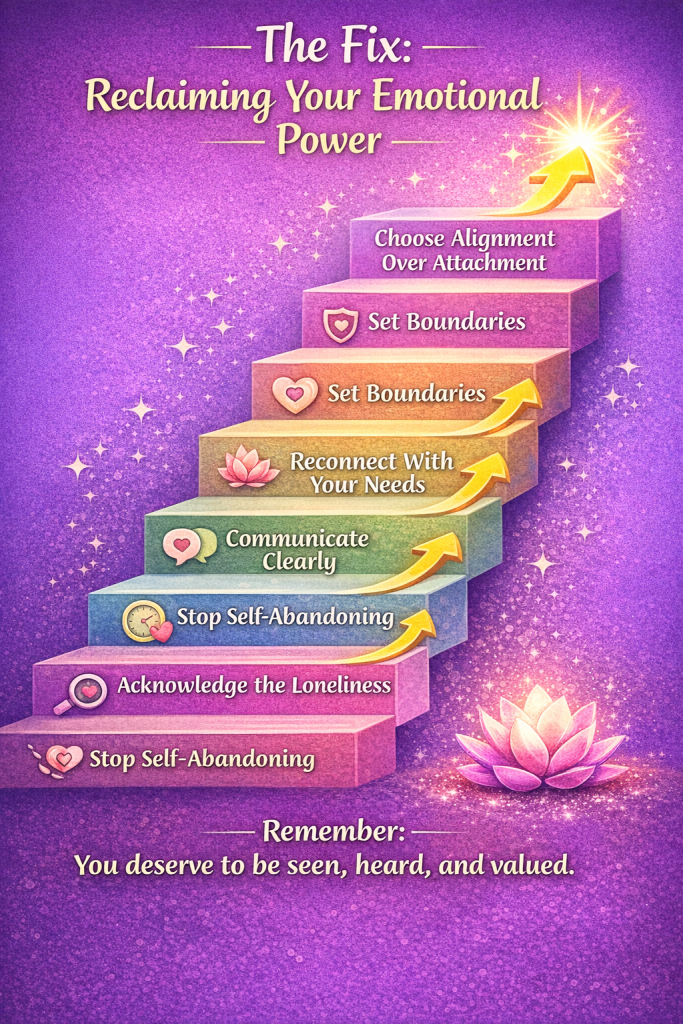
The shift away from begging starts internally. Instead of asking for proof of love, the focus moves toward clarity. Needs are stated once, calmly and honestly, without apology. What happens next is observed, not chased.
This can sound like, “I need more emotional presence to feel connected.” It isn’t followed by convincing or explaining. The response itself becomes information.
When emotional bids are consistently unmet, the work stops being persuasive. No amount of effort can create emotional capacity where it doesn’t exist. This shift protects dignity. It replaces chasing with clarity, and self-abandonment with self-respect.
Loneliness and Incompatibility
Not all loneliness comes from the situation, but some comes when you aren’t compatible with someone. When a hard place feels temporary, patterns keep coming through, and emotional needs are unmet even with clear communication, this probably doesn’t mean you aren’t putting forth effort, but that you’re incompatible.
Loving someone doesn’t mean that you have emotional alignment. Two people can care about each other but have different levels of connection, responsiveness, and intimacy.
A good example is that a woman might feel nourished with emotional depth and have a partner who loves independence and little emotional exchange. None of this is wrong, but there is a mismatch, and this can lead to loneliness.
Knowing these things is about realism.
Staying or Facing the Cost
Staying in a relationship means you have to share emotional responsibility. One person can’t make the connection work alone without costing them. Leaving might feel like a failure, but it’s an act of self-respect. Picking not to live in constant loneliness isn’t dramatic, but it’s grounding.
You don’t have to rush your decisions, but it can be quiet and thoughtful. The goal isn’t to prove how strong you are but to have integrity. Whether you choose to stay or leave, the choice should honor your emotional reality.
Emotional Fulfillment
Emotional fulfillment is about consistency. It feels like being considered, heard, and met without performing, asking, and becoming smaller. Connection becomes mutual and not just something you have to ask for.
When emotional presence is shared, loneliness is natural. There’s less self-editing, monitoring, and second-guessing. The relationship is a place of rest and not effort. This isn’t about perfection but about sustaining.
Final Thoughts: Loneliness in Relationships Isn’t Failure
Having loneliness in your relationship wasn’t a personal failure, but it’s information. Women don’t feel lonely because they are asking for more; they are lonely because they are asking by themselves. Having to beg for love takes away their dignity, but clarity can restore it.
When loneliness is listened to, it can guide the relationship. It shows self-trust, truth, and emotional dignity. Love doesn’t have to be chased to be real love, but it has to be shared.
Frequently Asked Questions
1. Can you feel lonely even if you are in a relationship?
Yes. Relationship loneliness can happen when you are physically with someone but do not feel emotionally seen, understood, or supported. You may share time, space, and routines with a partner while still feeling deeply alone inside the connection.
2. Why do some women feel lonely in relationships?
Many women take on the emotional work of keeping a relationship connected. When they are the one always initiating conversations, checking in, repairing distance, or carrying the emotional tone of the relationship, loneliness can quietly build over time.
3. Is relationship loneliness the same as being single?
No. Being single means not having a romantic partner. Relationship loneliness means having a partner but still feeling emotionally disconnected, unseen, or unsupported.
4. What are the signs of emotional loneliness in a relationship?
Common signs include feeling unheard, doing most of the emotional work, missing deeper conversations, feeling invisible, avoiding bringing up your needs, and feeling sad even when you are together.
5. Why does begging for love usually make things worse?
When love and reassurance are repeatedly requested from a place of depletion, the connection can start to feel forced instead of freely shared. This often creates more shame, self-doubt, and emotional exhaustion.
6. What is the difference between expressing a need and begging for love?
Expressing a need is calm, clear, and honest. Begging for love usually happens when you keep asking after your needs have already gone unmet for too long. One comes from self-respect, while the other often comes from emotional depletion.
7. Can a partner be present physically but absent emotionally?
Yes. A partner can be loyal, helpful, and physically there, yet still feel emotionally unavailable. This often shows up when conversations stay practical, affection feels routine, and emotional engagement is missing.
8. What does emotional attunement mean in a relationship?
Emotional attunement means noticing your partner’s emotional signals and responding with care, curiosity, and presence. It is part of what makes someone feel emotionally safe and genuinely connected.
9. Why do women often blame themselves for feeling disconnected?
Many women are socialized to keep relationships emotionally steady. Because of that, when a partner pulls away or stops engaging, they may assume they are too needy, too sensitive, or asking for too much, even when their needs are valid.
10. Can stress affect emotional connection in a relationship?
Yes. Ongoing stress can make people less emotionally available. When someone is dysregulated, overwhelmed, or shut down, they may pull back from closeness without fully understanding why.
11. What does self-abandonment look like in relationships?
Self-abandonment can look like staying quiet to avoid conflict, saying “it’s fine” when it is not, lowering your standards to keep the peace, or becoming easier to love by hiding your real emotional needs.
12. Is loneliness in a relationship a sign of failure?
No. Loneliness is not proof that you failed. It is information that something important is missing in the connection and needs to be understood honestly.
13. How do you talk about loneliness without sounding needy?
Speak clearly and directly. Use grounded statements such as, “I need more emotional presence to feel connected.” Focus on honesty instead of trying to convince, chase, or overexplain.
14. What if your partner hears you but does not change?
The response gives you information. If your emotional needs are clearly expressed and still remain consistently unmet, the issue may be a lack of emotional capacity, willingness, or compatibility.
15. Can incompatibility cause relationship loneliness?
Yes. Two people can care about each other and still be emotionally mismatched. One person may need deeper connection and emotional responsiveness, while the other may prefer more distance or less emotional exchange.
16. How can intuition help you understand relationship loneliness?
Intuition often shows up as a quiet but persistent feeling that something is off. It may appear as heaviness, sadness, or emotional distance before you can fully explain it. Paying attention to that feeling can help you reconnect with your truth.
17. Should you stay in a relationship if you constantly feel lonely?
That depends on whether emotional responsibility can become shared and whether the connection can improve in a real, mutual way. If loneliness stays constant despite clear communication and effort, it may be necessary to face the emotional cost honestly.
18. What does emotional fulfillment in a relationship look like?
Emotional fulfillment feels like being heard, considered, and met without constantly chasing connection. It creates a sense of rest, steadiness, and mutual care rather than confusion and emotional overwork.
19. How can women reclaim their emotional power in relationships?
They can start by acknowledging their loneliness, taking their needs seriously, speaking clearly, setting boundaries, and refusing to shrink themselves just to keep love. Emotional power grows when self-respect becomes stronger than fear of disconnection.
20. What is the biggest lesson from feeling lonely in love?
The biggest lesson is that love should not require losing yourself. Loneliness can be a signal that calls you back to clarity, dignity, and emotional self-trust.




This piece articulates a subtle yet pervasive form of suffering with compassion and clarity. Distinguishing asking from abundance versus pleading from depletion reframes agency in relationships and encourages inner work alongside interpersonal negotiation. The emphasis on intuition and self-trust invites readers to cultivate emotional clarity as a compass for kinder, wiser choices. ✨
Reading this felt like someone finally put words to a quiet ache I’ve carried for years. It made me consider why I keep quiet and try to fix things on my own. The advice about stating needs clearly and observing the response gives me courage to try a new way of relating. 🌻
Such an important point — listening to intuition before doubling down on people-pleasing can protect emotional health. I liked the emphasis on self-trust and clarity rather than blame. It reminds me that boundaries are an act of love for both self and partner, and that change often begins with one honest conversation.
I appreciated the concrete examples like initiating time together and starting intimacy since they made the pattern easy to recognize. The article normalizes feeling lonely while partnered and offers practical steps: express needs clearly, watch the response, and choose with dignity. That validation is comforting for anyone feeling invisible in a relationship. 💪
Nice and helpful piece. It makes sense that you can be with someone and still feel alone, and the tip to say your need once and then observe the response is smart. I feel more confident trying that approach to see whether the relationship grows or shows its limits. 🙂
This essay elegantly frames loneliness as information rather than failure, which is a crucial paradigm shift. By reframing unmet emotional needs as a signal for clarity and dignity, it invites thoughtful, courageous responses. I appreciated the integration of attachment dynamics and nervous system regulation as compassionate, evidence-informed pathways toward reclaiming agency in relationships.
This article really helped me see that being with someone doesn’t always mean you’re not lonely. I used to think I was the only one who felt that way, but reading this made things clearer and less scary. I feel hopeful about speaking up calmly and protecting my dignity. 😊
So true that presence doesn’t equal emotional presence; the piece explained that clearly. I appreciated the guidance on honest communication and the idea that a partner’s response becomes meaningful information. Remembering that persistent unmet needs may signal a lack of capacity feels both kind and realistic for difficult decisions.
I appreciated the pragmatic tone: not about quick fixes but sustained clarity and self-respect. The advice to state needs once and then observe the response centers dignity. That practice can transform decisions about staying or leaving into acts of integrity rather than reactions driven by loneliness or pain.
The discussion of nervous system safety and chronic stress as contributors to withdrawal was especially insightful. Recognizing dysregulation reduces shame and opens possibilities for co-regulation and paced conversations. This encourages empathy while still honoring responsibility, a balanced stance that supports mutual healing over blame. 🌿
Thank you for shining light on a quiet form of loneliness many women endure. The piece balances empathy with practical guidance, encouraging self-respect and honest communication. I appreciate the takeaway that loneliness is information — a prompt to protect emotional wellbeing and seek reciprocity rather than blame. It felt both validating and hopeful.
I really liked how the article said loneliness can happen even when you live with someone. It made me feel less weird for wanting more than routine hugs and chores. The bit about saying ‘it’s fine’ when it isn’t hit home, and I plan to practice clearer, calmer requests moving forward. 😊
Valuable reminder that emotional labor often falls unevenly and that exhaustion can be mistaken for neediness. The section about begging for love deepening loneliness really rang true. This piece gives language for healthy distinctions and permission to honor one’s needs without shame, which feels empowering and practical.
This article provides compassionate clarity for a frequently misunderstood pain. I valued the exploration of compatibility versus capability — caring does not always equal emotional attunement. The recommendation to observe a partner’s response and preserve dignity when needs stay unmet is grounded and empowering; it gives permission to honor one’s inner truth without guilt.
Wow, this really helped me! I always thought I was failing when I felt lonely even though I had a partner. Now I see it’s about being seen and heard. I’m going to try saying what I need calmly and not hide my feelings anymore. Thank you for making this so clear! 😊