
How People Mix Up Shamrocks and Clovers
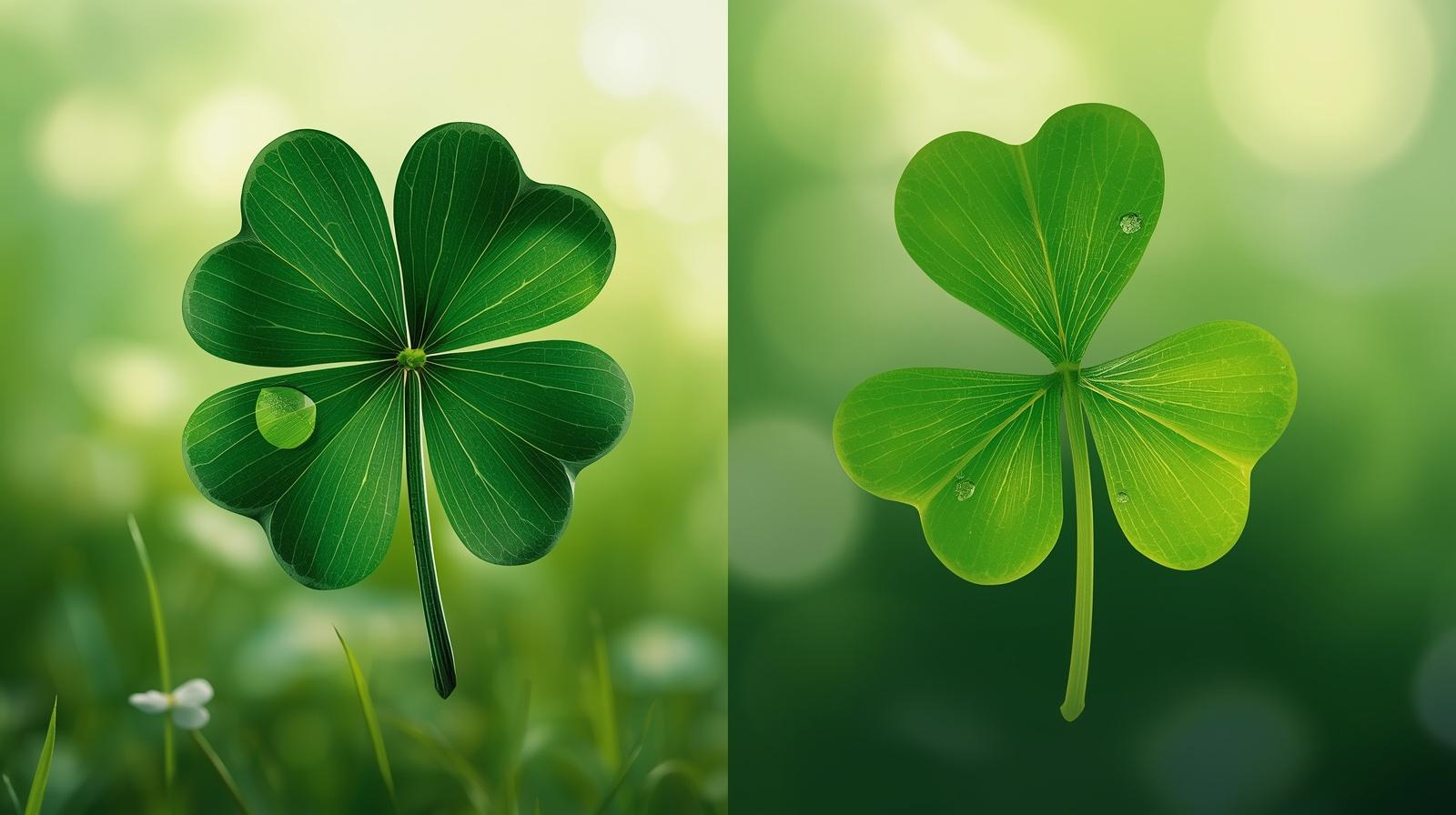
Each March, people see the same symbols on social media, coffee mugs, and on signs. Some have three leaves, and some have four leaves, and most people call them lucky clovers and then move forward with their lives.
The thing is, shamrocks and four-leaf clovers aren’t the same plant, symbol, or even have the same kind of meaning. One shows identity, balance, and continuity, and the other shows rarity, surprise, and a feeling of destiny.
This confusion isn’t accidental because over time, pop culture, folklore, and St. Patty’s Day blended two different symbols and called them both “Irish luck.” When you separate them, something interesting happens. Each of these symbols have their own personal, powerful, and meaningful symbol and idea.
Understanding the difference between these isn’t about being smarter than someone, but it shows you how humans give meaning to chance, signs, and intuition.
The Plant Difference Made Easy
Before getting into meaning or symbolism, it helps to look at what these plants actually are. The real difference between a shamrock and a four-leaf clover starts with how they grow.
Understanding the Shamrock
A shamrock is a small plant with three leaves. The name comes from an old Irish word that means “little clover.” Over the years, a few types of clover have been called shamrocks, but they all share one thing in common. They always have three-leaf sections.
Shamrocks grow everywhere. You’ll see them in yards, fields, and parks without trying. They spread easily and aren’t rare at all.
Because of this, shamrocks became symbols of everyday life and nature. They weren’t meant to feel special because they were hard to find. They were special because they were always there.
Understanding a Four-Leaf Clover
A four-leaf clover isn’t its own plant type. It’s the same clover as a shamrock, just with an extra leaf that grows by chance. This happens because of a natural change during growth, not because the plant is different.
Most clovers will always grow three leaves. Only a very small number grow four. That’s why people can search for a long time before finding one.
You don’t grow four-leaf clovers on purpose. You come across them unexpectedly.
That surprise is what turned them into symbols of luck.
History of the Shamrock
The meaning of the shamrock is found in culture, history, and community. It isn’t because of chance.
Shamrocks and Celtic Culture
The Celtic culture looked at plants as teachers long before Ireland was a thing. The shamrock’s three leaves were seen as a symbol of cycles and balance. Three was a sacred number, and it showed harmony instead of having too much. Some people would interpret the land, sky, and sea as life, death, and rebirth. The shamrock wasn’t magical, but it was symbolic and grounding. This reminded people that life moves in patterns.
Shamrocks and Irish Culture
As time went on, the shamrock was associated with the Irish identity. It showed resilience, heritage, and a shared story over an individual fortune.
The four-leaf clover is different than the shamrock, and the shamrock doesn’t single anyone out but belongs in a group. It’s about belonging and not about winning. This difference matters even today.
History of the Four-Leaf Clover
The four-leaf clover represents interruption or something that is unexpected.
Four-Leaf Clovers as a Symbol of Luck
As time went on, the symbol of the four-leaf clover changed. Rarity became a plus, and it became lucky. If you found something others couldn’t find, it felt personal, meaningful, and chosen.
Psychology calls this pattern recognition that is mixed with emotional timing. Intuitive traditions call it a sign. But either way, the four-leaf clover became a symbol of something special coming into your life.
The Shamrock and Spirituality
Spiritually, the shamrock is more about steadiness than sudden change.
What Three Leaves Mean
Across many traditions, the number three represents balance. It often shows up as mind, body, and spirit. Past, present, and future. Thoughts, feelings, and actions work together.
The shamrock reflects this sense of harmony. It points to life feeling connected and in rhythm rather than unpredictable.
This isn’t about lucky breaks. It’s about things flowing naturally when you feel grounded.
The Symbol of the Shamrock
People who feel drawn to shamrocks usually value stability, roots, and emotional safety. The energy of the shamrock doesn’t promise excitement. It offers reassurance.
In intuitive symbolism, this kind of energy often appears when someone is seeking calm, balance, or a sense of belonging rather than change.
The Four-Leaf Clover and Spirituality
Where the shamrock brings steadiness, the four-leaf clover introduces possibility.
What the Leaves Mean
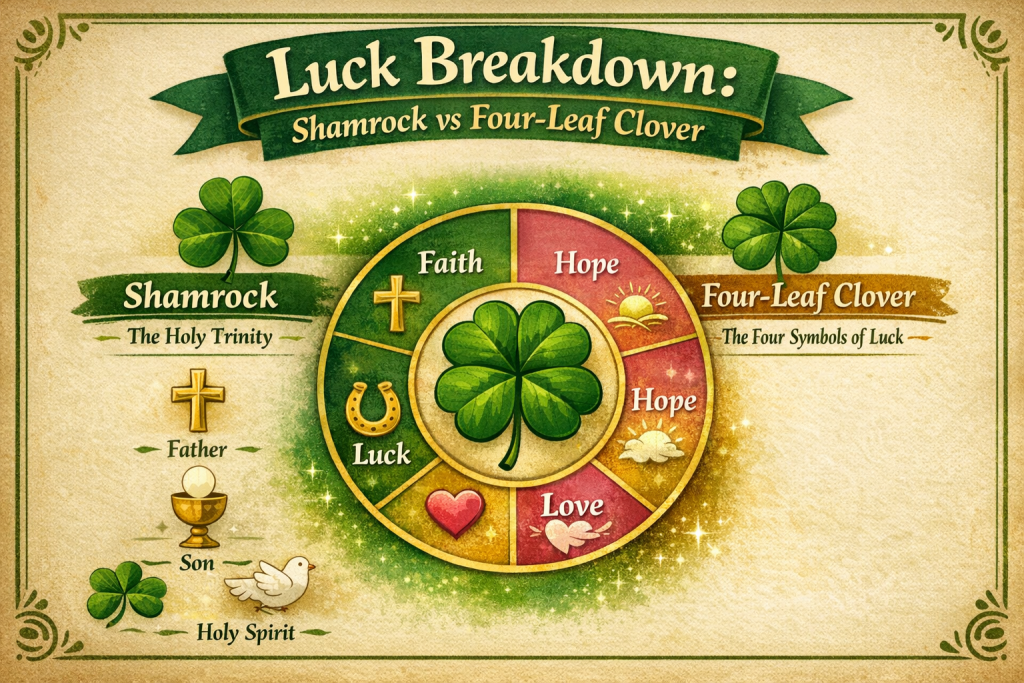
Traditionally, each leaf has been linked to faith, hope, love, and luck. That fourth leaf changes the feeling of the symbol.
Instead of balance, it represents something unexpected. It’s about moments that break routine and open new paths.
The four-leaf clover isn’t about stability. It’s about opportunity.
Four-Leaf Clovers and Intuition
Many people notice four-leaf clovers during emotional turning points. Times of choice. Transitions. Big life shifts.
From an intuitive perspective, awareness becomes sharper during these moments. When you’re already reflecting or searching inwardly, symbols are easier to notice.
The clover doesn’t create the change. It reflects the awareness happening around it.
Shamrocks Versus Four-Leaf Clovers
Even though they’re often grouped together, these two symbols carry very different emotional tones.
Intuitively, they speak to different needs, one offering grounding and calm, the other inviting movement and possibility.
Shamrock Energy
The shamrock energy is a collective energy. It shows tradition and continuity in a shared meaning. The energy feels grounded, steady, and familiar, like a place you’ve been before. Shamrock Energy supports alignment over change, and it’s about belonging, inner balance, and stability.
People who are drawn to shamrocks usually love things like family, culture, and roots. When getting a psychic reading, shamrock symbols can show up when someone is on the right path and needs confirmation over disruption.
Understanding the Energy of the Four-Leaf Clover
The four-leaf clover feels different than a regular clover. It isn’t about things staying steady or normal. It feels more like a small moment that stands out.
People often connect four-leaf clovers with surprise or timing. Not because it promises something good will happen, but because it shows up when someone is paying attention. It’s like life giving a quiet little nudge instead of a big sign.
From a psychic point of view, it’s less about luck and more about awareness. When you’re open and noticing the world around you, meaningful moments tend to stand out more.
Why Symbols Feel Different for Different People
Most people don’t pick symbols randomly. The one that feels important usually connects to what they’re going through in life.
When someone feels overwhelmed or just wants peace, the shamrock often feels comforting. It represents stability and feeling grounded.
When someone feels stuck or ready for something new, the four-leaf clover usually feels more exciting. It represents change and new chances.
Neither one is better. They just match different emotional moments.
Keeping the Roots
Someone chooses a shamrock because it reminds them of their family and where they come from.
When they talk about it, they don’t mention luck at all. They talk about memories, tradition, and feelings close to their heritage.
That’s the calm, grounding side of the shamrock.
A Change in Perspective
Another person is stressed about a big decision and goes outside to clear their head. While walking, they notice a four-leaf clover without even looking for one.
It doesn’t solve anything, but it makes them feel lighter. More hopeful. More willing to trust themselves.
That’s how symbols usually work. They don’t change reality. They change how we feel about it.
The Person Gives the Meaning
Two people can see the same four-leaf clover. One barely notices. The other feels like it means something important.
The clover didn’t change. The person did. Meaning comes from awareness, not the object itself.
Luck Versus Alignment
Luck sometimes gets looked at more as randomness, but in psychic work, it’s normally called luck, which is alignment and attention.
The shamrock shows alignment, and the four-leaf clover means paying attention. When someone is aligned internally, they will see opportunities more clearly. When someone is paying attention, these rare moments will be noticed more.
Neither of these symbols means having a future, but it shows what you can do to make your future possible.
Science and Magic
Botany shows us why four-leaf clovers are rare, and history explains why shamrocks became cultural symbols. Psychology shows us why people put meanings to chance events.
This doesn’t mean that intuition is cancelled, and explaining the meaning isn’t negative. If you understand how something happens, it doesn’t erase that it matters. People find that knowledge can help them to deepen their appreciation for the symbol without diminishing it.
Symbolism in Jewelry, Media, and Tattoos
Shamrocks in our culture are often used to show community, celebration, and heritage. Four-leaf clovers are used to suggest uniqueness, personal destiny, and luck.
People often choose designs intentionally, even if consumers don’t realize it. These symbols have their original energy even when they are being sold or commercialized.
Psychics and Clovers
Psychics don’t normally interpret symbols in isolation, and context matters more than traditions do.
A shamrock might show up during a reading to suggest patience, honoring roots and grounding, or a four-leaf clover might mean timing, opportunity, or the need for you to pay attention.
None of these symbols is a promise but a message.
Do Symbols Bring Good Luck?
Symbols don’t change your reality, but they change what you focus on. When you change your focus, your behavior changes, and when your behavior changes, outcomes change. This is how belief helps to motivate you.
Symbols don’t bring good luck, but they invite people to take action.
Picking Meaning Over Superstition
There is a difference between symbolism and superstition. Superstition makes you lose your power, and symbolism gives you insight.
Using a shamrock to remind you to be balanced or a four-leaf clover to remind you to be alert doesn’t make your life more magical, but it makes it intentional.
Final Thoughts: Two Plants, Two Meanings
The shamrock and the four-leaf clover might look similar when you just glance at them, but they have very different symbolic language. One shows balance, continuity, and shared identity, and the other shows rarity, personal opportunity, and awareness.
Neither one of them is better than the other, but both have strong meaning. When you know the difference, each of these symbols allows you to work in ways that it was meant to work.
Frequently Asked Questions
1. What is the main difference between a shamrock and a four-leaf clover?
A shamrock is traditionally a three-leaf plant associated with Ireland and St. Patrick, while a four-leaf clover is a rarer variation of clover that is usually linked with luck.
2. Is a shamrock always supposed to have three leaves?
Yes. A shamrock is generally understood to have three leaves. That three-part shape is one reason it became tied to Irish symbolism and religious meaning.
3. Does a four-leaf clover count as a shamrock?
Not usually. Even though people sometimes mix them up, a four-leaf clover is considered different because the extra leaf changes its meaning and makes it more of a luck symbol than a traditional shamrock.
4. Why is the shamrock important in Irish culture?
The shamrock is important in Irish culture because it has long been used as a national symbol of Ireland and is often connected with St. Patrick and Irish heritage.
5. Why is the four-leaf clover considered lucky?
The four-leaf clover is considered lucky because it is rare and has been associated in folklore with good fortune, blessings, and unexpected positive outcomes.
6. How rare is a four-leaf clover?
A four-leaf clover is much rarer than a regular three-leaf clover. That rarity is a major reason people see it as special and lucky.
7. Are shamrocks and clovers the same plant?
People often use the words loosely, but they are not always treated exactly the same in culture. A shamrock usually refers to a three-leaf plant used symbolically, while clover is the broader plant category.
8. Can a shamrock become a four-leaf clover?
A shamrock itself is identified by its three leaves. A four-leaf clover is a separate rare growth variation, so it would not normally be described as a shamrock once it has four leaves.
9. Is the shamrock a religious symbol?
It can be. The shamrock is often linked to the Holy Trinity in Christian tradition because of its three connected leaves.
10. What do the leaves of a four-leaf clover represent?
A common interpretation is that the four leaves represent faith, hope, love, and luck. Different traditions may phrase the meanings slightly differently.
11. Are all three-leaf clovers shamrocks?
Not always in a strict botanical sense, but in everyday conversation, many people use the term shamrock to describe a clover-like plant with three leaves, especially around Irish themes.
12. Do shamrocks bring luck too?
Some people do treat shamrocks as lucky symbols, but they are more strongly connected with Irish identity, tradition, and spiritual meaning than with the specific luck folklore of the four-leaf clover.
13. Why do people confuse shamrocks and four-leaf clovers?
People confuse them because both are small green leaf plants that look similar at first glance, and both are commonly used in St. Patrick’s Day decorations and seasonal designs.
14. Which one is used on St. Patrick’s Day, the shamrock or the four-leaf clover?
The shamrock is the more traditional St. Patrick’s Day symbol. The four-leaf clover also appears in decorations, but it is not the classic symbol in the same way.
15. Is a four-leaf clover connected to Ireland?
It is often associated with Irish-themed imagery, but its main meaning is luck rather than Irish religious or national symbolism.
16. Can you find a four-leaf clover in the same patch as regular clovers?
Yes. A four-leaf clover can appear in a patch of regular clovers, which is part of why finding one feels surprising and special.
17. Are shamrocks only used for religious meaning?
No. Shamrocks are used for many reasons, including Irish pride, cultural identity, festive decoration, and historical symbolism.
18. What color is a shamrock or four-leaf clover supposed to be?
Both are usually green. Their shared green color is one reason people visually group them together.
19. Which is more common, a shamrock or a four-leaf clover?
A shamrock, with its three leaves, is much more common. A four-leaf clover is rare, which is why people value it as a symbol of luck.
20. Should you use shamrock and four-leaf clover interchangeably?
It is better not to. They may look similar, but they carry different meanings. A shamrock is mainly a three-leaf Irish symbol, while a four-leaf clover is mainly a symbol of luck.




Great read — I never realized shamrocks and four-leaf clovers carry such different meanings. The clear explanation about identity, rarity, and how people project meaning onto plants made me smile. I’ll look at St. Patrick’s decorations differently now and appreciate both symbols more. Lovely balance of science and folklore! 🌿
Beautiful synthesis that honors both botanical fact and human meaning. The piece reminds readers that symbols like shamrocks and four-leaf clovers act as mirrors of our inner states—stability versus surprise—rather than as magical solutions. I appreciate the balance between history, science, and intuition here. ✨🌱
Nice explanation that I can follow easily. I like knowing that shamrocks are more about belonging and history while four-leaf clovers are about finding something rare and feeling excited. Now I’ll look more closely in the grass for little surprises. 😊🍀
Wow, I learned a lot. Shamrocks have three leaves and mean family and belonging. Four-leaf clovers are rare and make you feel lucky when you find one. This makes St. Patrick’s stuff more interesting and fun to think about. 😊🌿
What a neat breakdown! I always called everything a clover, but this piece made me smile by explaining that shamrocks are about community and four-leaf clovers are about rare little moments. I’ll tip my hat to both meanings from now on. 😄🌿
This is fun and helpful. I like that the article says shamrocks are three leaves and stand for community, and four-leaf clovers are rare and feel like luck. It makes me happy to know the meaning and why people care. 😊
I loved how the article separates everyday symbolism from rare serendipity. As someone who values roots and family, the shamrock’s message of continuity really resonates with me. Yet I still smile at the surprise of finding a four-leaf clover, even if it’s just for the story. 🍀
This is a thoughtful and articulate piece that clarifies how collective identity and individual chance occupy different symbolic registers. I appreciated the explanation about how attention and alignment mediate perceived luck, and how botanical rarity versus cultural ubiquity informs emotional resonance. A useful primer for anyone curious about meaning-making. 🌿📚
Really enjoyed the clear distinction between semiotic function and folklore: the shamrock operates as a cultural emblem of continuity, while the four-leaf clover functions as an index of chance and personal narrative. The article smartly ties botanical explanation to emotional experience, which deepens appreciation without draining charm. 🍃
Fascinating synthesis of botany, folklore, and psychology; this piece elegantly distinguishes the shamrock’s communal symbolism from the four-leaf clover’s individualized serendipity. I appreciate the nuanced view that symbols shape attention and behavior rather than deterministically altering fate. Insightful, well-researched, and pleasantly balanced between science and spirit. 🌱✨