
The Intuition Line
Most people have experienced intuition before they even know what it is. It comes as a quiet nudge, a gut feeling, or a sense of knowing that can’t be explained through logic. On the other hand, some people have never heard of an Intuition Line. This is why palmistry can turn an experience into a language.
The Intuition line is often misunderstood and is one of the most interesting lines on the hand. It’s subtle, and people often don’t even see it because it doesn’t stand out as much as the head line or the heart line. But when it does appear, it tells a story about sensitivity, perception, and how people work through things in their lives.
This is a line that isn’t loud, but it’s a quiet line. Those who have it often shape their decisions with more than just facts.
Understanding Palmistry and the Intuition Line
In palmistry, the Intuition Line isn’t considered one of the main lines, and this means that very few people talk about it. But this line can say a lot about people and their life experiences.
Most of the time, the major lines focus on things like emotions, thinking, life direction, and more, but the Intuition Line gives more information on awareness, sensitivity, and how people pick up information around themselves.
This doesn’t mean that someone is psychic because they have this line, and if you don’t have the line, it doesn’t mean you don’t have intuition. Palmistry shows tendencies, and it’s not about life limits.
What the Intuition Line Looks Like
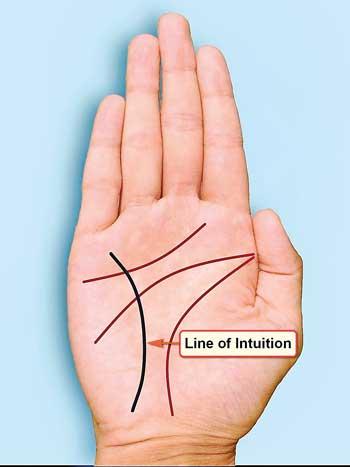
The intuition line usually appears as a soft curve along the outer edge of the palm. It often runs close to the area known as the Moon mount, which is linked to imagination, emotions, and the subconscious.
Instead of moving straight across the hand, it flows upward in a gentle arc. That curved shape is important. Straight lines tend to relate to logic and structure, while curved lines reflect feeling, awareness, and perception.
This line is more about sensing than thinking. It points to noticing patterns, emotions, and shifts that others might miss without trying to analyze them.
Where You’ll Find the Intuition Line
Most often, the intuition line starts near the wrist and follows the edge of the hand toward the little finger. It stays close to the outer side of the palm rather than crossing the center.
Because it runs near other smaller lines, it can sometimes be mistaken for influence lines or faint markings. Looking closely at its curve and placement helps tell the difference.
When it’s clear and continuous, palm readers often associate it with strong inner awareness. When it’s faint or broken, it usually reflects sensitivity that’s still developing or fluctuating with life experience.
The Symbolism Behind the Intuition Line
The Intuition Line shows a way of knowing that doesn’t always use reasoning.
Intuition and Senses
Palmistry isn’t viewed as magic when it comes to intuition, but it’s viewed as sensitivity. People who have a lot of intuition often have a strong intuition line, and they’re able to pick up on emotional undercurrents, tone, timing, and unspoken signals.
They’re able to read rooms easily, and they know when something feels off, even if they don’t know why. In psychology, this is considered pattern recognition and emotional intelligence. According to the American Psychological Association, humans often process information subconsciously before their mind catches up.
Intuition Versus the Imagination
Palmistry shows a difference between intuition and imagination. Where imagination is all about creating possibilities, intuition recognizes what is relevant.
People who have strong intuition lines often talk about feeling grounded when they make decisions, even if it’s unexpected. There’s a big difference between fantasy and knowing, and experience helps to sharpen the difference as time goes on.
The Intuition Line and Psychic Abilities
The Intuition Line is often associated with having psychic sensitivity, but that sensitivity can come in different forms and at different times.
People who have an intuition line often have claircognizance or clairsentience as some of their psychic gifts. These aren’t normally in the form of dramatic visions, but they’ll feel truth in their body or know things without knowing how they know them.
This can show up as feeling emotional shifts, being excited about outcomes, or being able to understand people fast. These abilities are usually seen quietly and practically. Psychic awareness isn’t about drama, but it’s about listening and understanding.
Psychics and the Intuition Line
A palmist will never interpret the Intuition Line as an isolation, but they will look at the clarity, depth, and consistency, and how it works with other lines and features of the hand.
Having a faint line might mean that you don’t use your sensitivity, or you doubt yourself, whereas a clear line can show inner trust and perception. A line that is broken might mean that you have times of intuitive suppression.
Context matters more than almost anything when doing palmistry.
Kinds of Intuition Lines and the Meanings
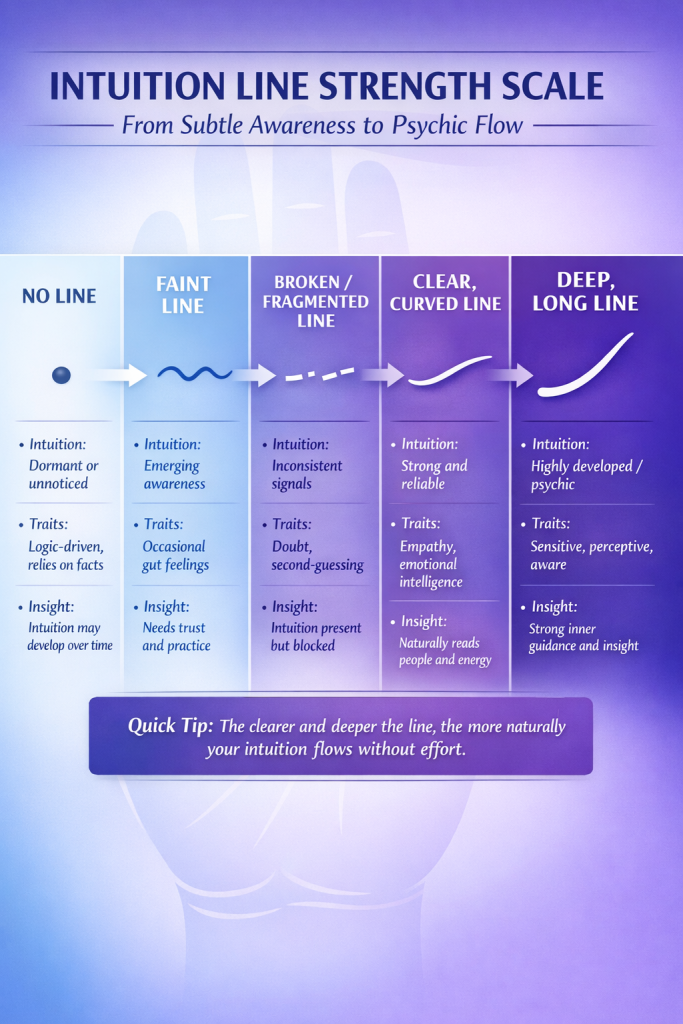
No two Intuition Lines look the same, and the differences show how intuition is experienced and how you express it.
Long and Clear Line
Having a long line that is continuous suggests that you are consistently using your inner guidance. These are people who often rely on intuition in a natural way through all of their experiences.
These people can make decisions accurately and fast even without logic.
Broken or Fragmented Line
A fragmented or broken line can mean that you are sensitive, but you have a lot of self-doubt. Intuition might be strong, but your life experiences or social conditioning might have caused you to stop trusting yourself.
These can appear with people who were told not to listen to their feelings earlier in life.
Faint Line
A faint line doesn’t mean that you have little or weak intuition, but it means subtle intuition. Having confidence and awareness can make this line deeper as time goes on.
Palmistry shows growth just as much as it does what you’ve inherited.
Multiple Lines
Having multiple Intuition Lines can mean you have a lot of sensitivity. People like this are able to pick up emotional information easily, and they need to have strong boundaries so that they don’t get overwhelmed.
Sensitivity is something that needs to be managed for these people.
Intuition Verses Other Lines
When you understand the different lines, you can understand the meanings. Here are some of the different lines:
Head Line and Intuition Line
The head line shows conscious thinking, while the Intuition Line shows subconscious perception. When both of these are balanced and strong, the person can use logic and intuition together.
When the head line is the dominant line, intuition might be ignored, but when the intuition line is stronger, it might mean that you don’t use logic correctly.
It’s important to balance these lines and not to let one be stronger.
Fate Line and Intuition Line
The fate line shows external influences and direction, and the intuition line shows internal guidance.
When both of these things are seen, intuition helps to shape the life direction instead of reacting to the circumstances of life.
Intuition Line and the Mount of the Moon
The Mount of the Moon is connected to the intuition line.
Mount of the Moon
The Moon mount sits along the outer edge of the palm and is connected with emotions, imagination, dreams, and the deeper part of awareness that most people don’t consciously think about. When this area is full or raised, and an intuition line runs nearby, it often points to someone who senses things beneath the surface.
These are the people who notice emotional shifts in rooms, pick up on unspoken tension, and often receive insight through dreams or sudden realizations rather than logical steps.
Intuition and Emotional Awareness
Intuition tends to grow strongest when emotional awareness is balanced with healthy boundaries. Feeling deeply can be a gift, but without discernment, it can become overwhelming. When someone learns when to absorb and when to step back, their intuitive clarity usually becomes much stronger and more reliable.
Which Hand Shows the Lines?
Some people naturally show intuition on the non-dominant hand, which often reflects inborn sensitivity. This can look like a clear intuition line that’s been there since childhood, showing natural emotional perception.
When the line is stronger on the dominant hand, it usually develops over time through experience, healing, or learning to trust inner feelings. This suggests intuition that was built, not just born.
Seeing the line on both hands often reflects a blend of natural sensitivity and life-shaped awareness working together.
Intuition Isn’t Dramatic
One person may quietly sense how relationships will turn out long before anything actually happens. They don’t make dramatic predictions. They simply adjust their choices early and protect their energy. Their biggest struggle is usually learning to trust what they already feel.
Another person might absorb emotions from everyone around them and feel drained in busy spaces. Their intuition is strong, but without boundaries, it turns into overwhelm. Once they learn emotional separation, clarity replaces exhaustion.
Getting a Clear Intuition Line
Sometimes the intuition line is barely visible early in life and becomes clearer after a major emotional shift, loss, or personal growth period. As confidence increases, so does awareness.
Palm lines don’t lock anyone into a destiny. They often change as people do.
Does the Intuition Line Change as Time Goes On?
This line can fade, get deeper, and change as awareness changes. When you use intuition, it can strengthen the expression but ignoring it makes it softer. The hand knows the experiences that you’ve been through.
Using Intuition with or Without an Intuition Line
Intuition gets stronger when you reflect, listen, and trust yourself. The hand can help to confirm that you have intuition, but it doesn’t create it.
What matters more is practice over any kind of line or marking.
The Intuition Line Matters
The Intuition Line shows that you’ve had inner experiences, and it gives a language to what some feel but have a hard time putting into words.
Palmistry helps people to see that they can trust themselves.
Final Thoughts: Knowledge Doesn’t Come Loudly
The intuition line shows us that not all knowledge comes dramatically or loudly, but some truths are quiet, and you want to notice them. Whether this line is shown on your hand or not, everyone has intuition.
Palmistry just gives you a map of what is going on with the hand, but listening is the real skill that everyone can have.




Beautifully written and accessible. The comparison between straight lines and curved intuition lines was especially helpful, and I appreciate the reminder that palmistry maps tendencies rather than destinies. The guidance about balancing emotion and logic feels realistic and empowering. Great read! 🌿
A thoughtful synthesis of symbolism and lived experience. The emphasis on context, line clarity, and interaction with the head and fate lines is particularly useful for anyone curious about how perception and decision making integrate. The piece also responsibly avoids sensationalism while honoring subtlety. Very well done.
Clear, reassuring, and practical — this article breaks down a topic that often feels mysterious. I appreciated the description of the Moon mount and how the intuition line can reflect both inborn sensitivity and learned awareness. The reminder that boundaries help clarity was especially helpful. 👍
I agree with this take and want to add that tracking changes over time can be empowering. Noticing when a line deepens after growth or healing is a gentle form of self-observation, and it supports the idea that our inner landscape evolves with experience and practice. 🌼
This piece offers a nuanced perspective on the Intuition Line, treating it as a living marker of sensitivity and learned perceptual skills rather than an immutable fate. I appreciate the balanced discussion on clair-senses, developmental trajectories, and the importance of reflective practice to strengthen inner knowing. Insightful and warm. ✨
Really enjoyed this write-up! It makes me want to look at my own palms more carefully and not freak out if lines are faint. The idea that intuition grows with practice and life experiences is comforting. Thanks for sharing these simple, kind insights. 😊
I enjoyed how the article blends symbolic reading with psychological insight, noting that intuition often functions as rapid pattern recognition rather than mystical foresight. The practical tips on cultivating emotional boundaries and trusting subtle cues were thoughtful and grounded. Very encouraging and clear.
I loved the kind tone and the way the article reassures readers that not having a clear line doesn’t mean a lack of intuition. The suggestions about practicing listening and building boundaries felt actionable. It motivated me to pay more attention to my own inner signals. 💕
This was easy to follow and made me think about my own hands. I like that intuition is called a quiet thing. It feels good to hear that lines can change with life and practice. Nice hopeful piece. 😊
What a gentle explanation of something I always wondered about. The idea that the intuition line can be faint but still meaningful really helps me stop worrying. I like the practical advice about boundaries and using feelings with care. Thanks for this!
Short and sweet article that actually made palmistry feel sensible. The parts about the line changing with life and the difference between natural and developed intuition were clear. I liked the gentle encouragement to practice trusting yourself and watching the hand over time.