
Purple Aura
Purple is an aura color that people seem to find most interesting. It is talked about as mystical, rare, and from another world. This makes people curious, but at the same time, it also makes them skeptical. Why the color purple? What does it mean when someone has a purple aura, and why does this color get more attention? Why is it linked to having more intuition and higher perception?
Aura colors have become more popular now than ever because people have made wellness and self-reflection a big part of mainstream life. This isn’t because people are past being rational and having logic, but because people are looking for a way to describe the experiences that they have that don’t fit in productivity or clinical words. Purple is a color that often shows up in conversations about personal reinvention, insight, and creativity.
If you want to know more about what a purple aura is, how it represents intuitive and psychic traditions, keep reading. This article talks about why the interpretations need to be contextual, grounded, and responsible instead of just treating the color purple as spiritual or supernatural. This article will look at purple as a symbolic reflection of imagination, perception, and inner awareness, and the qualities that people see in themselves during certain parts of their lives.
What Auras Represent
Psychic traditions describe auras as a subtle field of information that surrounds a person and reflects emotional states, mental focus, and internal awareness. Instead of it being looked at as a literal light, psychic readers often describe aura information as impressions, and they translate them into a color so that they can communicate what they mean and have clarity.
According to psychology, aura experiences are understood differently. People process small and subtle signals like posture, tone shifts, facial expressions, pacing, and emotional cues, and this happens often without conscious awareness. When psychics describe aura colors, they might be taking complex and internal perceptions and putting them into a symbolic language that people can understand.
Both of these viewpoints come to the same conclusion, and that is that aura colors are interpretative and not a diagnosis. They don’t determine identities and shouldn’t make predictions. They are tools that are used to describe what someone is feeling and not a fixed truth.
The difference is important when looking at colors as strong as purple, which brings internal focus.
An Uncommon Color: Purple
Purple is often seen as a rare aura color, but that doesn’t mean that this color stays. Instead, purple can come when you are going through certain emotional or psychological situations and should never be a constant color.
Psychics often look at purple energy during times of strong reflection, creativity, or internal questioning. These are times that can change. They come when someone is looking more at their own beliefs, exploring unfamiliar ideas, or changing how they see themselves.
Since purple reflects internal processing and not outward behavior, it can be less visible and might be harder to describe. Unlike colors that are about action, emotions, or interaction, purple is one that works with quiet mental activity that is happening on the inside.
Themes and The Color Purple
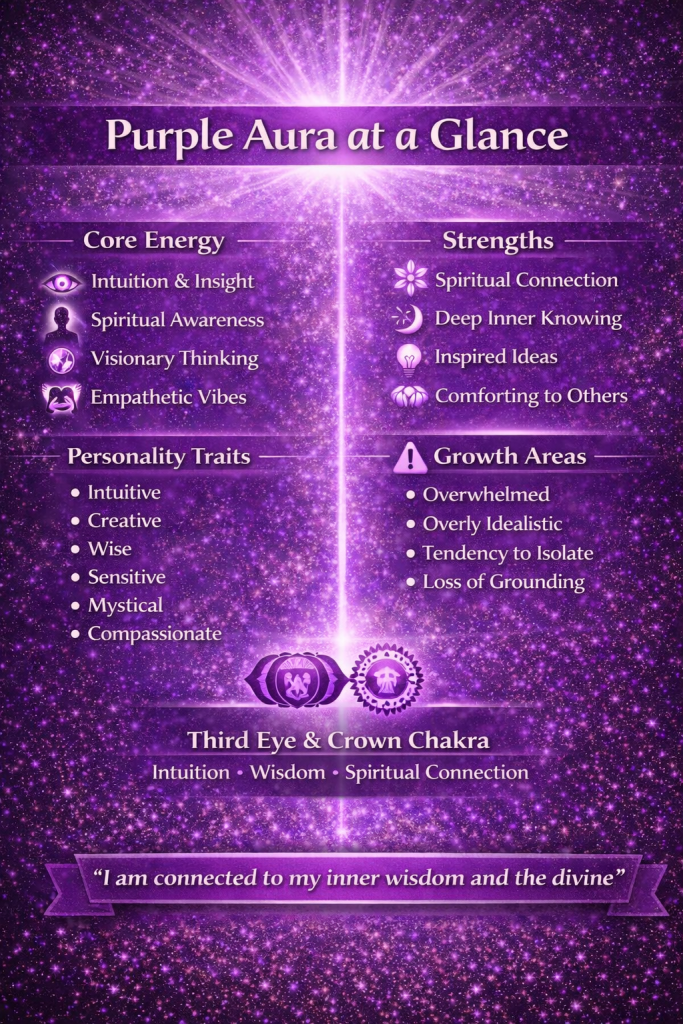
Purple energy is about perception, curiosity, and abstract thinking. It shows that the mind is exploring and looks beyond what you’re going through in your life and considers patterns, meaning, and possibilities.
Instead of looking at it as certainty, purple is associated with asking questions. It says that someone is comfortable asking questions and looking at their complex lives instead of rushing to a conclusion.
Purple aura descriptions often come when someone is:
- Looking at perspectives that they are unfamiliar with.
- Developing their intuition.
- Having deep creative work.
- Reconsidering assumptions.
In this sense, purple represents awareness in motion, not answers fully formed.
Emotional Patterns and Purple Energy
Emotionally, purple energy is often associated with depth and sensitivity. People who are connected to this color are normally seen as reflective instead of reactive, processing experiences internally before they start expressing them outwardly.
Some of these traits can include:
- Being sensitive to emotional tone.
- Having empathy instead of being impulsive.
- Having comfort even with uncertainty.
- Having a strong inner world.
While this depth can be a strength, it can also become draining. Extended periods of inward focus may lead to mental fatigue, emotional overload, or a sense of being misunderstood. For this reason, purple energy is often described as benefiting from grounding, such as rest, routine, and external engagement that balances internal activity.
Purple Symbolism and Psychology
From a psychological point of view, purple aura traits overlap with openness to experience, creativity, and introspection. Research in color psychology frequently associates purple with imagination, abstraction, and complex thinking.
According to the American Psychological Association, they note that color symbolism can influence perception and emotional response, particularly when colors are culturally linked to creativity and depth. Purple’s intuitive associations may reflect how people describe subconscious pattern recognition, which is recognizing connections before consciously articulating them.
Seen this way, a purple aura becomes symbolic language for heightened internal processing instead of having evidence of supernatural ability.
Interpreting Auras Without Absolutes
In many spiritual traditions, purple has symbolized wisdom, reflection, and expanded awareness. Unlike colors tied to physical vitality or emotional urgency, purple is often associated with perception itself.
Psychics are careful to say that purple doesn’t mean enlightenment or superiority. It reflects a time of exploration, which is a period of awareness that is changing but isn’t permanent. Purple energy should point towards curiosity and not completion.
Different Shades of Purple
Aura descriptions matter more than labeling the color:
- Lavender: Linked with curiosity and intuition.
- Violet: Deep focus and introspection. Comes normally during times of change or creativity.
- Indigo: Analytical intuition and insight while working with rational thinking and logic.
- Murky or cloudy: Mental overload and not a loss of intuition.
These different colors can show temporary situations and aren’t fixed characteristics or traits.
Purple Energies and Relationships
When looking at relationships, purple energy can be associated with curiosity, depth, and emotional intelligence. People say that this energy can have meaningful connections and thoughtful communications instead of just interactions.
Strengths purple energy may bring include:
- Attentive listening.
- Empathy.
- Open to different points of view.
- Comfortable discussing different emotional topics.
Challenges can arise when internal processing replaces communication. Because much of their experience occurs inwardly, purple-energy individuals may need to consciously share their thoughts rather than assume understanding.
Healthy purple energy in relationships balances perception with presence.
How Purple Auras Work
Purple energy often appears in roles that reward insight, interpretation, and long-term thinking. These are not limited to creative fields but include any work centered on understanding systems, ideas, or people.
These different paths include:
- Writing and creative design.
- Research and analysis.
- Strategy and planning.
- Education, coaching, or counseling.
The unifying factor is not profession but mindset. Purple energy thrives where curiosity meets synthesis. Its main challenge is translating insight into action, which is why grounding structures often support its effectiveness.
Symbols of Purple and Mental Load
Symbolically, purple is associated with cognition and awareness, not as a medical claim, but as a metaphor for mental focus. When balanced, purple energy aligns with clarity and inspiration. When overstimulated, it mirrors what psychology describes as cognitive overload.
This explains why purple aura descriptions frequently come with periods of intense mental demand or creative pressure.
Real-Life Examples of Purple Energies
In one example, a creative professional experiencing burnout repeatedly received purple aura descriptions during a period of intense reflection and questioning. As rest and balance returned, the energy shifted toward lighter tones, suggesting integration rather than excess.
In another case, purple energy appeared while someone was weighing multiple life directions. The color surfaced during exploration, not after a decision was made.
A third example involved someone redefining identity after a career transition. Purple impressions emerged during experimentation and learning, then faded as clarity solidified.
Across examples, the pattern is consistent: purple appears during inquiry, not certainty.
Do Aura Colors Stay the Same?
Most psychics agree that aura colors are fluid. Purple is rarely described as permanent because it reflects active perception rather than stable identity.
Purple energy often shows up during:
- Learning.
- Reinvention.
- Creativity.
- Philosophical questions.
- Spiritual questions.
- Times of reevaluation.
As insights work together, the energy typically shifts. Change is considered a sign of growth, not loss.
Psychics and Purple Auras
Psychics look at aura color as just one piece of information. When they interpret purple in an emotional tone, it shows life challenges and people’s own experiences. Instead of the psychic telling you that you’re intuitive as your identity, a good reader would say something like:
- You have active intuition that is still developing.
- You process things deeply.
- You’re in a phase where you have heightened awareness.
Framing the reading this way avoids there being exaggeration and brings respect to yourself. Purple readings are about guidance and not about predictions.
Science and Skeptics About Purple Auras
When you look at purple auras from a scientific viewpoint, aura colors are best looked at through symbolism, psychology, and perception. People naturally look at purple as creative, complex, and abstract because of its historical and cultural symbolism.
According to the American Psychological Association, color psychology shows that colors can influence cognitive and emotional responses, especially when they have strong cultural meanings.
In another study by the APA, they talk about how intuition and subconscious processing suggest that people will sense patterns and meanings before their mind can put meaning to it.
Using an aura language as a way to express impressions instead of evidence is what the energy field is all about.
Looking At Your Own Aura
A good way to look at your aura isn’t to ask what your aura color is, but to ask questions such as:
- Am I focused on myself, and am I grounded?
- What am I curious about or questioning?
- What am I processing in my life right now?
Aura colors and concepts work best if you use them as mirrors to look at yourself and not labels. They give a language for understanding what’s going on inside of you, and not as your identity.
Aura symbolism can support self-awareness without encouraging you to be obsessed or dependent on it.
Why People Still Connect with Purple Auras
Our culture is about information overload, quick change, and even burnout, and the color purple represents thoughtful exploration without pressure. Purple energy can mean imagination, curiosity, and the willingness to be uncertain at times. Using aura language allows people to have words for the experiences that they have that don’t fit in clinical terms or productivity terms.
This doesn’t mean that you have to have supernatural or literal belief, but that you just have to recognize.
Final Thoughts: Purple Aura
A purple aura can be seen as perception in motion. It reflects imagination, curiosity, and inner exploration instead of something mystical or spiritual.
When you look at your aura in a responsible way, the purple aura encourages people to have balance, respect, and reflection. It reminds us that insight starts when you ask questions and not with answers. Purple isn’t a destination, but it’s an invitation to be more aware.



As someone trained in cognitive psychology, I appreciate how the article bridges intuitive traditions with psychological mechanisms like subconscious pattern recognition and emotional mirroring. It’s rare to see metaphysical concepts treated with both nuance and academic respect.
I really needed this today. I’ve been going through big life changes, questioning everything—and reading that purple energy shows up during these times gave me peace. It feels validating rather than weird.
I really appreciated how this article reframed purple auras as tools for self-reflection instead of magical nonsense. It made me feel like introspection and intuition aren’t just spiritual buzzwords but valid parts of emotional intelligence.
The language used here is so calming and thoughtful. It doesn’t try to force belief but offers gentle insight into how we process emotion and thought. I feel seen in my quiet moments of reflection 💜
I read this whole thing expecting magical powers or at least some glittery light show around my head… turns out it’s more like therapy in disguise 😅 Kinda disappointed not gonna lie.
So you’re telling me that seeing purple means I’m like, deep or something? That’s cool but also kinda sounds made up 😅 Still, it’s fun to think about when I’m zoning out in class.
Honestly, this whole aura thing seems pretty far-fetched. There’s no real science behind it, just people guessing about emotions with colors. Sounds like astrology in a different outfit.
‘Purple energy thrives where curiosity meets synthesis.’ Wow! That line hit me harder than my finals did. It’s nice to think that overthinking might actually mean I’m vibing on a higher wavelength!
@Pickles Same! This made me feel better about being stuck in my head all the time – maybe it’s not bad after all.
@Pickles Right?? I thought it was just anxiety but apparently I’ve got that indigo aura glow-up 😂✨
So the mighty hue of purple does not make one enlightened nor divine? Shocking! Next you’ll tell me lightning isn’t sent by gods either ⚡ Honestly though, good job demystifying things without mocking them.
Wait so purple means you’re thinking too much but also maybe a creative genius? Sounds like every art student during finals week 😂 If stress had a color, it’d totally be violet.