
Domestic Violence Isn’t Always Noticed
Domestic violence usually doesn’t start with a dramatic situation that makes the abuse obvious, but it normally starts quietly in a way that is hard to describe. It can be a shift in tone, a “joke” that hurts, a feeling that you are no longer yourself, just to keep the peace in your home.
If you’re reading this, you can find resources that you need to help you, or if you need confirmation on what you’re experiencing, keep reading. This guide can help you.
It shows practical safety planning and inner reality that helps you to see how abuse changes your thinking, remembering, and how to decide what to do. It can make clear choices feel urgent and possible. You aren’t crazy, but you’re just responding to a situation that is bringing pressure in your life.
Why This Guide Is Important
Many domestic violence guides follow the same format, like defining abuse, listing the signs, linking to a hotline, and then the article ends. That is useful, of course, but it misses things that survivors sometimes struggle with.
When you live in a place where people are controlling you, it can cause your inner self to feel out of whack. You might know that something is wrong, but you aren’t sure if it counts. You might have evidence, but the doubt you have might make you feel wrong. You might plan to leave, but then feel guilty or scared.
This guide can help you to:
- See why clarity comes in waves.
- Why attachment and fear can go together.
- How the nervous system affects how you make decisions.
- How intuition can support clarity.
- How you can create a safety plan that works.
Understanding Domestic Violence
Domestic violence isn’t a relationship problem, but it’s a control problem. According to the CDC, the definition of intimate partner violence can include physical violence, stalking, sexual violence, psychological aggression, and a pattern of coercive control.
The World Health Organization shows that violence against women, including intimate partner violence, is a major health and human rights issue and shows that it impacts the scale globally.
Abuse isn’t defined by one situation; it’s defined by a pattern that takes away freedom.
Domestic Violence Beyond Physical Harm
Not all harm shows bruises, and some is to reprogram people.
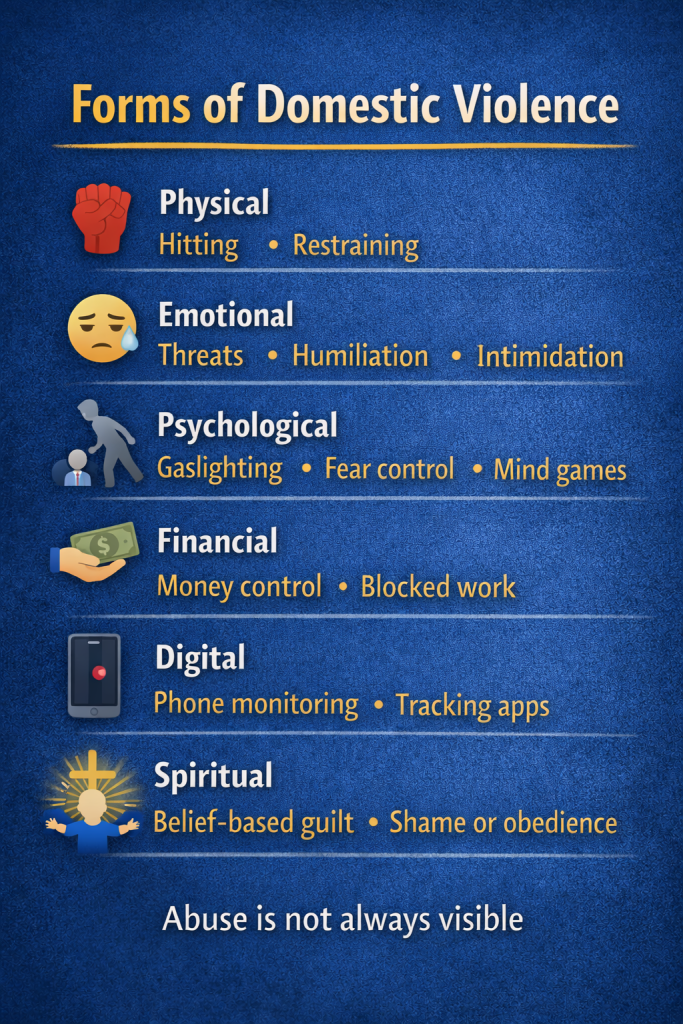
Emotional and Psychological Abuse
Emotional abuse takes away reality, and some common patterns include:
- Gaslighting: Where people question your memory or try to change it.
- Criticism can be framed as just being honest.
- Being kind to make you chase them.
- Emotional withdrawal to punish.
- Apologizes that they don’t change behavior.
A survivor might say that nothing happened today, but their body feels like they are ready for the next blow. This is a clue that something bad is going on.
Financial Control
Financial abuse is control and making someone being dependent. This can look like:
- Controlling employment.
- Sabotaging work.
- Restricting money.
- Forcing debt in your name.
- Making you justify your basic needs.
- Monitoring everything you buy.
It can be hard to just leave when it means you’re losing transportation, childcare, housing, money, or even your phone.
Digital Abuse
Digital abuse is a modern type of abuse. It can include things like:
- Demanding your passwords.
- Tracking your location.
- Forcing you to check in.
- Monitoring your messages.
- Controlling your social media.
- Threatening to share messages or pictures you sent them.
This makes you feel that you aren’t alone even when you are.
Spiritual Manipulation
This can sound like this:
- Leaving me is morally wrong.
- This is the karma you deserve.
- If you were more spiritual, you would stay with me.
- A good person would forgive.
Spirituality that says that you have to accept abuse isn’t spiritual or growth at all, but it’s control that is wearing church clothes and asking you to bow to them.
Why Abuse Can Happen Quietly
Abuse doesn’t normally start with something that is obvious, and it normally quietly escalates.
Small boundary crossings become routine. Your discomfort gets reframed as overreacting. The standard for what counts as “bad enough” keeps shifting. You adjust, not because you’re weak, but because adapting is how humans survive.
Many survivors describe understanding what was happening only in hindsight. They waited for one clear moment that would justify leaving, only to realize later that the moment was made up of hundreds of smaller ones.
That isn’t ignorance or failure. That’s conditioning.
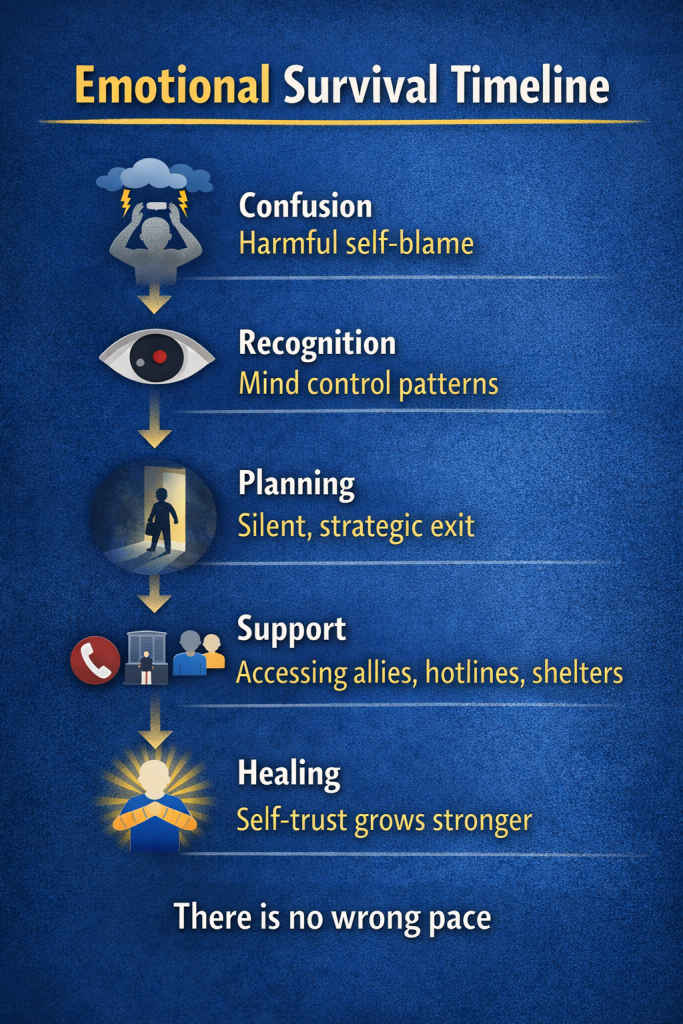
The Inner Conflict: Why Leaving Is So Hard
Leaving isn’t just a practical decision. It’s emotional, neurological, and social all at once. Even when someone knows the relationship is harmful, their body, brain, and circumstances may still be pulling them to stay.
Trauma Bonding and the Push–Pull of Relief
Trauma bonding can form when fear and relief are mixed together. Harm is followed by kindness just often enough to keep hope alive. Apologies come at the right moment. Promises are made when you’re closest to leaving.
Over time, the nervous system learns to cling to relief rather than safety. You endure the bad because the good feels like proof that it might finally change. This is why someone can feel love and fear at the same time and still be acting completely rationally based on what they’ve been conditioned to expect.
Shame and Self-Blame
Abuse trains people to turn inward.
Common thoughts start to loop:
- I should have known better.
- I might be too sensitive.
- I don’t want to hurt them.
- It’s not that bad compared to other people’s situations.
Shame sticks because it keeps people quiet. And silence is where abuse thrives. When someone believes the harm is their fault, they’re far less likely to reach for support.
Isolation and the Cost of Speaking Up
Many survivors aren’t just afraid of the abuser. They’re afraid of what happens if they leave.
Not being believed. Being judged. Losing family, friends, or community. Financial instability. Legal involvement. Retaliation.
Sometimes the relationship isn’t the only trap. The social and practical consequences form another set of locked doors, making escape feel impossible even when the harm is clear.
Why Leaving Can Increase Risk at First
This is one of the hardest truths to talk about, but it matters.
Leaving can be a high-risk period because control is being challenged. That doesn’t mean leaving is wrong or unsafe by default. It means it’s safest when it’s planned, supported, and intentional.
If someone’s situation allows for it, safety planning isn’t a delay or weakness. It’s prevention. It’s choosing survival over urgency, and strategy over pressure.
Safety First: Practical Steps That Truly Protect Lives
Safety planning works best when it’s personal, not generic.
The National Domestic Violence Hotline describes safety planning as a practical, individualized approach to improving safety while experiencing abuse, preparing to leave, or after leaving. In other words, it’s about working with your real life, not an ideal version of it.
Build a Safety Plan That Matches Your Reality
Start with what’s true for you, not what you think you should be able to do.
Helpful questions to reflect on include:
- When does risk increase in your situation, such as after drinking, during arguments, around money, or during jealousy spikes?
- What does escalation actually look like for you?
- What items do you need to keep accessible, like keys, identification, medications, or a charged phone?
- Who is one person you could reach out to if you needed support, even if it’s just to check in?
If it’s safe to do so, using an established safety planning tool can help you think through details you might miss when you’re under stress. The National Domestic Violence Hotline offers guided resources that are designed to adapt to different situations rather than forcing a one-size-fits-all plan.
If You’re Not Ready or Not Able to Leave Yet
Not leaving does not mean doing nothing.
Small, quiet steps can still reduce risk. These might include identifying one safe person who could be a check-in contact, choosing a simple code word that means “call me” or “I need help,” or keeping copies of important documents somewhere you can access them if needed.
Paying attention to patterns can also be protective. Noticing what tends to come before escalation allows you to anticipate risk rather than being blindsided by it. Learning about resources quietly, without alerting your partner, is another form of preparation.
Safety is a process. Progress doesn’t have to be dramatic to be meaningful. Sometimes the safest steps are the ones no one else ever sees.
Digital Safety Matters Too
If there’s any possibility of digital monitoring, even small changes can make a difference.
Only if it’s safe in your situation, you might consider using a device your partner can’t access for research or planning, logging out of shared accounts, or disabling location sharing when possible. Creating a separate email account for sensitive communication can also help, as can being cautious with shared cloud photo libraries or shared password managers.
If you suspect surveillance, it’s usually safer to seek guidance from a domestic violence advocate who understands digital safety rather than confronting your partner directly. Support from someone trained in this area can help you make changes without increasing risk.
Other Resources
Emergency hotlines matter. They save lives. But long-term support matters too.
Many countries also maintain directories of services beyond crisis response. For example, Canada offers province- and territory-specific listings for people experiencing family violence, helping survivors find local support that fits their situation.
It’s also important to remember that “resources” can mean more than a phone number. Support may include transitional housing and safety planning, trauma-informed counseling, legal advocacy or court accompaniment, financial empowerment programs, or peer support groups where survivors don’t have to explain everything from the beginning.
You don’t have to carry every piece of this alone. Support can be layered, practical, and gradual.
When You Leave, and They’re Still in Control
Many survivors expect the worst to be over once they leave. Sometimes that’s true. Sometimes the abuse changes shape instead of disappearing.
Post-separation abuse can include stalking or surveillance, repeated unwanted contact, using mutual friends or family to gather information, financial sabotage, threats involving custody or reputation, or what’s sometimes called legal abuse, where court processes are used to intimidate or exhaust someone.
This is why emotional recovery can feel delayed. Even after leaving, the body may stay on high alert because the threat hasn’t fully stopped reaching you.
If you’ve left and things feel harder instead of easier, that doesn’t mean you made the wrong decision. It may mean the control strategy is shifting, not that your choice was a mistake.
Surviving and the Nervous System
Abuse isn’t only psychological. It affects the body too.
Living in long-term fear can lead to hypervigilance, trouble sleeping, brain fog, sudden panic without a clear trigger, emotional numbness, or difficulty making decisions. These responses can feel confusing or frustrating, especially once the immediate danger has passed.
But these reactions are not signs that something is wrong with you. They’re survival adaptations. When the body learns to expect danger, calm can feel unfamiliar or even unsafe. A helpful reframe is this: your nervous system isn’t broken. It’s training.
Healing often involves gently retraining the nervous system to recognize safety again. That usually happens through consistent support, predictable routines, and trauma-informed care, not through forcing yourself to “be over it.” Recovery is less about erasing the past and more about teaching the body that the present is different.
Regaining Your Identity After Abuse
One of the hardest parts of leaving abuse is getting your identity back. Abuse can make you ask things like:
- Who can I trust?
- What do I actually like?
- What am I allowed to want and need?
- What do I want in my life?
After leaving, a survivor might feel strange with no one telling them what to do or making them feel a certain way. This silence can make them feel empty and free all at the same time. You can start rebuilding your identity by:
- Reconnecting with a hobby you wanted but gave up.
- Making one choice each day based on what you want and not fear.
- Practicing saying no whenever you want to.
- Noticing what your body says when you are in safe or unsafe places.
Remember, you aren’t rebuilding your old self, but you are building a stronger and newer you that has boundaries and self-respect.
Recovering Financially After Abuse
Financial recovery is part of leaving. Survivors might face things like:
- Damage to their credit.
- Problems getting a job.
- Housing instability.
- Legal costs.
- Shared debt.
Make sure that you are starting your financial growth by doing things that give you a choice, such as:
- Get employment through a support program.
- Check your credit score.
- Open your own account.
- Talk to a financial advisor who understands trauma.
Money isn’t just money, but it’s part of your recovery and growth.
Legalities in Abuse
Legal options can feel overwhelming, especially when you’re already exhausted. The system isn’t designed for people who are traumatized, sleep-deprived, or trying to stay safe.
This isn’t legal advice. Think of it as orientation. A way to understand the landscape without having to master everything at once.
Tools Like Protection Orders
Protection orders, which may be called different things depending on where you live, are meant to reduce contact and increase safety. For some people, they help. For others, the decision feels complicated.
Many survivors hesitate because they worry about retaliation, escalation, or not being believed. That hesitation makes sense. A trained advocate can help you assess risk in your specific situation and think through whether this option increases safety or not. The safest choice is always contextual, not universal.
Children and Custody Agreements
When children are involved, control doesn’t always stop with separation. It can continue through schedules, communication apps, exchanges, and court processes.
Psychological abuse is often harder to explain in legal settings, especially when it doesn’t leave visible marks. This is where documentation, consistency, and support from advocates or legal professionals can make a real difference. You’re not exaggerating. You’re translating an experience into a system that struggles to understand it.
When the System Feels Overwhelming
That overwhelm is common. It’s not a personal failure.
A more workable approach is to take things one piece at a time:
First, understand what your options are. Then, learn what kinds of documentation can help.
Then, decide what action, if any, feels safest right now. You don’t need to become an expert overnight. You’re allowed to move slowly and strategically.
Intuition and Logic
Many survivors say they knew something was wrong long before they could explain it or prove it.
Intuition often shows up quietly, through body-based signals. Tension around certain topics. A sense of dread before predictable blowups. Repeating dreams or mental images. A persistent feeling that something is off, even when the words don’t come easily.
From a grounded perspective, intuition is pattern recognition. Your brain and body notice inconsistencies and threats before the conscious mind has language for them.
There’s an important distinction here: Fear tends to say, freeze, appease, disappear.
Intuition tends to say, notice, prepare, protect. Learning to tell the difference can take time, especially after abuse has trained you to doubt yourself.
Psychics and Healing Support
Some people turn to spiritual or psychic frameworks after abuse because they restore something abuse tries to take away: inner authority.
To be clear, intuitive or psychic insight should never replace safety planning, legal support, counseling, or emergency services. It’s not a substitute for protection.
When used responsibly, intuitive guidance can help survivors rebuild trust in their own perceptions, name emotional patterns they’ve been taught to ignore, strengthen boundaries, and find meaning without excusing harm.
A responsible psychic or intuitive practitioner will never blame you for the abuse, never tell you to stay in danger “for a lesson,” never discourage professional or legal support, and will always prioritize your autonomy and safety over any prediction.
If spirituality is used to pressure you, shame you, or keep you in harm’s way, that isn’t guidance. It’s another form of control.
Things Survivors Notice
Here are some things that survivors might recognize:
Emotional Control
A partner calls themselves protective. They discourage friendships, monitor communication, and criticize your closest relationships. Over time, you stop reaching out because it doesn’t feel worth the conflict. Isolation grows quietly, without a single dramatic moment.
Financial Control
A partner insists they handle all the money because they’re “better at it.” Eventually, you realize you don’t have access, clarity, or the ability to plan. Asking questions leads to silence, anger, or punishment.
Intuitive Warnings
You notice a familiar body sensation before arguments. A tight throat. A sinking feeling. You tell yourself you’re just anxious. Later, you recognize it as a consistent early warning signal you were taught to ignore.
Rebuilding After Leaving
After leaving, you notice something unexpected. You can breathe. Alongside the relief, there’s grief and confusion. You wonder who you are now. Healing doesn’t begin with a dramatic breakthrough. It starts with small, daily choices that restore autonomy.
Supporting Someone Who Has Been Abused
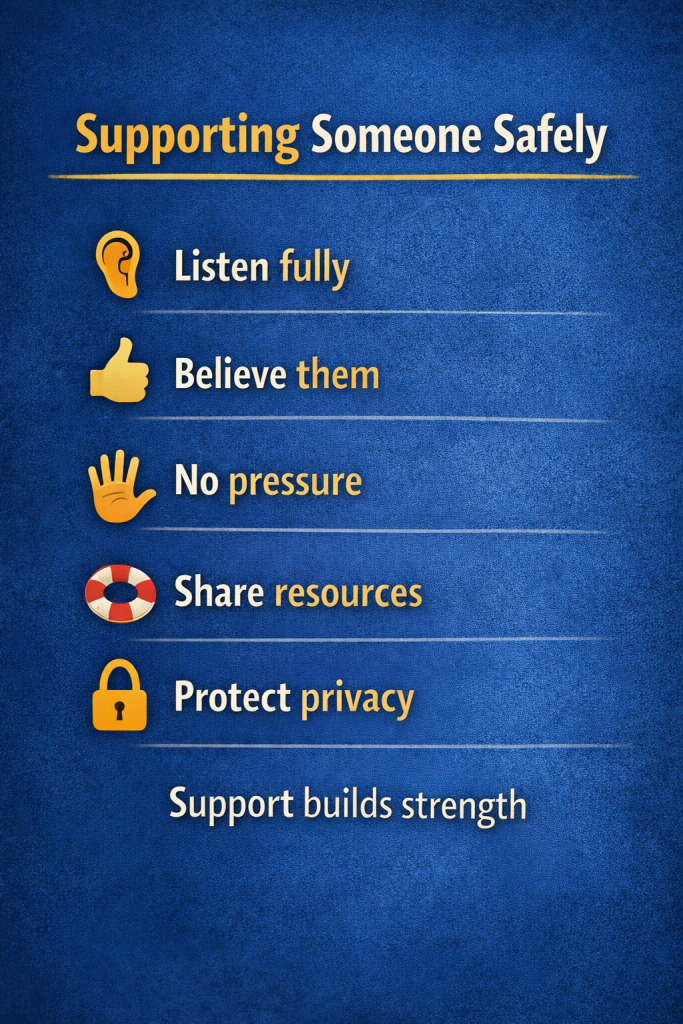
If you’re reading this to help someone else, your role isn’t to rescue them. It’s to help restore their sense of agency.
What helps sounds simple, but it’s powerful:
- “I believe you.”
- “You don’t deserve this.”
- “I can help you look at options when you’re ready.”
- “Do you want emotional support or practical help right now?”
What often causes harm, even when meant well:
- “Just leave already.”
- “Why do you stay?”
- “Are you sure it’s really that bad?”
- “But they’re nice sometimes.”
Pressure can echo control. Patience can rebuild trust.
Children and Their Environment
Children pick up the environment that they are part of. Even if they aren’t harmed directly, they can feel fear, unpredictability, and sadness when seeing their caregiver emotionally drained. Here are some things that you can do to help them:
- Set routines.
- Use age-appropriate reassurance.
- Don’t overshare details.
- Get them trauma-informed counseling or other support.
- Avoid language that makes them feel responsible.
- Set routines.
If you’re protecting children, it’s important that their emotional safety is protected as well.
Going from Survival to Self-Trust
Healing isn’t linear, and you might feel strong one day and weak the next. This doesn’t mean you’re failing, but that your nervous system is resetting. You can rebuild your self-trust by:
- Setting boundaries without apologizing.
- Noticing red flags.
- Paying attention to discomfort early on.
- Choosing safety.
Many survivors talk about becoming more intuitive after they go through abuse. That means survival skills are sharper, perception is wider, and healing turns the sharpness into discernment.
Resources and Helplines
- National Domestic Violence Hotline safety planning (USA)
https://www.thehotline.org/what-is-a-safety-plan/ The Hotline - CDC overview of intimate partner violence (USA, public health)
https://www.cdc.gov/intimate-partner-violence/about/index.html CDC - WHO fact sheet on violence against women (global health)
https://www.who.int/news-room/fact-sheets/detail/violence-against-women World Health Organization - Government of Canada family violence services directory (Canada)
https://www.canada.ca/en/public-health/services/health-promotion/stop-family-violence/services.html Canada
Final Thoughts: You Aren’t Weak
You aren’t weak when you’re dealing with abuse, but you’re responding to danger. If you are still, clarity can come, and if you have left your abusive situation, then healing can come one step at a time. If you’re supporting someone going through abuse, patience is safe and shows love. You deserve to have dignity, safety, and peace!
FAQ
What counts as domestic violence?
Domestic violence includes a pattern of behaviors used to control a partner or family member, such as physical harm, threats, intimidation, coercion, isolation, and other controlling actions.Can domestic violence be emotional or psychological without physical injuries?
Yes. Emotional abuse, gaslighting, humiliation, threats, and fear-based control are forms of domestic violence even without physical harm.What is coercive control?
Coercive control is ongoing behavior that limits someone’s freedom through monitoring, intimidation, isolation, rules, and threats.What are common warning signs that a relationship is becoming unsafe?
Frequent jealousy, isolation from friends/family, monitoring your phone, controlling money, threats, intimidation, and escalating arguments can be warning signs.Is financial control considered abuse?
Yes. Restricting access to money, blocking work, taking paychecks, or forcing debt can be financial abuse.What is digital abuse?
Digital abuse includes tracking your location, reading messages, controlling accounts, installing spyware, or harassing you online.What is spiritual or religious abuse?
It can include using beliefs to shame you, demand obedience, isolate you from community, or justify harmful behavior.If I’m not ready to leave, can I still get help?
Yes. You can talk to a hotline, advocate, counselor, or trusted person to explore options and safety planning without committing to leaving.What is a safety plan?
A safety plan is a personalized set of steps to reduce risk, prepare for emergencies, and access help safely.What should I include in an emergency “go bag”?
Common items include ID, keys, medications, charger, cash, important documents, and a small set of essentials. Store it somewhere safe if possible.How can I create a safe way to contact support if my phone is monitored?
Consider using a safer device, private email, clearing browser history, changing passwords, or contacting support from a trusted location. A local DV hotline can advise safer steps.What if I’m worried a partner is tracking my location?
Turn off location sharing where possible, review app permissions, and consider checking for unknown devices or apps. Get help from a domestic violence advocate for safer tech steps.When is it safest to leave?
Safety varies. For many people, risk can increase during separation, so planning with a professional advocate can improve safety.What should I do if there are threats or weapons in the home?
If you feel in immediate danger, call emergency services. You can also contact a crisis hotline for safety planning guidance.How do I help a friend who might be experiencing abuse?
Listen without judgment, believe them, avoid pressuring them, offer resources, and prioritize privacy and safety.What should I avoid saying to someone who is being abused?
Avoid blame, ultimatums, or “just leave” statements. Focus on support, options, and safety.Why do some survivors stay or return?
People may stay due to fear, financial dependence, children, isolation, immigration concerns, trauma bonding, stigma, or lack of safe alternatives.What is trauma bonding?
Trauma bonding is a strong attachment formed through cycles of harm and reconciliation, making it harder to leave.Can domestic violence happen in LGBTQ+ relationships?
Yes. Abuse can occur in any relationship, regardless of gender identity or sexual orientation.Can domestic violence happen to men?
Yes. Anyone can experience domestic violence, including men, non-binary people, and people of all backgrounds.What if I share children with the abusive person?
You can still seek help. Advocates can help you plan for custody, exchanges, documentation, and safety steps that reduce risk.What if my partner threatens self-harm if I leave?
Take threats seriously and contact emergency services or a crisis line. This is not your responsibility to manage alone.How can I document abuse safely?
If it’s safe, keep notes with dates, screenshots, photos, and copies of records in a secure place (not easily accessible on a monitored device). Consider advice from an advocate.What legal options might be available?
Depending on location, options can include protection orders, police reports, and legal aid for family law. A local DV organization can guide you.What resources exist besides shelters?
Many communities offer hotlines, counseling, legal clinics, support groups, advocacy, housing help, and safety planning.What should I do if I’m being stalked after leaving?
If you’re in danger, call emergency services. Document incidents, tell trusted people, and contact a DV/stalking resource for safety strategies.How can I rebuild emotional strength after abuse?
Small steps help: grounding techniques, supportive counseling, safe community, routines, and gentle self-trust rebuilding over time.What are grounding techniques I can use during panic or fear?
Try slow breathing, naming 5 things you can see, feeling your feet on the floor, holding a cold object, or repeating a calming phrase.Will contacting a hotline automatically trigger police involvement?
In many places, hotlines provide confidential support and options. Limits can apply in certain situations (like imminent danger). Ask the hotline about confidentiality.What if I’m in immediate danger right now?
Call emergency services immediately. If you can, go to a safer location and contact a local crisis hotline for urgent support.




I think this guide sheds light on how abuse can be invisible yet deeply damaging. It’s important that people understand coercive control and trauma bonding aren’t just buzzwords—they’re real psychological patterns that trap people.
Yeah Dot, but don’t you think sometimes folks overthink things? Like calling every argument ‘abuse’? Seems like we’re pathologizing normal rough patches in relationships. Where’s the line?
This article is incredibly empowering. It goes far beyond the typical advice and really speaks to the inner confusion that survivors deal with. The focus on intuition and the nervous system makes it feel so personal and compassionate. Truly life-saving information for anyone in an abusive situation.
“Abuse wears church clothes”—wow, that’s poetic AND terrifying ⚡️This piece hits hard. We often miss how spiritual beliefs are weaponized to control others. People need to read this and see manipulation for what it truly is: cowardice wrapped in righteousness.
‘You aren’t rebuilding your old self, but a stronger new you’—OMG I felt that! 💪 This read like a motivational speech mixed with therapy journaling prompts 😂 But honestly it helped me remember I’m not broken!
I found this article overly emotional and slightly manipulative in tone. While abuse is undoubtedly serious, framing every disagreement or emotional imbalance as ‘coercive control’ risks diluting real cases of domestic violence.
Okay but like… why is this article so long? I was just looking for some quick tips, not a therapy session in writing 😩 Still, I guess some of it made sense if you’re into that deep stuff.