

What Is a Rune Reading?
A rune reading is a modern divination practice in which symbols from historical runic alphabets are drawn, cast or arranged and interpreted around a question.
Many readers use Elder Futhark, an early runic writing system with 24 characters. Modern rune readings may assign each character themes such as communication, movement, disruption or growth.
It is important to separate two things:
- historical runes, which were writing systems used by Germanic-speaking peoples; and
- modern rune divination, which applies symbolic and spiritual meanings to those letters.
The second practice can be meaningful without pretending every modern interpretation is securely documented Viking-age tradition.
A Short History of Runes
Runes are letters from several related alphabets used across parts of northern Europe. The earliest securely identified runic inscriptions date to roughly the second century CE.
Elder Futhark is the earliest commonly classified runic alphabet and contains 24 characters. Later systems included Younger Futhark in Scandinavia and Anglo-Saxon Futhorc in England and Frisia.
University of Oxford teaching material on Scandinavian runes explains that runic inscriptions were a form of written evidence, with many Viking-age stones serving monumental or commemorative purposes and other examples used more informally.
Were Runes Historically Magical?
Runes appear in Old Norse literature in magical and supernatural contexts, and some historical inscriptions may have had ritual or protective functions. But scholars caution against assuming that later literary descriptions reproduce ordinary historical practice exactly.
Cambridge scholarship notes that we know relatively little about real-life magical rune use and that many specific occult meanings attached to individual runes come from much later, including twentieth-century esoteric and neopagan systems.
So it is reasonable to discuss runes and magic as part of cultural history while being careful not to present a modern divination chart as an unchanged ancient Viking manual.
How Modern Rune Readings Work
A modern reader usually begins with a question, draws or casts one or more runes and interprets the symbols in context.
The process is similar to other symbolic practices such as tarot: the symbols provide prompts that can help a person organize thoughts, consider alternatives or notice themes they had not articulated clearly.
A rune does not objectively reveal a hidden future or another person’s private thoughts.
Common Reading Formats
One-Rune Reflection
Draw one rune and use its modern symbolic meaning as a theme for the day or for a specific question.
Three-Rune Spread
Three runes might be interpreted as situation, challenge and next step. Some readers use past, present and future, but “future” should be treated as reflection on possibilities rather than a guaranteed forecast.
Full Casting
Some practitioners scatter several runes onto a cloth and interpret position, proximity and orientation. These methods vary considerably between modern traditions.
Do Reversed Runes Have Different Meanings?
Some modern systems use reversed meanings and others do not. There is no single historically established rule requiring reversals.
If you use reversals, treat them as part of the interpretive system you have chosen rather than an ancient universal law.
Modern Rune Meanings Are Interpretive
Contemporary guides often associate runes with concepts such as:
- Ansuz: communication or inspiration;
- Raidho: travel, movement or process;
- Gebo: exchange or partnership;
- Hagalaz: disruption or change;
- Jera: cycles or harvest;
- Fehu: resources or prosperity.
These can be useful symbolic prompts. They should not be presented as archaeological proof that ancient rune users assigned exactly the same psychological or predictive meanings.
Ask Better Rune Questions
Open-ended questions usually create more useful reflection than demands for certainty.
Try:
- What should I consider about this career decision?
- What pattern am I repeating in this relationship?
- What resource am I overlooking?
- What would a cautious next step look like?
- What part of this situation needs more information?
Avoid using runes to diagnose health, prove infidelity, identify a missing person or make high-stakes financial decisions.
Can Runes Predict Wealth or a Promotion?
No rune can guarantee money, a job offer or a promotion. If a symbol such as Fehu prompts you to think about resources, translate that into practical questions about skills, applications, savings, salary or risk.
The symbol can inspire reflection; the outcome still depends on real-world conditions and decisions.
Rune Reading and Intuition
Some psychics describe receiving intuitive impressions while looking at a rune. Those impressions are subjective and should remain clearly distinguished from verifiable information.
A reader can say, “This symbol makes me think about stalled communication,” without claiming to know exactly what another person is secretly thinking.
Do Runes Need Cleansing or Charging?
Some modern practitioners cleanse rune sets with sound, smoke, moonlight or simple intention. These are ritual choices, not requirements supported by historical evidence.
If you use smoke, candles or salt, consider the material of the rune set and ordinary safety. Do not expose stones, wood or finishes to methods that may damage them.
Speaking or Chanting Rune Names
Some contemporary spiritual traditions speak or chant rune names during meditation. This may function as ritual, concentration or symbolic practice.
There is no established evidence that pronouncing a rune creates a literal protective shield, changes external events or activates a measurable vibration with predictable effects.
Rune Reading Myths vs. Reality
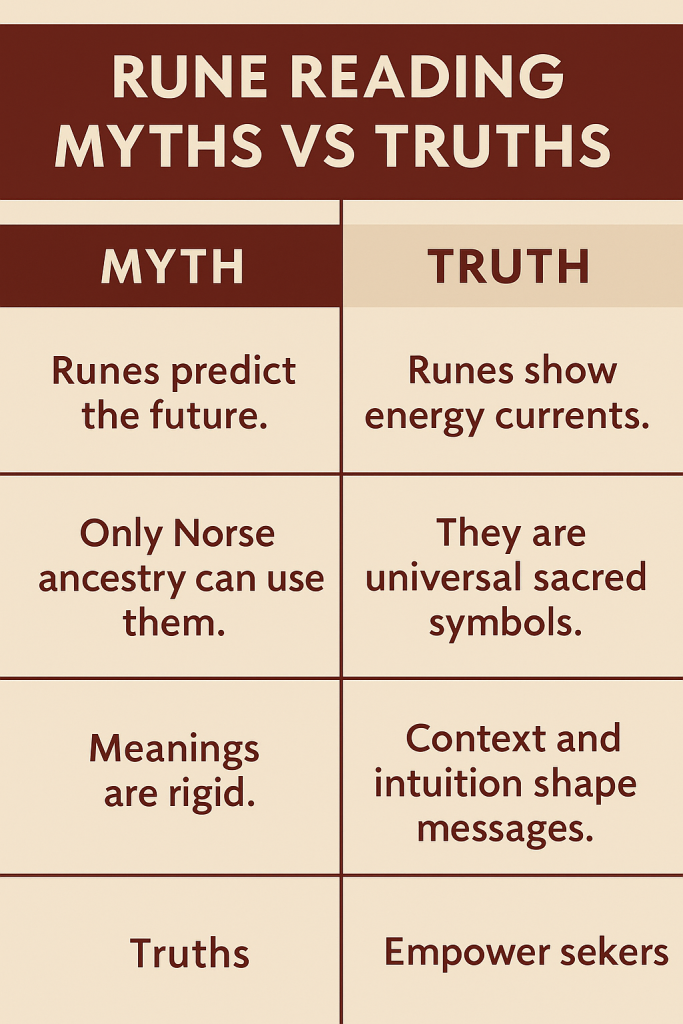
Myth: Every rune has one ancient fixed meaning
Modern meanings vary between systems, and historical evidence is more complicated.
Myth: Runes guarantee the future
Rune readings are better treated as symbolic reflection than reliable forecasting.
Myth: A frightening rune predicts disaster
A rune such as Hagalaz can be interpreted as a prompt about disruption without predicting a literal crisis.
Myth: A professional psychic makes the symbols objectively true
A reader may add experience and perspective, but the interpretation remains subjective.
Can Anyone Use Runes?
You do not need Scandinavian ancestry to study the history of runic writing or use a modern rune set. Respectful practice means learning the historical context and avoiding claims that a recent occult system is identical to ancient Norse religion.
Rune Reading vs. Runecasting
The terms are often used interchangeably, but “runecasting” usually emphasizes physically casting multiple runes, while “rune reading” can include a single draw or arranged spread.
For a practical casting-focused guide, see How to Cast Runes: Meanings, Spreads, History and Practice. For a broader comparison with tarot, pendulums and scrying, see Divination Methods: Tarot, Runes, Pendulums and Scrying.
How to Evaluate a Rune Reading
After a reading, ask:
- Did the interpretation help me identify a useful question?
- Did it respect my agency?
- Did the reader distinguish symbolism from fact?
- Was I pressured to spend more money because of a curse or threat?
- Am I using the reading as perspective or as a substitute for evidence?
Final Thoughts
Runes have a real and fascinating history as Germanic writing systems. Modern rune divination builds a newer symbolic practice on top of that history.
You do not have to dismiss rune reading to describe it accurately. The strongest approach respects the historical evidence, labels modern meanings as interpretations and uses the symbols for reflection rather than guaranteed prophecy.
Frequently Asked Questions
What is a rune reading?
It is a modern divination practice that interprets runic symbols around a question or situation.
How old are runes?
The earliest securely identified runic inscriptions date to roughly the second century CE.
Is Elder Futhark a Viking alphabet?
Elder Futhark predates the Viking Age; Younger Futhark was the main Scandinavian runic system during much of the Viking Age.
Were runes historically used for magic?
Runes appear in magical contexts, but evidence for standardized historical divination meanings is limited and complex.
Do runes predict the future?
They have not been established as a reliable forecasting method.
Do reversed runes always have special meanings?
No. Reversal systems vary among modern readers.
Do I need Norse ancestry to use runes?
No, but learning their historical and cultural context supports more respectful use.
What is the safest way to use a rune reading?
Use it as a reflection tool while keeping health, legal, financial and safety decisions grounded in appropriate evidence and expertise.


