“Psychic” and “clairvoyant” are often used interchangeably, but in modern spiritual practice they usually describe different levels of specificity. Psychic is the broader term. Clairvoyant is a label for a psychic who says impressions arrive mainly through mental images or visual symbols.
These are spiritual-practice terms rather than scientifically established categories of perception. A reader’s label does not guarantee accuracy, access to hidden facts or an ability to predict the future.

What Does “Psychic” Mean?
Psychic is an umbrella term used for practitioners who say they work with intuition or extrasensory impressions. Depending on the reader, they may describe information as feelings, words, images, cards, symbols or a sense of knowing.
There is no standardized certification that proves a person has a psychic ability. When choosing a reader, ethics and expectations matter more than the label.
What Does “Clairvoyant” Mean?
Clairvoyance literally means “clear seeing.” In psychic traditions, a clairvoyant says impressions arrive visually as mental pictures, colors, symbols or scenes.
For example, a reader might picture a bridge and interpret it as reconnection. The image is still an interpretation; it does not independently prove that reconciliation will occur.
Are All Clairvoyants Psychics?
In common metaphysical usage, yes: clairvoyance is treated as one type of psychic practice. Not every psychic calls themselves clairvoyant because some emphasize feelings, inner words, cards or other methods.
What Are the Other “Clairs”?
Spiritual communities also use terms such as:
- Clairaudience: “clear hearing,” usually described as inner words or sounds.
- Clairsentience: “clear feeling,” described as intuitive emotions or bodily impressions.
- Claircognizance: “clear knowing,” described as sudden ideas or certainty.
- Clairalience and clairgustance: claimed intuitive smell or taste.
These labels describe how practitioners interpret experiences; they are not medical or scientific diagnoses.
Psychic vs. Clairvoyant Reading
A general psychic reading may use several methods. A clairvoyant reading usually emphasizes imagery. In practice, many readers use multiple approaches and the distinction can be loose.
If you want to know exactly what a clairvoyant session may involve, see Clairvoyant Reading: What to Expect, Ask and Avoid.
Which Reader Should You Choose?
Choose based on the style you prefer rather than assuming one category is more accurate.
- If you like visual metaphors and symbols, a clairvoyant style may appeal to you.
- If you prefer cards, astrology or another structured tool, choose a reader who uses that method.
- If you want claimed communication with deceased loved ones, look specifically for a medium.
- If you are unsure, read the advisor’s description and client feedback before booking.
What Neither Type Can Reliably Do
A psychic or clairvoyant should not be treated as able to:
- guarantee future events;
- diagnose physical or mental illness;
- tell you to stop medication or treatment;
- verify another person’s private thoughts;
- prove infidelity without evidence;
- guarantee legal, financial or gambling outcomes.
Intuition Is Not Scientific Proof of Psychic Ability
Psychology recognizes intuition as rapid judgment that can draw on experience and cues processed outside conscious awareness. Research on intuition does not establish that humans perceive hidden energy fields, future events or private information through psychic means.
Spiritual practitioners may connect the two ideas, but they should remain clearly distinguished.
How to Evaluate a Reader
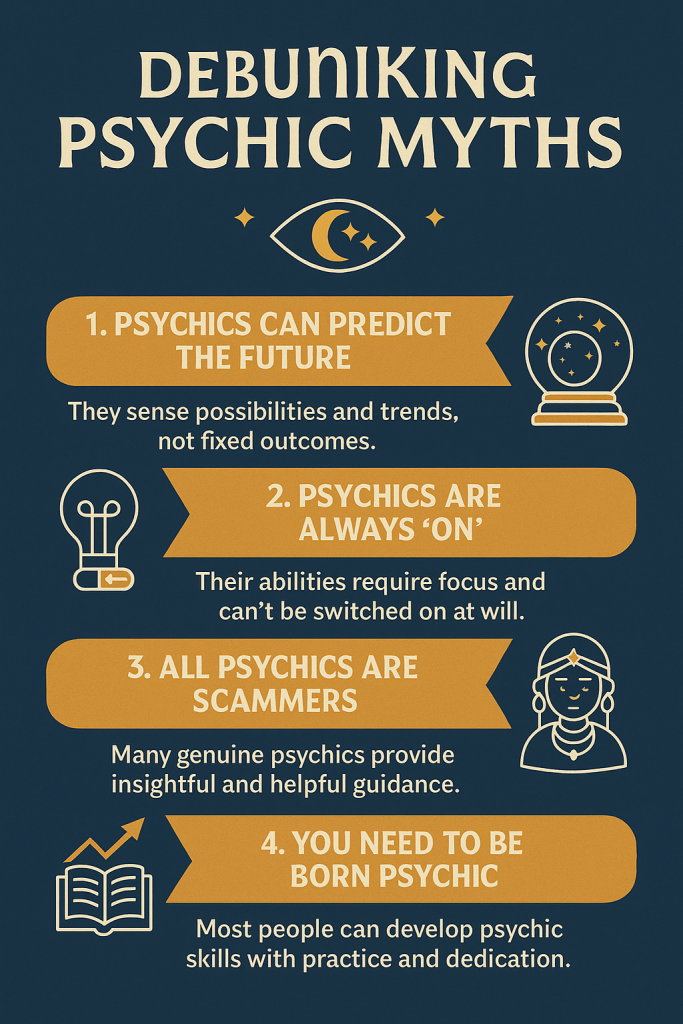
- Look for clear pricing.
- Avoid guaranteed outcomes.
- Reject curse-removal or fear-based upsells.
- U.S. Postal Inspection Service guidance on psychic scams specifically warns about claims that bad luck, a curse or impending harm requires payment to remove.
- Choose readers who respect consent and privacy.
- Be wary of claims to diagnose health or know another person’s mind with certainty.
- Do not book so frequently that readings replace your own judgment.
Phone, Chat and In-Person Readings
Psychic and clairvoyant readers may work by phone, chat, video or in person. There is no established evidence that one delivery format is inherently more psychically accurate than another.
Choose the format that helps you communicate clearly, keep track of time and take useful notes.
Related Clairvoyance Guides
For the definition and evidence boundaries, read What Is Clairvoyance? Meaning, Experiences and Limits. If you are exploring your own imagery, see Clairvoyant Experiences: Signs People Associate With Inner Vision.
If your main question is romantic, compare psychic abilities commonly used for love readings before choosing a reader style.
Frequently Asked Questions
What is the main difference between a psychic and a clairvoyant?
Psychic is the broader label; clairvoyant usually refers to a psychic who says impressions arrive visually.
Are all clairvoyants psychics?
In common metaphysical terminology, yes, although the labels are not standardized.
Is a clairvoyant more accurate than another psychic?
No evidence establishes one psychic style as inherently more accurate.
Can either predict the future with certainty?
No. Future claims should be treated as interpretations, not guarantees.
Can either read another person’s mind?
Psychic impressions should not be treated as verified access to private thoughts.
Can a psychic or clairvoyant diagnose illness?
No. Health concerns require qualified professional evaluation.
How do I choose between them?
Choose the reading style, communication method, ethics and pricing that fit your needs.
What is the biggest red flag?
Fear tactics, guaranteed outcomes, medical claims or pressure to keep paying for protection or certainty.