

Fun matters. Rest matters. Pleasure matters. A healthy life does not require turning every enjoyable moment into a productivity lesson or spiritual achievement.
At the same time, some activities feel good in the moment but leave you stressed, overspent, sleep-deprived or disconnected afterward. Other pleasures leave you rested, connected or creatively energized. The useful question is not whether one kind has a “higher vibration.” It is whether the pattern works well in your actual life.
Fun and Fulfillment Can Coexist
Fun is often immediate: a concert, a game, a dessert, a night out, a new purchase or an hour of scrolling. Fulfillment is broader. It may come from relationships, learning, creativity, contribution, rest, meaningful work or progress toward something you value.
A review of hedonic and eudaimonic wellbeing research distinguishes pleasure and pain avoidance from meaning, self-realization and fuller functioning. The two perspectives can overlap, which supports seeking a workable balance rather than treating enjoyment and purpose as opposites.
You do not need to choose one forever. A balanced life can include both spontaneous pleasure and longer-term meaning.
Do Not Reduce Pleasure to “Dopamine Hits”
Online discussions often describe every enjoyable activity as a “dopamine hit.” Dopamine is involved in motivation, learning and reward processes, but human pleasure and wellbeing are far more complicated than one neurotransmitter.
You do not need to diagnose yourself as “dopamine addicted” because you enjoy social media, dessert, shopping or entertainment. Instead, look at behavior: Is the activity interfering with sleep, money, work, relationships, health or responsibilities?
Using the 80/20 Image as a Reflection Prompt
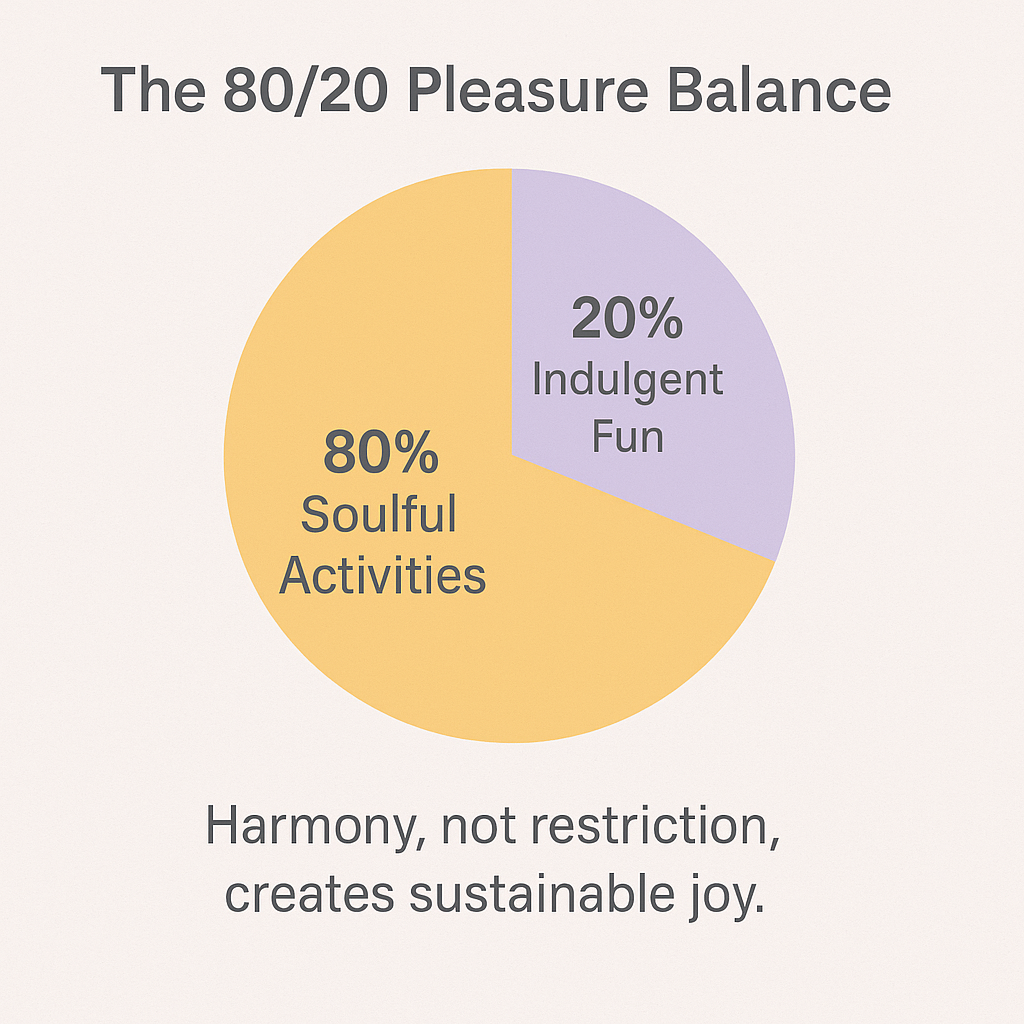
The 80/20 image can be useful as a reflection prompt, but it is not a scientifically established rule. You do not need to spend exactly 80 percent of your energy on meaningful activities and 20 percent on indulgence.
A better use is to ask whether your week contains enough of both: responsibilities and play, connection and solitude, effort and recovery.
Ask What Happens Before, During and After
If you are unsure whether an activity is helping or becoming avoidance, review the whole cycle.
- Before: What am I feeling or trying not to feel?
- During: Am I actually enjoying this, or doing it automatically?
- After: Do I feel rested, connected, neutral, regretful or more stressed?
- Next day: Did the activity create a problem with money, sleep, work or relationships?
No single answer proves that something is “aligned” or “misaligned.” Look for repeated patterns.
Enjoyment Is Not Automatically Escapism
Watching a show after a difficult day, buying something within your budget or going out with friends can simply be enjoyable. You do not have to justify pleasure by making it productive.
Escapism becomes more concerning when an activity is repeatedly used to avoid problems that still need attention, especially when the behavior creates new problems.
Signs Pleasure May Be Becoming Avoidance
- You regularly spend more than you can afford.
- You lose sleep because you cannot stop scrolling, gaming or watching.
- You increasingly need the activity to avoid uncomfortable emotions.
- You repeatedly cancel responsibilities for it.
- You hide how much time or money you spend.
- The behavior is damaging relationships.
- You want to cut back but repeatedly cannot.
These are behavioral clues, not evidence of a blocked chakra or damaged aura.
Noticing the Effects of Enjoyment
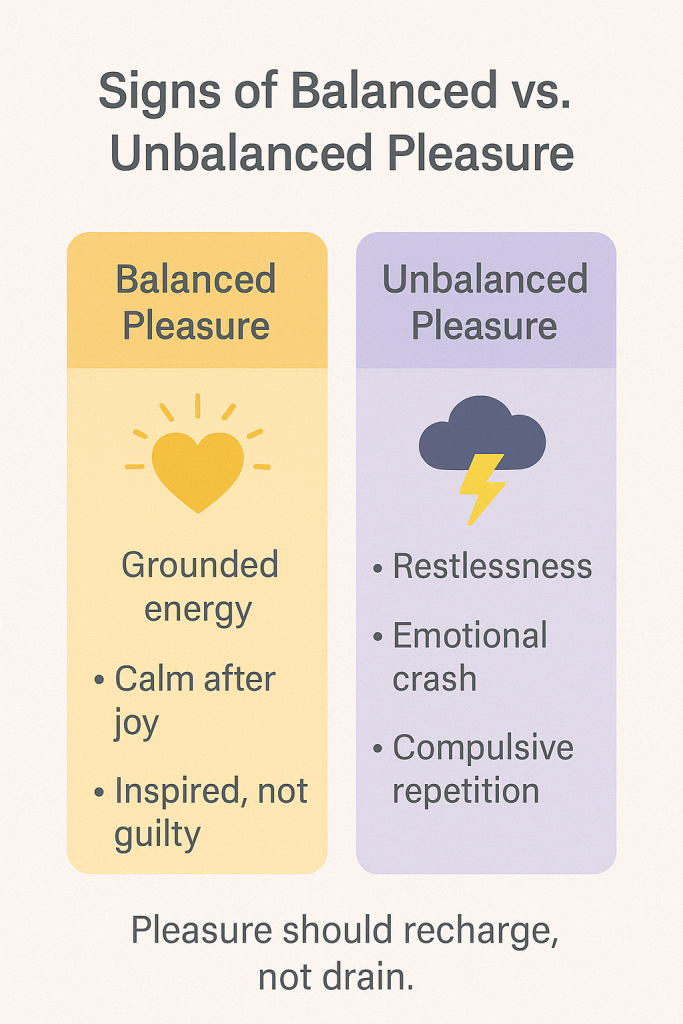
Use this graphic as a journaling checklist rather than a diagnosis. Feeling tired after a party, for example, may simply mean you stayed up late. It does not prove that your energy field is depleted.
Values Help When Feelings Are Mixed
Sometimes an activity is both fun and costly. A late-night event may be worth being tired the next morning. A vacation may be expensive but meaningful. A demanding hobby may create frustration and deep satisfaction.
Instead of asking only, “Does this feel good?” add: “Does this fit my values, budget, commitments and health?”
Make Room for Low-Cost Pleasure
Enjoyment does not need to require shopping or travel. Build a personal list of inexpensive or free activities that genuinely appeal to you:
- Walking somewhere pleasant.
- Music.
- Cooking with someone.
- Reading.
- Drawing or making something.
- Games.
- Time with a pet.
- Calling a friend.
- Gardening.
- A quiet bath or shower.
The point is not that these activities are spiritually superior. They simply expand your options.
Rest Is Not a Reward You Have to Earn
Some people turn balance into another strict rule: work first, then earn pleasure. Rest is a basic part of functioning, not a moral prize.
If you are chronically exhausted, adding more “joy rituals” may not solve the underlying problem. Look at workload, sleep, caregiving, health, conflict and whether your schedule is realistic.
Alcohol and Other Substances
Alcohol can affect judgment, coordination, sleep and mood. If drinking repeatedly causes problems, discuss a safer plan with an appropriate health professional. If you may be physically dependent or have been drinking heavily over a prolonged period, seek medical advice before suddenly stopping or sharply reducing: NIAAA warns that withdrawal can be dangerous. That does not need to be explained as alcohol “blocking intuition” or weakening energetic boundaries.
If substance use feels difficult to control or is harming your life, qualified medical or addiction support is more appropriate than spiritual diagnosis.
Spiritual Practices Can Add Meaning
If you enjoy tarot and other divination tools, meditation, prayer, crystals or ritual, you can use them as optional reflection tools.
A simple three-card tarot prompt might be:
- What am I seeking from this activity?
- What am I overlooking?
- What would a balanced next step look like?
The cards do not determine whether an activity is healthy. They give you images and questions to think with.
A Brief Pleasure Review
Choose a manageable period to reflect on, and make short notes if useful:
- What I enjoyed.
- What restored me.
- What created more stress than it was worth.
An activity can appear in more than one list. That is useful information. The goal is not purity; it is awareness.
A Free Enjoyment-and-Trade-Off Note
Choose one activity rather than judging your whole life. Mixed effects are allowed: something can be enjoyable and leave you tired.
- The activity: what did you do, and what did you want from it?
- What it gave: enjoyment, company, rest, learning or something else.
- What it cost: time, money, energy or an effect on another commitment. Use your actual circumstances, without assigning a moral score.
- A possible adjustment: keep it, change one part, pause it or ask for support.
Example: a late film night with a friend was fun, but the next morning was difficult. You might suggest an earlier showing next time. That preserves the connection without declaring the evening “bad energy.”
Read your result: you have one observation and an option to consider. There is no correct percentage of pleasure, required improvement or diagnosis here. If a behavior feels out of control or causes serious harm, professional support is more useful than repeating the worksheet.
For a wider choice of everyday supports, visit the practical and spiritual happiness guide. This note focuses on one activity’s trade-offs.
Relationships and Shared Pleasure
Partners and friends do not need identical ideas of fun. One person may prefer crowds; another may prefer quiet activities. Healthy balance includes negotiation rather than assuming one person’s style is more evolved.
Create a shared “joy menu” with activities each person enjoys, plus a few things you are willing to do for the other occasionally.
When to Get More Support
If eating, shopping, gambling, sexual behavior, substance use, exercise, gaming or another activity feels compulsive or is causing serious consequences, a qualified professional can help assess what is happening.
A psychic reading may be used for spiritual reflection, but it should not diagnose addiction, trauma, depression or another health condition.
Final Thoughts
Balanced pleasure is not a frequency, chakra formula or fixed 80/20 ratio. It is a practical pattern in which enjoyment can coexist with responsibilities, health, relationships and the things you value.
Keep fun. Keep meaning. Notice what each activity costs and gives you, and adjust without turning ordinary pleasure into either a moral failure or a spiritual test.
Frequently Asked Questions
1. What is the difference between fun and fulfillment?
Fun usually describes immediate enjoyment. Fulfillment is a broader sense that something is meaningful or worthwhile. One activity can provide both.
2. Are “dopamine hits” bad?
No. Dopamine is part of normal brain function. Judge habits by their effects on your life rather than treating dopamine as a moral category.
3. Is the 80/20 pleasure rule scientifically proven?
No. Use it only as a loose reflection prompt, not a required ratio.
4. How can I tell whether pleasure is becoming avoidance?
Look for repeated consequences such as overspending, sleep loss, hiding behavior, neglected responsibilities or inability to cut back.
5. Can tarot help me make healthier choices?
Tarot can provide reflection prompts, but health and high-stakes decisions should be based on evidence and appropriate professional advice.
6. Is feeling tired after socializing a sign of bad energy?
Not necessarily. Late hours, noise, alcohol, sensory load and ordinary social effort are common explanations.
7. When should I seek professional help?
If a behavior feels compulsive, unsafe or is harming health, finances, work or relationships, qualified professional support is appropriate.
Also useful: 22 Practical and Spiritual Ways to Support Happiness — for balancing enjoyment with habits that support longer-term wellbeing.


