
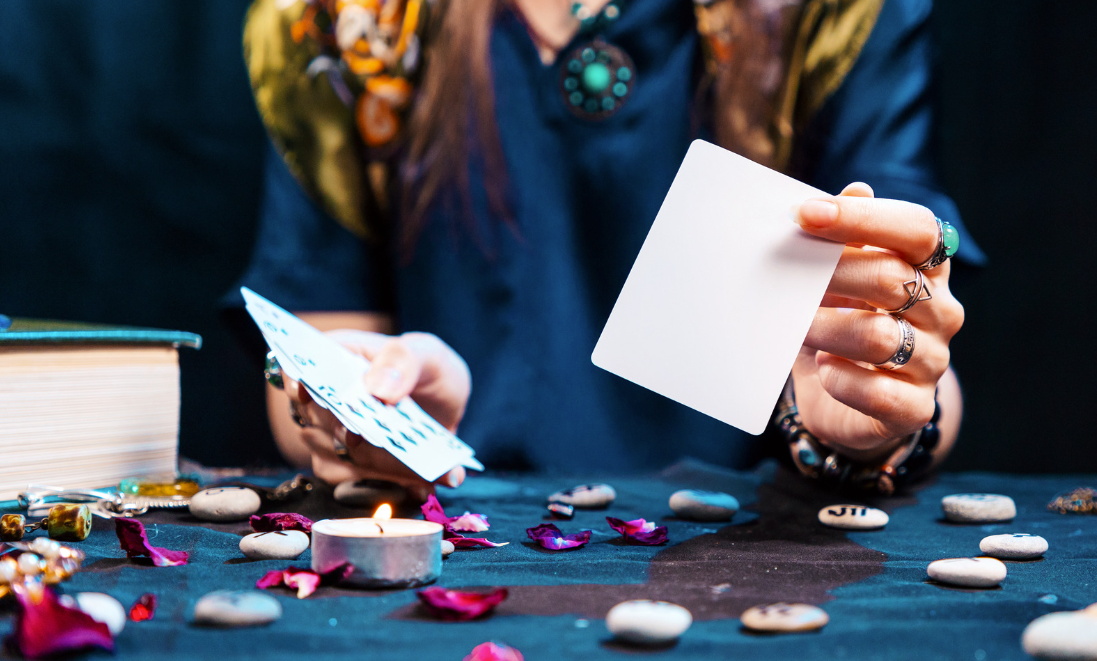
Cartomancy is something that has been around since ancient times. This is a way that people have used things to help predict the future. Did you know that you can use a deck of playing cards to help do a future reading?
Using a Deck of Cards
There are 52 cards in a deck and the cards have four suits. Hearts, spades, diamonds, and clubs are the four suits and there are 13 cards in each of these suits.
Getting Answers
Just like getting a cartomancy reading with a deck of tarot cards, using a regular deck of cards can give answers depending on the kind of spread that is used and the questions that are asked. The reader can get answers using regular cards just like using tarot cards.
Questions to be Asked
Cards are more flexible than using tarot cards and no matter how you ask the question, the cards can give you answers. There are cartomancy spreads that can help you to understand things in your life more. The person that is giving the reading will shuffle the cards and will meditate on your question. The cards can give answers and the answers are more than just yes or no answers.
What Do the Cards Mean?
You can find out what the cards mean but sometimes using tarot cards as a beginner might be easier. Using a deck of cards means that there are only 52 cards while there are 73 in a tarot deck. The thing is though that tarot cards have a meaning and even though you have to interpret the tarot cards there is a book that beginners can use for the reading.
Using either tarot or a regular deck of cards means that you will be dealing with different suits. There are also similar types of cards where there is an Ace, King and Queen in a regular deck, there are also court cards in a tarot deck.
Regular cards have hearts, spades, diamonds and clubs and tarot decks have cups, swords, wands, and pentacles. The court cards are similar and here is what they mean:
- Aces are in all four suits, and they can mean new beginnings.
- The kings in the decks show male energy and the queens show female energy.
- Playing cards have a jack in each suit and the tarot cards have knights and pages. The jacks are like the knights and pages.
The king, queen, and jack work together in one suit and play together in the family of cards. The ace is part of the whole family and means a new start. Tarot cards are part of cartomancy and correspond with the suits.
Spreads and Questions
You can ask any questions in your cartomancy reading and there are different spreads that are 3 card, five card or even single card spreads. Some even use seven card spreads. This kind of spread can tell you a lot about your family, your job, and about other things in your life. This depends on the kinds of questions that you ask. You can also find out about your past, present and future when you ask open-ended questions.
Yes and No Readings
Another way that you can do a cartomancy reading is to ask yes and no questions. You can decide that the black cards say one thing and the red cards say something else. Pick one card from your deck and that is the answer that you get. If the red card is the one that is the no answer, then the black card will be the yes answer.
If you need to have more information about the yes or no answer that you get, then you have to look at the suit that is drawn. The diamond or the heart can mean a more positive answer than the spades or the clubs. A club is more of a positive card, but this can also mean that you will have problems in your future.
Cards that have higher numbers are more dramatic than lower numbers and you should always pay attention to the number on the card. You can draw a hear card that is a 9 and this can mean yes, and it can be surrounded with a lot of joy. This can be different if your reading is about love.
3 Card Spread
When you want to get an answer that is more detailed you can use a 3-card spread. This kind of spread means that you will ask a question such as, “Will I get a promotion?” and then you will lay out your cards.
The first card will mean the past, the middle card will mean the present and the third card means the outcome of the situation. Look at the colors of the cards and if there are more re than black, notice this. Red cards are positive and black cards can represent that there is some kind of problem with what you’re asking.
If you have two red cards and you have one black card, then chances are that your answer is good. The card that is in the past spot might be black and if it is, it can mean that you’re stuck and that you might not be able to move forward. This can mean that you are stuck in your job or in some kind of situation. If the other cards are red, this can mean that you are having positive things that are affecting you in a good way. You might be moving to a new job soon.
If the last card is a red Ace of Diamonds, you will see that this can represent having a new beginning of your job. This can mean that you are going to be successful in your job and your career. You can use cartomancy to find this out!
Using Cards for a Love Reading
Once you start doing readings you might want to learn how to do a love reading. One kind of spread is called the “Love Pyramid.” This is a layout that you can use if you’re in a relationship. You might ask, “Is my relationship going anywhere?” Then as you shuffle the cards, focus on what you want to know and then lay them out left to right like a pyramid.
Look left to right and see if you have certain colors of cards. Here is an example:
- Two of hearts.
- Four of clubs.
- Four of diamonds.
- Two of spades.
The two cards that are red and the two cards that are black can mean that your relationship was once balanced. The two of hearts shows that the relationship has a strong attraction with each other and the four of diamonds says that your relationship is solid. The four of clubs can mean that you are having a happy and good relationship. The last card might mean that you are at a standstill, and you aren’t able to move forward. Even if the relationship started out strongly it might have come to a place where it isn’t moving.
Next, choose three more cards and put them above the other cards. These are considered foundation cards and are part of your pyramid. The cards might be:
- Eight of diamonds.
- Ten of clubs.
- Five of diamonds.
Look at the cards from left to right and see that the card on the right represents something new. It might mean that you or your partner took on a new job or that you’re in a relationship that is stable but that nothing is new. The middle card can show that you are facing a problem and that it might be something that is because of your job. The last card shows that you have stress, and you aren’t happy.
When you put the cards together you will see that the relationship causes you to feel stress because you are worried about not spending time together because of the job that you are at and working too hard.
There are two more cards in the Love Pyramid and these cards can suggest how you can solve the problems in your relationship. Pick two cards and put them above the three cards that you just looked at. These should be read left to right.
These are the cards that can help you to know how to solve your problems. This will look like a pyramid, and you will be working to get the answers that you need to your questions.
The cards that were picked from left to right might look like this:
- Six of hearts.
- Eight of clubs.
The six of hearts can show the past and this can show the different memories that you had with each other that were good. If you want to have a better relationship, you have to go to your present and leave your past behind. This will help to make your relationship happy.
The eight of clubs card shows that you can progress and move. This can indicate taking a trip. If you have traveled a lot together in the past this can show that in the cards. You might have gone on an adventure together and you have been busy working and you stopped traveling. Look at the times that you did things together and you were happy, and this can help you to move together into the future.
Now you have the final card to put down in your Love Pyramid. This needs to go over the two cards that you just put down. Pick one card and put it on the top to finish off your pyramid. This is the card that will give you the answers to your question.
The card might be:
- Three of hearts.
The three of hearts can show that your relationship is happy and that you are playful with each other. It can show that you have solved your issues by moving forward and not staying in the past. It shows that you can spend time together and enjoy being together. You will see that you and your partner can be happy again. Celebrate being a couple and learn to love each other in the time that you have.
Final Thoughts
Being someone that does cartomancy can help you to find new possibilities in your life and help you to see things from a different perspective. Look at the cards to help you to find answers to the questions in your life.


This article is nice and simple. I like that you can use normal cards to ask questions. Shuffle, pick, and see colors. Red feels warm and hopeful. Black can mean a problem but not always. Try a three-card spread and trust your gut when reading.
This is an elegant and clear introduction to cartomancy that balances practical instruction with interpretive freedom. I appreciate the emphasis on asking open-ended questions and observing suits and colors rather than forcing yes/no outcomes. Combining intuition with reference meanings creates richer, more responsible readings for oneself and others. 🔮
Excellent point about responsible readings — that resonated. I also appreciate the practical spreads and the suggestion to ask open-ended questions; those tips help keep interpretations compassionate and constructive, especially when dealing with sensitive topics like relationships or career decisions.
Thanks for the clear words! I like that it says to mix intuition with book meanings. I will write down my card spreads and try to notice patterns over time. The Love Pyramid sounds fun to practice with a friend soon.
I love how this piece explains cartomancy using ordinary playing cards — so approachable and practical. The historical context and comparison to tarot make it easy to decide where to begin, and the three-card and Love Pyramid spreads are especially useful for focused readings. 🔮✨
Nice and friendly explanation that makes trying cartomancy feel doable. I like the clear steps for three-card spreads and the Love Pyramid layout. Beginners will enjoy practicing with simple yes/no draws and then moving on to more complex spreads when they feel ready. 😊
This helped me feel brave to try readings at home. The step-by-step shows shuffling, focusing on a question, and reading suits and colors. I will keep it simple and honest, and see what patterns appear after a few tries.
I appreciate the approachable tone and practical examples, especially the Love Pyramid. The piece makes it clear that questions shape outcomes and that cards are tools for reflection, not fixed destinies. I’ll combine this with journaling to track how readings mirror my life.
An informative and thoughtful article that demystifies cartomancy while honoring its symbolism. I appreciated the connections between suits and tarot equivalents, plus the emphasis on numerological weight — higher numbers often signal greater drama. This piece encourages learning, intuition, and reflective practice, which are essential for meaningful readings.
Great overview for beginners who want to try cartomancy with a standard deck. The tips about suits, court cards, and number meanings are practical and easy to remember. I appreciate the Love Pyramid example because it shows how cards build a narrative, step by step. 😊
Beautifully written and balanced: this article offers practical cartomancy techniques while reminding readers that interpretation requires sensitivity and context. The distinctions between suits and court roles are helpful, and the Love Pyramid serves as an excellent case study in compassionate reading. Encourages learning, self-awareness, and ethical practice. 🌟
I felt encouraged to learn more after reading this. The clear steps and examples make cartomancy less scary and more fun. I will practice small spreads and write down what I feel so I can learn how card meanings grow over time.
Insightful overview with useful practical guidance. I particularly liked the tip about paying attention to red versus black and the suggestion to interpret numbers for intensity. This article makes card reading accessible while preserving respect for symbolic nuance.
This piece is a friendly treasure chest for curious souls wanting to try cartomancy with a regular deck. The comparisons to tarot, the spread suggestions, and the Love Pyramid example make it easy to practice and reflect. Perfect for a beginner-friendly dive into card reading. 🃏⚓
Lovely guide for anyone wanting to explore love readings with cards. The Love Pyramid example is heartwarming and practical, showing how small details can reveal bigger patterns about time spent together and future possibilities. A gentle reminder to communicate openly alongside any reading advice. 💕
What a helpful guide! I like that it compares tarot and playing cards and gives concrete spreads to try. The advice to meditate on a question while shuffling is simple but powerful. Definitely trying the Love Pyramid this weekend to reflect on my relationship. ♣️♥️
While it’s intriguing to see how cartomancy has been simplified to using a standard deck of playing cards, one can’t help but question the efficacy and authenticity of such practices. The article suggests that interpretations can be made from regular playing cards just as accurately as those from traditional tarot decks. But playing cards lack the rich, symbolic imagery and detailed archetypes that tarot cards offer, which are crucial for tapping into the subconscious mind and providing meaningful insights. To assume that a simplified deck can perform on par is to undermine the depth and history embedded in traditional tarot practices.
This article is incredibly informative and provides a deep understanding of the parallels between tarot cards and regular playing cards in the realm of cartomancy. The detailed explanation of the different spreads and their meanings is particularly enlightening. It provides a comprehensive guide for anyone looking to delve into the practice, regardless of their level of experience. Truly fascinating!
I can’t help but chuckle at the idea of asking a deck of cards about my love life. ‘Will I meet my soulmate?’ *draws the Jack of Spades* – Oh great, looks like I’m destined for heartbreak…again!
The explanation of the similarities and differences between regular playing cards and tarot cards is quite insightful. This piece would have been even more informative with more examples of how to interpret specific card combinations.
While cartomancy with playing cards is undeniably intriguing, it’s important to consider the historical context and cultural significance of such practices. Understanding their origins can provide deeper insights into their continued relevance today.
Exactly, Monika! The symbolism and archetypes found in card readings can offer valuable psychological insights, much like the interpretative practices in Jungian psychology.
I agree, understanding the history and cultural roots of cartomancy adds a layer of depth to the practice. It’s not just about predicting the future, but about connecting with centuries-old traditions.
The section about different types of spreads and how they can be used to answer various questions is helpful for beginners. Perhaps including some visual aids or diagrams of these spreads would further enhance understanding.
Seriously? People actually believe a deck of playing cards can predict their future? This article is perpetuating superstitions that have no basis in reality. It’s 2023, folks!
The detailed look at how to perform specific readings, like the ‘Love Pyramid,’ makes the practice of cartomancy seem more accessible. It would be beneficial to have a follow-up article focusing on advanced cartomancy techniques.
Ah, the ancient art of cartomancy! There’s a certain charm to using a simple deck of playing cards to unravel the mysteries of life. It’s fascinating to think that something as mundane as a deck of cards can carry such profound meanings.
In a world filled with algorithms, it’s refreshing to see a nod to the ancient practices of divination. Who needs big data when you have a trusty deck of cards? Aces and Kings might just be the original predictive analytics.
The article provides a clear introduction to cartomancy with both playing cards and tarot cards. It’s intriguing to see how traditional playing cards can be used similarly to tarot cards in readings.
The article provides a comprehensive overview of cartomancy using regular playing cards, which is quite fascinating. The detailed explanation of the suits and their meanings, such as hearts representing emotional aspects and diamonds indicating material wealth, offers a good starting point for beginners. The comparison between regular playing cards and tarot cards is particularly useful, highlighting both the simplicity and complexity of each system. Additionally, the specific card spreads like the Love Pyramid and three-card spread are practical examples that readers can immediately apply. Overall, a very informative piece that bridges the gap between traditional tarot and more accessible playing card divination.
I appreciate the historical context provided about cartomancy. It would be interesting to know more about the origin and cultural significance of using playing cards for divination.