

Some days, the wish for a different life starts with a very ordinary frustration: searching for your keys, putting off a message or having no clear place to sit with your thoughts. You do not have to solve your whole future before making one of those moments easier.
Begin with one small change you can make using the time and resources you have. If spiritual reflection is part of your life, let it help you notice what matters; then choose a practical response you can actually try.
Big Life Changes Often Start Small
When people want to change their lives, they often imagine a dramatic reset: a new career, a perfect routine, a complete relationship overhaul or a sudden spiritual breakthrough. In practice, sustainable change is usually less dramatic. Small actions repeated consistently can be easier to maintain and easier to evaluate.
Spiritual practices such as tarot journaling, meditation or intention-setting can be meaningful reflection tools. They should not be treated as mechanisms that guarantee transformation, reveal hidden causes or replace practical planning.
Start With One Area You Can Actually Influence
Choose a specific area rather than trying to reinvent everything at once. Examples include sleep routines, spending habits, exercise, study time, social connection, job searching or relationship boundaries.
Ask three questions:
- What is happening now?
- What would a modest improvement look like?
- What is one action I can repeat this week?
A Small Reset and a New Habit Are Different Jobs
Moving your keys to a reliable place is a change to your surroundings. Sending the message you have postponed is a single completed task. Reading each evening is an ongoing habit. All can be useful, but they need different kinds of follow-through.
This guide begins with the first two: reducing one obstacle or taking one manageable step. If you already know the routine you want to build, use the self-improvement and habit-practice guide for cues, repetition and review.
A Four-Line Small-Change Plan
- The friction: describe one moment that is harder than it needs to be.
- The adjustment: choose one action or change to the surroundings.
- The first opportunity: say when you can try it.
- What I will notice: name an ordinary sign that it helped or needs changing.
An imagined example: “I search for my library card when I am already leaving. I will keep it in the bag I take to the library. I can move it there tonight. On my next visit, I will notice whether I find it without searching.”
Your completed note is a small experiment. The result tells you whether that adjustment made this task easier; it is not a grade for your character or a promise of a transformed life.
Tarot as a Reflection Tool
Tarot can provide prompts for personal reflection. Rather than asking a card to decide your future, use it to generate questions.
- The Fool: What new step am I considering?
- The Star: What gives me hope or perspective?
- The Tower: What assumption may need to change?
- The World: What have I completed, and what did I learn?
A card can be useful because of the reflection it triggers, not because it proves that the universe selected a particular outcome.
The Breeze Method: Make Room for One Small Change
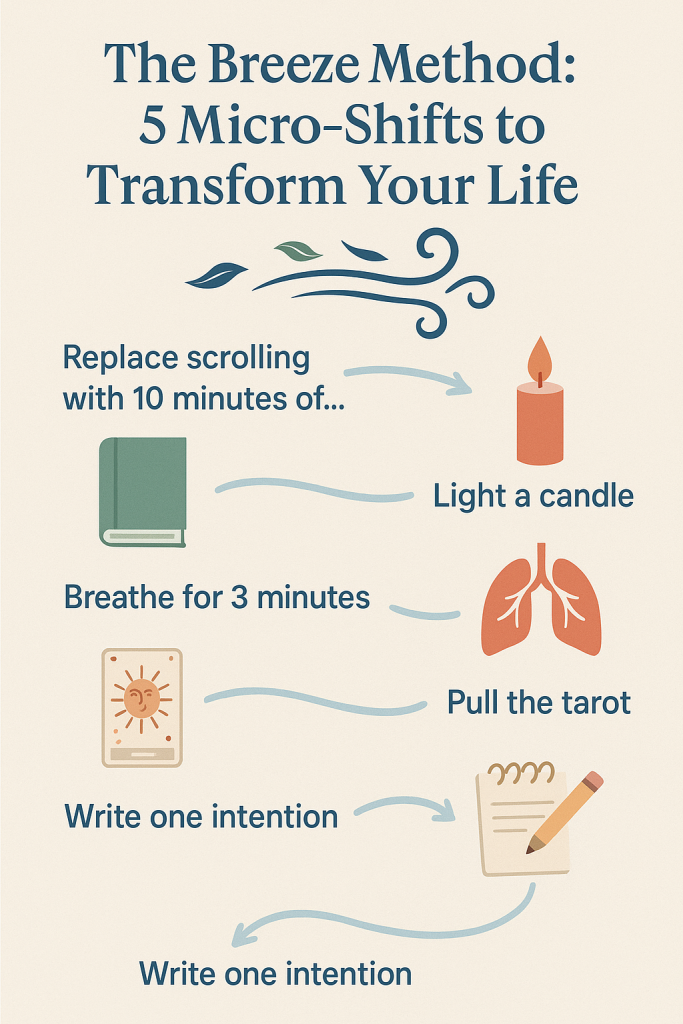
Think of a breeze as a little movement in a room that has felt still. A brief pause, a journal line or a card image can help you notice a choice you have been overlooking. Make the next step manageable enough to begin. A battery candle is a simple option when you want gentle light without an open flame.
- Replace ten minutes of scrolling with a short walk or journal entry.
- Prepare one healthy meal component rather than overhauling your entire diet.
- Send one job application rather than planning an entire career change in one evening.
- Schedule one difficult conversation instead of rehearsing it for weeks.
Do Not Use “Feeling Light” as Proof
A choice that feels exciting or relieving is not necessarily the safest or best choice. Likewise, a worthwhile choice can feel uncomfortable because it involves uncertainty, effort or grief.
Evaluate changes by what actually happens over time: sleep, mood, finances, deadlines, relationship behavior, health indicators, completed work or other relevant outcomes.
Synchronicities Can Be Meaningful Without Being Instructions
Repeating numbers, meaningful songs, chance encounters and vivid dreams can feel personally important. They do not objectively confirm that a decision is correct.
If a coincidence inspires reflection, ask what it reminds you to consider. Then return to the facts of the situation.
Symbolic Release Rituals
Some people use unsent letters, cord-cutting visualizations, candles or other rituals to mark a transition. These can function as symbolic acts of closure.
A ritual does not remove a literal energetic bond or guarantee emotional recovery. Pair symbolic release with practical steps such as reducing unwanted contact, changing routines, seeking support and rebuilding activities that belong to you.
When a Major Change Follows a Loss
Breakups, layoffs, moves and other disruptions can eventually lead to growth, but that does not mean the loss was “meant to happen” or automatically beneficial.
Allow room for grief and uncertainty. Positive change can come later without rewriting every painful event as destiny.
Community and Support
Friends, mentors, counselors, support groups and professional advisers can provide perspective and accountability. A psychic reading may also be used for optional reflection if that is meaningful to you.
A reader should not diagnose hidden trauma, guarantee that a career move will work, or claim that your aura proves why you are stuck.
Keep, Adjust or Put It Back
After you use the change, ask what became easier. If moving an item made someone else’s routine harder, agree on a better place. If the first step exposed a larger problem, decide what information or support you need next.
You can undo an unhelpful adjustment without calling the experiment a failure. For an ongoing routine, move to a habit plan; for a major transition after a loss or move, use the starting-over guide.
Final Thoughts
You do not need a dramatic reinvention to move your life in a better direction. Choose one area, make the next action concrete, repeat it long enough to learn from it, and adjust when the evidence tells you to.
Evidence note: A real-world habit-formation study found that automaticity developed gradually and at very different rates across participants and behaviors. Repetition in a consistent context matters more than a universal transformation deadline.
Spiritual practices can add meaning and reflection. Your choices, habits, resources, relationships and real-world feedback are what turn reflection into change.
Frequently Asked Questions
1. Can one small habit really make a difference?
Yes. Small actions can accumulate when they are repeated consistently, although no single habit guarantees a major life change.
2. Can tarot help with personal growth?
It can provide reflection prompts and symbolic language. It should not be treated as objective proof about your future.
3. Should I trust my intuition when making a big decision?
Use intuition as one input. For high-stakes decisions, compare it with facts, consequences and qualified advice.
4. Do repeating numbers mean I am on the right path?
No objective test shows that repeating numbers confirm a decision. You can still use them as personal reflection prompts.
5. Can a psychic reveal the hidden reason I am stuck?
A reader may offer an interpretation, but that is not a diagnosis or verified explanation.
6. What is the safest way to make a major change?
Break it into concrete steps, assess risks, use appropriate professional guidance where needed and review what happens over time.
7. Can rituals help after a breakup or transition?
They may provide symbolic closure. Practical boundaries and support still matter.
8. What if my change does not feel easy?
Difficulty does not mean a choice is wrong. Many worthwhile changes involve effort, uncertainty and adjustment.
Related guide: For larger transitions, see Starting Over After a Big Life Change: Practical Steps.


