
Being fired can be financially stressful and emotionally disorienting. Even when you expected the decision, losing a job can affect routine, confidence, professional identity and plans you assumed would continue.
You do not need to call the firing a blessing, karmic lesson or message from the universe in order to recover from it. Start with the immediate facts, stabilize what you can and then decide what you want to build next.
First: Separate the Event From Your Worth
A firing can happen because of performance, fit, restructuring, conflict, policy violations, management decisions or many other factors. The reason matters, but none of those automatically defines your total ability or future value.
Give yourself permission to feel embarrassed, angry, relieved, sad or uncertain without turning the event into a verdict on who you are.
Handle the Immediate Practical Tasks
Before trying to “think positive,” deal with the information that affects your next few weeks.
- Save copies of documents you are entitled to keep.
- Confirm final-pay details and return-of-property requirements.
- Review health insurance, benefits or other coverage changes.
- Check the unemployment or employment-insurance rules that apply where you live.
- Update your personal budget based on the new income situation.
- Write down important dates and contacts while the information is fresh.
If there is a dispute about discrimination, retaliation, unpaid wages, a contract or another legal right, use appropriate professional or government resources rather than a psychic interpretation.
Do Not Force a Positive Story Too Quickly
Some job losses eventually lead to better opportunities. Others are simply painful disruptions. You do not have to decide immediately that the universe “redirected” you for a reason.
A more realistic thought is: “I do not know yet what this will lead to, but I can influence what I do next.”
Review What Happened Without Self-Attack
When the initial shock settles, ask what information from the experience is useful.
- Was the role a poor fit?
- Were expectations unclear?
- Did you receive repeated feedback you ignored?
- Was the organization unstable?
- Did conflict with a manager become unmanageable?
- Were you undertrained or overextended?
- Is there a skill you want to improve before the next role?
The goal is learning, not proving that everything was your fault.
Preserved Guide: Turning Fired Into Fired-Up
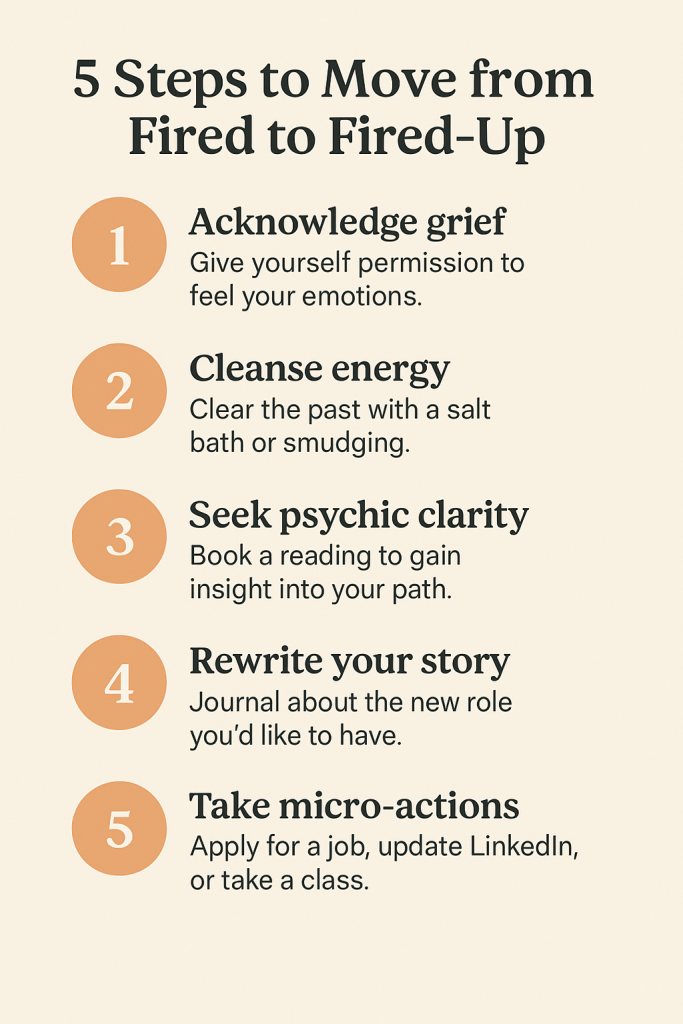
This infographic can still work as a recovery checklist when read practically. Use emotional processing and reflection alongside concrete actions such as budgeting, updating professional materials and contacting people in your network.
Rebuild Confidence With Evidence
Confidence after job loss is easier to rebuild through action than through grand affirmations.
Make an evidence list:
- Projects you completed.
- Problems you solved.
- Skills you developed.
- Positive feedback you received.
- Metrics you can document.
- Responsibilities you handled well.
This material is useful for both self-confidence and future interviews.
Update Your Résumé and Online Profiles
Refresh your résumé while recent projects and accomplishments are easy to remember. Focus on specific contributions rather than only listing duties.
Also review professional profiles, portfolio materials and contact information. If appropriate, ask former colleagues who know your work whether they would be comfortable serving as references.
Decide Whether You Want the Same Kind of Role
Job loss can create a useful decision point. You may want another version of the same job, or you may realize the role no longer fits your priorities.
Compare:
- Skills you want to keep using.
- Tasks you want less of.
- Income requirements.
- Schedule and location needs.
- Growth opportunities.
- Industries that interest you.
- Training required for a change.
Career reflection should include practical constraints as well as meaning.
Test Career Changes Before Making a Huge Leap
If you are considering a new field, gather evidence before spending heavily or abandoning a workable path.
- Talk with people doing the job.
- Take a short course.
- Try a freelance or volunteer project.
- Review real job postings and required qualifications.
- Compare typical compensation and working conditions.
Small tests can reveal whether an imagined career matches the real one.
Networking Does Not Have to Feel Transactional
You do not need to message everyone asking for a job. Tell trusted contacts what happened in a concise way and what kind of work you are exploring.
For example: “My role ended this week, and I’m starting to look at content-strategy positions in healthcare and education. If you hear of a team that needs that background, I’d appreciate the lead.”
Prepare a Short Interview Explanation
If a future employer asks why the job ended, answer honestly and briefly. Avoid blaming an entire former workplace or inventing a more flattering story.
Depending on the situation, you might explain what changed, what you learned and why the new role is a better fit.
Positive Thinking Should Stay Realistic
Useful optimism is not “Everything happens for a reason” or “This firing guarantees something better.” It is believing that useful action is still possible.
Try language such as:
- “This is difficult, and I can still take the next step.”
- “One job ending does not erase my skills.”
- “I can learn from this without defining myself by it.”
- “I do not need to know the whole future today.”
Spiritual Rituals Can Mark the Transition
If you enjoy prayer, tarot, meditation, crystals or symbolic release rituals, they can help you create a pause and reflect on what you want next.
Keep the role clear. A salt bath does not remove workplace “vibrations,” astrology cannot prove the firing was perfectly timed and tarot cannot guarantee which career will succeed.
A useful three-card reflection might ask:
- What did I learn from this role?
- What do I want to leave behind?
- What practical action deserves attention next?
A Psychic Reading Is Not Career Counseling or Financial Advice
A career reading can offer symbolic or intuitive reflection, but it should not determine whether you accept a job, take on debt, spend savings on retraining or make another high-stakes financial decision.
For clearer boundaries, see Career Psychic Readings: Questions, Limits & Practical Guidance.
Protect Your Routine During the Search
Unemployment can remove structure from the day. Create a modest routine rather than turning the job search into an all-day emergency.
- Set a regular wake time.
- Schedule focused job-search periods.
- Include exercise or movement you enjoy.
- Keep contact with supportive people.
- Leave room for rest and ordinary life.
Watch for Financial Panic
If money is tight, make a short-term plan based on essential expenses, available savings and legitimate benefits or support. Avoid making impulsive investments, gambling or expensive business decisions because a psychic, horoscope or “sign” says a breakthrough is coming.
When Emotional Distress Is Becoming Hard to Manage
Job loss can interact with depression, anxiety, sleep problems and existing stress. If distress is persistent or significantly affecting daily functioning, a qualified healthcare or mental-health professional may be appropriate.
Spiritual practices can coexist with professional care, but they should not replace it.
A 7-Day Recovery Start
- Day 1: collect documents and clarify immediate logistics.
- Day 2: update your budget.
- Day 3: list accomplishments and skills.
- Day 4: update your résumé and professional profile.
- Day 5: contact three trusted people.
- Day 6: research five realistic roles or paths.
- Day 7: review what you learned and choose next week’s priorities.
You can move more slowly if needed. The sequence is a structure, not a test.
Map the Next Career Step
When you are ready to move from recovery into a structured search, use Career Journey: Map Your Next Professional Move to compare current openings, transferable skills, training needs and low-risk experiments.
Final Thoughts
Being fired is not proof that you failed spiritually, outgrew a vibration or completed a karmic contract. It is a real career event with practical and emotional consequences.
Recover by handling the immediate facts, learning what is useful, protecting your finances and building evidence through small actions. If spiritual reflection helps you make meaning from the transition, keep it—but let your next career move be guided by reality as well as hope.
Practical source: The Consumer Financial Protection Bureau’s job-loss guide covers unemployment, health insurance, housing, bills, spending and credit. Eligibility and employment rights vary, so confirm current local rules.
Frequently Asked Questions
What should I do first after being fired?
Clarify final-pay, benefits, documentation and return-of-property requirements, then review your short-term budget and applicable unemployment rules.
Does being fired mean I was bad at my job?
Not necessarily. Reasons vary. Review the specific feedback and circumstances rather than making a global judgment about your ability.
How should I explain a firing in an interview?
Be honest, brief and focused on what you learned and why the new role is a better fit. Do not invent a different reason.
Should I change careers after being fired?
Only if the evidence supports it. Research and test a new field before making an expensive or irreversible transition.
Can tarot or astrology show my next career?
They can be used for reflection, but they cannot verify which career will succeed or replace practical research.
Can a psychic tell me why I was fired?
A reading cannot independently establish an employer’s motives. Use direct feedback, documentation and observable workplace facts.
How do I rebuild confidence?
Document your skills and past accomplishments, take small job-search actions and collect new evidence that you can move forward.