

Integrity as Value
Integrity is something that is valuable, but in a relationship, it is even deeper. It’s not just about being honest, but also about being accountable, consistent, and aligning your actions with your words. Integrity is one of the things that creates a strong foundation and creates a place of emotional safety, love, and connection.
When there is integrity, relationships can feel respectful, fulfilling, and secure. When there isn’t integrity, even a strong relationship can break down.
Integrity and Relationships
Integrity is defined as doing what you say you’ll do. When it has to do with relationships, it isn’t just about keeping promises, but also:
- Being responsible for the actions you take.
- Being aligned with your values.
- Being emotionally consistent.
- Following through when you commit to something.
This also means showing up in your relationships in ways that you say you will, and not just when things are easy, but you should show up when things are hard.
Integrity Creates a Foundation of Love
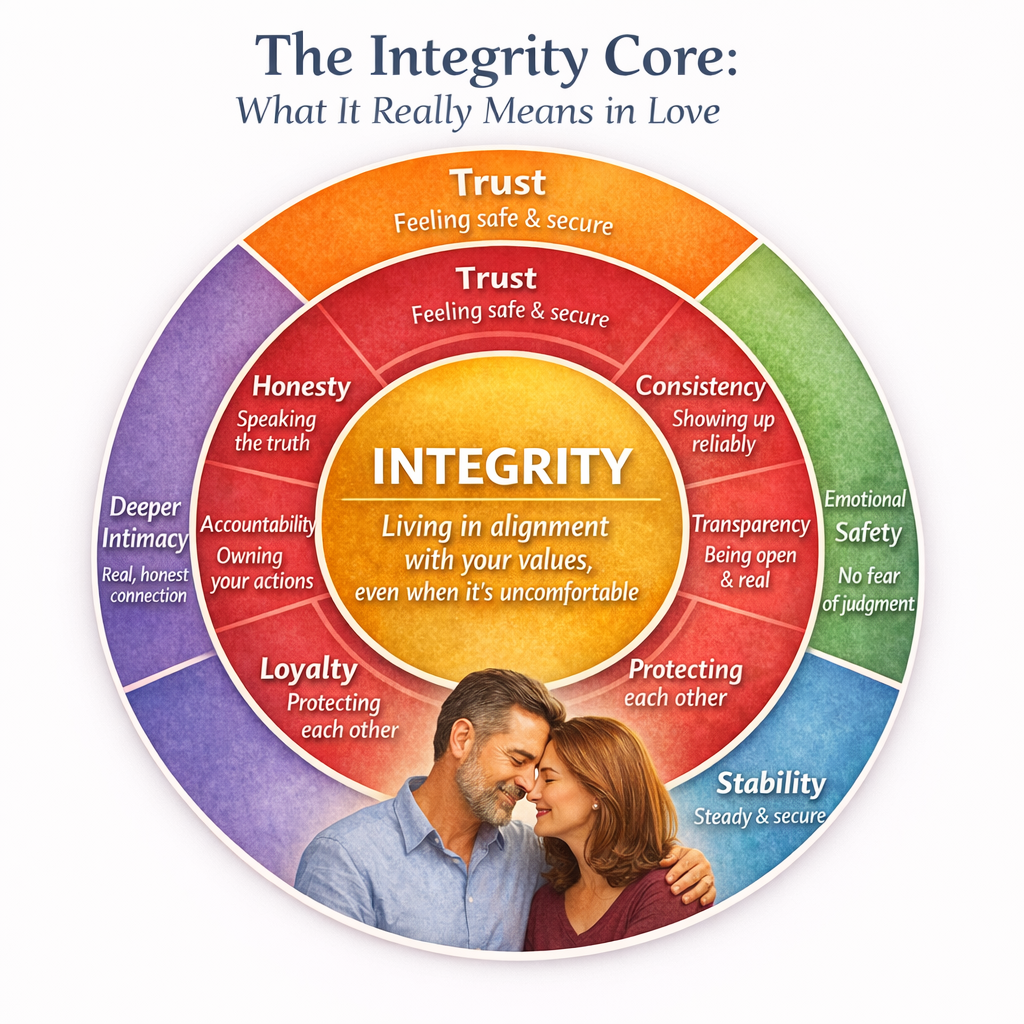
Some couples understand what it takes to make their relationships work, and they know that communication, kindness, and trust are very important, but they also know that these things alone aren’t enough. The real difference in a good relationship is action.
Knowing and Doing
Couples often know relationship dynamics that are healthy, but don’t always use them consistently. Others will take principles that are important and live by them. The difference between these two is integrity.
Integrity takes what you know and turns it into actionable behavior. It changes intention into something that is real and visible.
Integrity, Trust, and a Connection
Trust is not built through words alone. It is built through repeated, consistent actions over time. Here’s what happens when integrity is in a relationship:
- The relationship feels secure.
- Conflict is easy to resolve.
- Partners trust your actions and intentions.
- You believe in each other’s words.
- Both partners feel emotionally safe.
When there’s strong integrity in a relationship, even when there are challenges, they’re manageable because the foundation is built on trust.
What Happens When There’s No Integrity
Relationships don’t just fall apart because someone makes one mistake. It’s the small mistakes that are repeated that weaken and break the integrity of the relationship. Here is what broken integrity looks like:
- Justifying your actions instead of being responsible for them.
- Avoiding responsibility when you’re being hurtful.
- Making promises and not keeping them.
- Saying you’ll change but never following through.
As time goes on, these patterns can cause frustration, doubt, and emotional distance.
As Trust Erodes
When there isn’t integrity, trust doesn’t just leave at once, but it starts fading slowly. Each time you break a promise or you make an excuse, it eats away at the connection.
Soon, the partners might start to question both actions and intentions.
How Excuses Break Relationships
One of the biggest problems in relationships is making excuses. This erodes integrity. Excuses are harmful because they:
- Allow people to avoid responsibility.
- Don’t address the issues and just explain them away by saying things like:
- I didn’t have time.
- You made me act that way.
- It’s not that big of a deal, like you’re making it.
Even if these responses seem justified at the time, it stops growth in the relationship and create a place where things can’t be solved.
As time goes on, making repeated excuses takes away accountability, and this makes the relationship weaker.
Healthy Couples React Differently
The strongest relationships don’t mean that the couples are perfect because everyone makes mistakes. The difference is how the couples respond. Here are some traits of high-integrity couples:
- They do what they say.
- They own their mistakes.
- They don’t blame each other.
- They repair a conflict fast.
- They align their actions with their words.
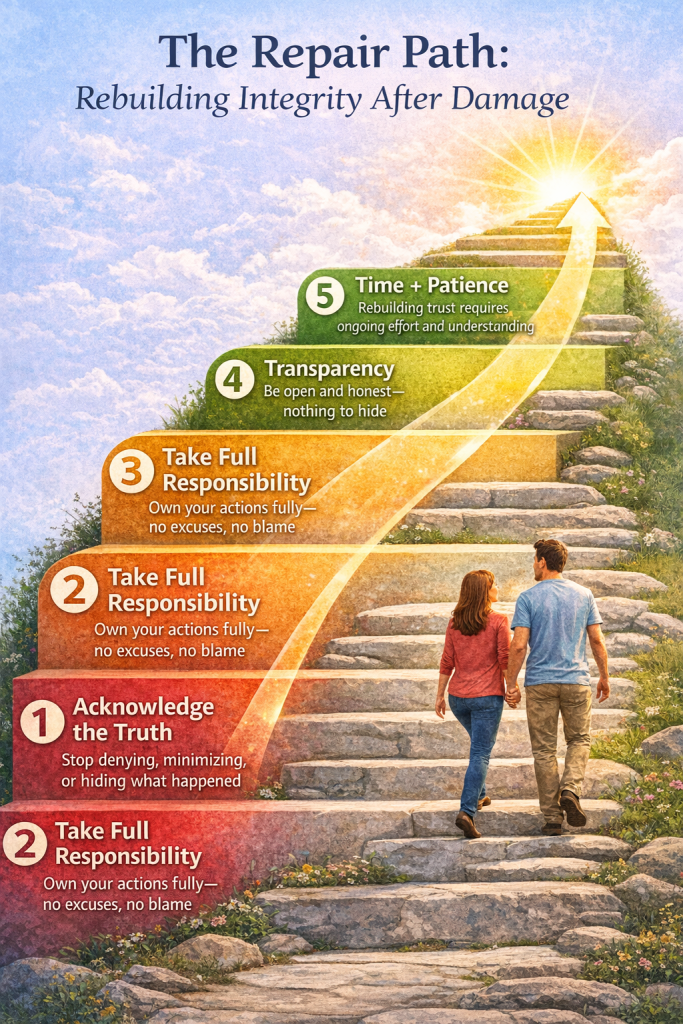
When they mess up, they don’t just defend themselves, but they acknowledge what they did, take responsibility, and fix it.
Owning Mistakes without Creating Blame
One of the best relationship skills is being able to take responsibility instead of shifting the blame to something or someone else. This looks like:
- Instead of saying, “I acted that way because of you,”
- You say: “I can now see how my actions affected you, and that’s on me.”
By taking responsibility, it builds trust, reduces defensiveness, and makes a place for real communication and a strong connection.
Integrity Builds Self-Confidence
Integrity doesn’t just make relationships better, but it also builds self-confidence. Integrity builds confidence because it:
- Allows you to trust yourself.
- It makes you more grounded.
- It reduces internal conflict.
- It helps you to develop a sense of identity.
As self-confidence grows, you can learn to rely more on yourself and follow through on what you say you will do.
Strengthening Integrity
Integrity isn’t something that you either have or you don’t have, but it’s something that you can strengthen. Here are some ways to improve integrity in yourself and your relationships:
- Make sure your actions align with your words.
- Be responsible quickly when you mess up.
- Follow through on even small commitments.
- Be honest about your limitations.
- Make fewer promises, but make sure you keep them all.
Being consistent in small actions and commitments will have long-term results in your life and your relationships.
Self-Reflection Exercise
Here is an easy self-reflection exercise to reflect on your relationship. Ask yourself:
- Where do my words and actions not align?
- Where am I making excuses instead of being responsible?
- What commitments have I made and not completed?
Pick one of these areas and see which ones you can improve on.
Final Thoughts: Integrity and Not Perfection
Integrity isn’t about being perfect because everyone falls short sometimes. What matters is how you act and respond when you do.
When you choose accountability and stop making excuses, when you’re consistent and set intentions, and when you take action instead of just talking, then you can create a relationship that is built on respect, trust, and connection.
As time goes on, it can create a stronger relationship that is full of emotional stability, confidence, and fulfillment.
Frequently Asked Questions
1. What does integrity mean in a relationship?
Integrity in a relationship means your actions match your words. It includes honesty, accountability, consistency, follow-through, and staying aligned with your values even when things feel difficult or uncomfortable.
2. Why is integrity so important in love?
Integrity helps create trust, emotional safety, respect, and stability. Without it, even strong feelings can weaken over time because love needs reliable behavior, not just good intentions.
3. Is integrity the same as honesty?
Not exactly. Honesty is part of integrity, but integrity is bigger. It also includes keeping promises, taking responsibility, being emotionally consistent, and doing what you say you will do.
4. How does integrity build trust between partners?
Trust grows when someone repeatedly follows through, tells the truth, owns mistakes, and acts in dependable ways over time. Integrity turns promises into something your partner can actually rely on.
5. Can a relationship survive without integrity?
A relationship may continue for a while without integrity, but it usually becomes more fragile. Repeated broken promises, excuses, and inconsistency often create doubt, resentment, and emotional distance.
6. What are signs of low integrity in a relationship?
Common signs include making promises and not keeping them, hiding important truths, blaming the other person, avoiding responsibility, saying change will happen without real effort, and acting differently when things get hard.
7. Do small broken promises really matter?
Yes. Small broken promises can slowly weaken trust because they send the message that your words are not dependable. Over time, the damage adds up and can affect the whole relationship.
8. How do excuses damage a relationship?
Excuses prevent real accountability. Instead of solving the issue, they often minimize hurt, shift blame, or avoid responsibility, which makes it harder for both partners to repair trust and move forward.
9. What is the difference between intention and integrity?
Intention is what you hope or plan to do. Integrity is what you actually do. A loving intention matters, but relationships become stronger when that intention is backed by visible and consistent action.
10. Can integrity be rebuilt after trust has been damaged?
Yes, but rebuilding integrity takes time. It usually starts with telling the truth, taking full responsibility, becoming more transparent, and following through consistently long enough for trust to feel safe again.
11. What should I do if I broke my partner’s trust?
Start by being honest about what happened. Avoid excuses, own your actions fully, listen to the impact on your partner, and focus on consistent changed behavior instead of asking for instant forgiveness.
12. What does accountability look like in a healthy relationship?
Accountability means owning your behavior without blaming stress, your partner, or outside circumstances. It sounds like, “I can see how I hurt you, and I take responsibility for that.”
13. Can someone love you and still lack integrity?
Yes. A person may have real feelings and still struggle with consistency, honesty, or responsibility. Love alone is not always enough to create a secure relationship if integrity is missing.
14. How can couples strengthen integrity together?
Couples can strengthen integrity by communicating clearly, making fewer promises they can actually keep, addressing problems early, being truthful about limitations, and repairing hurt instead of avoiding it.
15. What role does emotional consistency play in integrity?
Emotional consistency helps your partner feel safe. It means you do not only show care, patience, and reliability when life is easy, but also during stress, conflict, and disappointment.
16. Does integrity help with conflict resolution?
Yes. When integrity is present, conflict is usually easier to repair because both people are more likely to be truthful, responsible, and focused on solutions instead of excuses or blame.
17. How do I know if my words and actions are out of alignment?
You may notice that you often promise change but repeat the same behavior, avoid difficult conversations, or say one thing while acting in a way that causes confusion, disappointment, or mistrust.
18. Can integrity improve self-confidence too?
Yes. When you consistently act in line with your values, you trust yourself more. That can reduce inner conflict, strengthen your sense of identity, and make you feel more grounded in your choices.
19. What are simple ways to practice integrity every day?
Practice small acts of follow-through, admit mistakes quickly, be honest when you cannot do something, avoid overpromising, and check whether your behavior reflects the kind of partner you want to be.
20. Is integrity about being perfect?
No. Integrity is not perfection. It is about how you respond when you fall short. A person with integrity admits mistakes, takes responsibility, and works to repair the damage instead of defending it.




I loved the straightforward advice here. It’s nice to see that being honest and doing what you promise actually works. Saying ‘I messed up’ and fixing it makes a big difference, and showing up when it’s tough builds real trust. Simple actions add up. 🙂
This resonates so much. The distinction between intention and integrity is simple but profound: wanting to be better is not enough without follow-through. I liked the self-reflection prompts — they make the ideas practical and doable. Small consistent acts really rebuild trust over time. 🌱
This was clear and kind. I like the part about showing up when things are hard because that feels safe. Saying sorry and fixing things is better than hiding. Keeping small promises every day really helps people trust each other more. 😊
Thank you for such a thoughtful piece. It reminds me that integrity is an active practice — not just a label we apply to ourselves. I appreciate the practical tips about fewer promises and honest limits; those small changes are often the most transformative for long-term trust. 💬❤️
I really liked this article because it explains how doing what you say builds trust. Small promises kept day after day make a big difference, and owning your mistakes helps love grow. Simple habits and honest talk can change a relationship for the better. 🙂
A very cogent exploration of how integrity operates within intimate partnerships. The article persuasively links behavioral consistency to attachment security and provides actionable strategies to cultivate accountability. Emphasizing repair, transparency, and measured commitments offers a reliable roadmap for couples seeking sustained emotional reliability. Well articulated and useful. 👍
This piece on integrity is truly insightful. The way it ties consistent action to emotional safety is compelling; it reminds me that trust isn’t theoretical but phenomenological, built by repeated small reparative acts. Practically, I appreciate the emphasis on responsibility and measurable follow-through — concrete habits matter more than noble intentions. 🌟
This article is a powerful reminder that character in relationships is proven through steady, honest behavior. I particularly liked the emphasis on repair and accountability as mechanisms for restoring trust. Practicing transparency, limiting promises, and consistent follow-through over time create resilience and deeper connection. Thank you for this clarity. 🌿
Really helpful breakdown — especially the part about excuses slowly eroding trust. I plan to start with the suggestion to make fewer promises and follow through on small ones. That seems manageable and likely to change how secure a relationship feels, day to day. 🍩
Such a warm and useful read! I appreciate the reminder that small daily commitments are the building blocks of trust. Owning mistakes quickly and simply saying what you can actually do helps relationships grow stronger. Cute, kind, and full of good advice. 💖