

When you’re trying to control your partner, it often doesn’t look like control at first, but it appears as helping and supporting, or as trying to save the relationship from falling apart. Sometimes these behaviors do come from fear of loss, care, or a desire to keep the connection alive. The problem is that, as time goes on, this can create imbalance, pressure, and emotional exhaustion for both partners.
Learning to change from controlling others to being responsible for your own happiness is one of the best changes you can make in a relationship. This change helps reduce tension and creates a place for mutual respect, emotional independence, and a real connection where both partners feel free instead of controlled.
Seeing Hidden Control
Here are some ways that controlling might be hidden:
When Helping Becomes a Form of Control
There are some people who try to control their partner’s life in subtle ways without even realizing it. This can sound like:
- I’ll do it because it’s easier that way.
- If I don’t handle it, you won’t get it done.
- I don’t want them to have to deal with the consequences of this.
At first, these things might feel like you are supporting your partner, but as time goes on, they can change the balance of the relationship. One of the partners will start to take on more responsibility, and the other will become less accountable and engaged. This change in the dynamics can take away equality in the relationship.
As this continues, it can lead to burnout, frustration, and even resentment. The one taking on more responsibilities might feel underappreciated, while the other partner feels controlled or that they’re incapable of doing things on their own. What started out as just helping can turn into a place where distance is created instead of a connection.
Controlling Outcomes
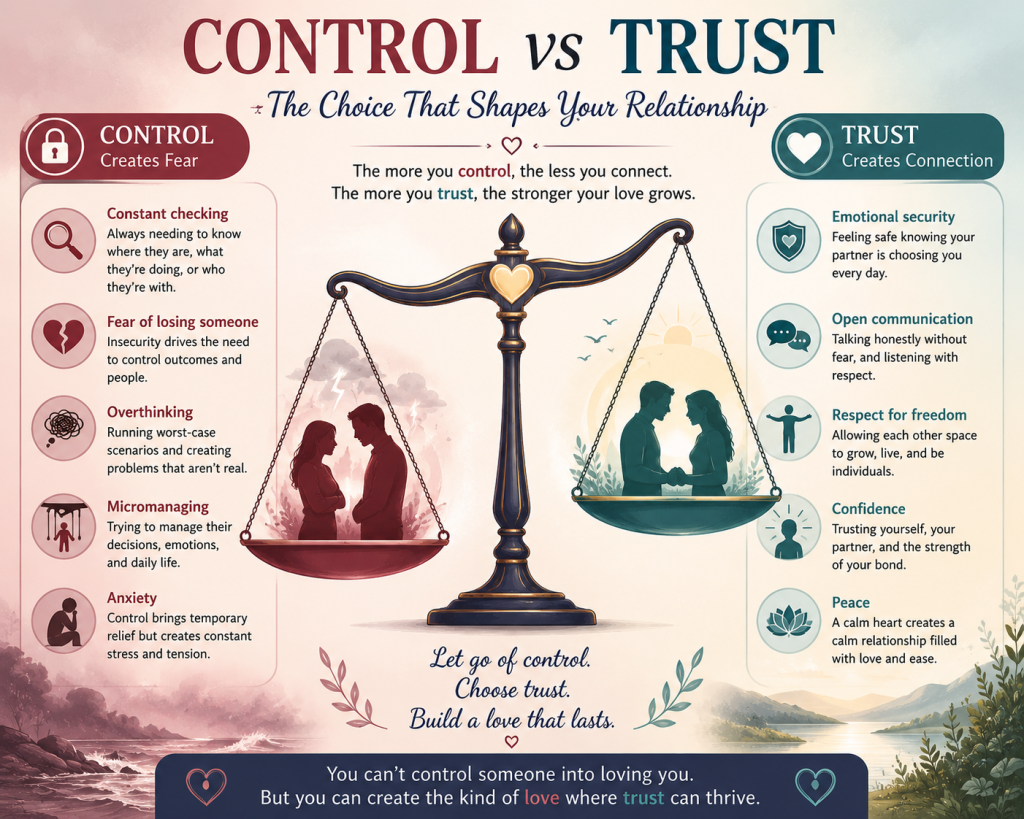
Most of the time, when people try to control the outcomes in a relationship, this is driven by fear: fear of uncertainty, fear of emotional discomfort, or fear of losing the relationship.
Some believe that if they try harder, make better plans, or manage the situations better, then they can create a predictable outcome of what’s going to happen. You have to remember that relationships involve two independent individuals, and no amount of effort can control the other person’s decisions or their feelings.
It’s important to realize that control can be an illusion and can feel unsettling because it brings up anxiety and vulnerability. This also opens a door to a healthier mindset where you can focus on what you can influence and what you cannot.
Why People Control Their Partners
Here are some reasons people want to try to control their partners:
Fear of Loss
Control often comes from a fear of losing the connection with a partner. When your emotional stability feels tied to how your partner is behaving, it is easy to try to manage or influence their behavior. This can look like:
- Always monitoring how your partner responds.
- Trying to fix things before they get out of control.
- Feeling responsible for keeping the relationship going.
The more someone has fear, the more intense their urge to control will be. By recognizing this pattern, you can move forward towards change.
External Focus Vs. Internal Responsibility
When you put all your attention on changing your partner, it takes away from your own growth and your own self-awareness. Instead of asking these questions:
- What do I need right now?
- How can I take care of myself?
You find yourself asking these things:
- How can I get my partner to act differently?
Asking this question can lead to frustration because it puts you in a sense of control outside of yourself. When you bring the focus back inward to your own self, it can restore clarity and balance.
Common Controlling Behaviors
Here are some common controlling behaviors to look out for:
Taking Over Your Partner’s Responsibilities
Doing things that your partner is able to handle on their own might seem helpful, but it also takes away their opportunity to take ownership of their own life.
As time goes on, doing this can lead to dependency and reduce their ability and motivation to be responsible for their own life and their own actions.
Stopping Consequences
Protecting your partner from the consequences of their own behavior might unintentionally enable patterns that need to be changed.
When someone experiences consequences for their actions, it’s what helps to motivate growth. Without these consequences, change is less likely.
Hidden Boundaries
Not all boundaries are genuine and helpful boundaries, and sometimes what appears to be a boundary is actually an attempt to be in control.
A real boundary is about protecting your own well-being and not forcing someone else to behave in a different way. This requires consistent follow-through.
Fixing or Changing Your Partner
Growth has to come from inside someone, and even though you can offer to support them, you shouldn’t take responsibility for someone else’s personal development. Trying to force them to change can lead to frustration and resistance from both partners.
Falling Into Patterns to Get a Reaction
When your emotional needs aren’t being met, it’s easy to fall into patterns that are meant to get a reaction, even if you don’t realize you’re doing it. These can look like:
- Pulling away and not communicating.
- Trying to make your partner jealous.
- Saying things you don’t fully mean just to get attention.
The intention behind these behaviors is usually connection. You want to feel seen, heard, or cared about. But instead of bringing you closer, they often create confusion, tension, and distance.
Wanting Support from Your Partner
It’s completely normal to want support from your partner. That’s part of being in a relationship. But when your emotional state fully depends on them, it can start to feel overwhelming, for both of you.
Support should be something you share, not something one person carries alone. Learning how to manage your own emotions creates balance and takes pressure off the relationship.
Knowing When You’re in Control
Things start to feel different when you understand what’s actually in your control.
You have control over:
- How you respond to situations.
- The boundaries you set.
- The choices you make.
You don’t have control over:
- What your partner thinks or feels.
- How they act.
- Whether they decide to change.
Once you accept that, it becomes easier to stop overthinking and start focusing on what you can actually change.
Letting Go of Control in a Healthy Way
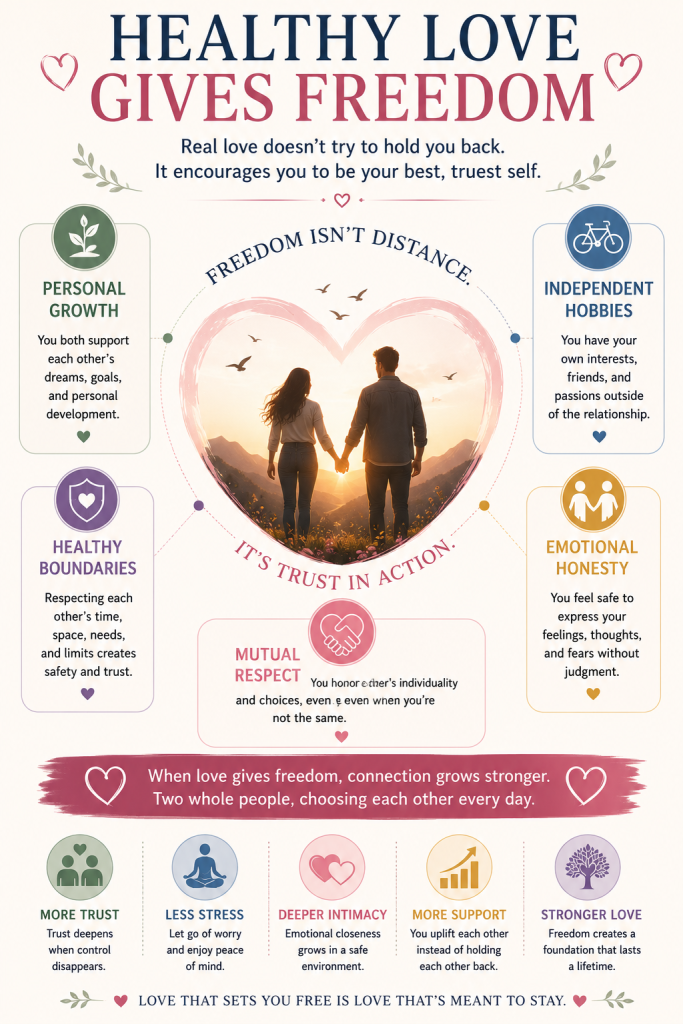
Here are some ways to let go of control in a healthy way:
Focus On Yourself and Not Your Partner
When everything feels off in a relationship, it’s easy to focus only on your partner.
Instead, try shifting your attention back to:
- Your own growth.
- Your interests.
- Your overall well-being.
This helps you feel more grounded and less dependent on what your partner is doing.
Ask Before You Try to Fix Things
Sometimes we jump in to fix things without checking if the other person even wants help.
Try asking:
- “Do you want my help with this?”
Respecting their answer, even if it’s no, helps to build trust and gives them space to handle things their own way.
Take Time to Pause Before Reacting
When emotions get intense, it helps to pause and settle yourself before reaching outward. This might look like:
- Taking a moment to breathe.
- Give yourself time to think.
- Sitting with your feelings instead of reacting immediately.
This creates emotional strength and reduces the need to rely on someone else to fix how you feel.
Be Honest About Your Partner
If your partner is clear about not wanting to change something, it’s important to take that seriously. Instead of trying to push or convince them, ask yourself:
- Can I accept this as it is?
This helps you make decisions based on reality, not hope.
Figure Out What Matters in the Relationship
Take time to figure out what truly matters to you in a relationship.
Think about:
- What you’re willing to accept.
- What you’re not willing to compromise on.
This creates clarity and helps you move forward with confidence.
Setting Boundaries to Protect Your Emotional Space
Boundaries help protect your time, energy, and emotional space.
That means:
- Saying what you’re okay with.
- Following through when something crosses a line.
- Staying consistent, even when it feels uncomfortable.
Boundaries don’t push people away, but they help to create structure and balance. Trying to control situations or reactions usually comes from wanting to feel secure and connected.
But real connection doesn’t come from control, but it comes from understanding, balance, and personal responsibility.
When you focus on what you can control and allow your partner to do the same, the relationship starts to feel less stressful and more stable.
Letting Go and Getting Free
Letting go of control doesn’t mean that you’re giving up; it means that you’re changing to a healthy and balanced way of relating to other people. When you let go of the need to control, you:
- Reduce emotional pressure.
- Create a space for a genuine connection.
- Regain time and energy.
- Strengthen your sense of self.
Instead of trying to force the outcome, you allow the relationship to move forward naturally.
Building a Healthy Relationship
Healthy relationships are based on shared responsibility where each partner:
- Manages their own emotions.
- Respects each other’s independence.
- Communicates honestly and openly.
- Supports growth without being controlling.
By doing these things, you create a dynamic where both partners feel supported, respected, and free to be who they are.
Final Thoughts: Letting Go of Control
Sometimes when you try to control your partner, it comes from a place of fear or care, but it doesn’t usually have the outcome that you want. The strength of a real relationship comes from being responsible for your own happiness, setting boundaries, and letting your partner do the same.
When you change your focus to yourself, you improve your relationship and create a grounded and stronger version of who you are.
FAQ
1. What does letting go of control mean in a relationship?
Letting go of control means releasing the need to manage your partner’s choices, feelings, timing, or behavior and choosing trust, communication, and emotional balance instead.
2. Why do people try to control relationships?
People may try to control relationships because of fear, insecurity, past betrayal, anxiety, low self-worth, or a desire to avoid uncertainty.
3. Can control damage a relationship?
Yes. Control can create tension, resentment, emotional distance, fear, and conflict, even when the controlling partner believes they are trying to protect the relationship.
4. What is the difference between control and care?
Care supports your partner’s well-being and freedom. Control pressures, monitors, or limits your partner in order to reduce your own fear.
5. How does trust improve a relationship?
Trust helps both partners feel safer, calmer, more respected, and more emotionally connected without needing constant proof or reassurance.
6. What are signs I may be too controlling?
Signs may include checking on your partner constantly, overanalyzing messages, needing immediate replies, making demands, or feeling anxious when you cannot manage the outcome.
7. What can I control in a relationship?
You can control your reactions, communication style, boundaries, honesty, emotional growth, and willingness to listen and repair conflict.
8. What can’t I control in a relationship?
You cannot control your partner’s thoughts, feelings, choices, healing process, timing, or whether they respond exactly the way you want.
9. How do I stop overthinking my relationship?
Start by slowing down, breathing, checking whether you have facts or fears, journaling your thoughts, and communicating calmly instead of reacting quickly.
10. Does letting go mean I stop caring?
No. Letting go does not mean you stop caring. It means you stop trying to force outcomes and begin choosing healthier trust and emotional balance.
11. How can I build trust instead of control?
You can build trust by being honest, respecting boundaries, keeping promises, listening carefully, giving space, and talking openly about fears.
12. Why is freedom important in love?
Freedom allows both partners to grow, maintain individuality, enjoy healthy independence, and choose the relationship from love instead of pressure.
13. What are healthy boundaries in a relationship?
Healthy boundaries are clear limits around time, privacy, communication, emotional needs, friendships, and personal space that help both partners feel respected.
14. Can a controlling relationship become healthy?
It can improve if both partners recognize the pattern, take responsibility, respect boundaries, and commit to healthier communication and behavior.
15. What should I do if my partner is controlling?
Start by naming the behavior calmly, setting clear boundaries, seeking support, and paying attention to whether your partner respects your limits.
16. Is needing reassurance always controlling?
No. Reassurance is normal in relationships. It becomes unhealthy when it turns into constant demands, monitoring, accusations, or pressure.
17. How does control affect emotional intimacy?
Control often makes emotional intimacy harder because one partner may feel judged, trapped, mistrusted, or afraid to be honest.
18. What daily practices help release control?
Helpful practices include journaling, deep breathing, meditation, honest communication, self-care, emotional regulation, and accepting uncertainty.
19. How do you know love is based on trust?
Love based on trust feels safe, respectful, honest, calm, and supportive. Both partners can be close without losing their independence.
20. What is the first step to letting go of control?
The first step is noticing when fear is driving your behavior, then pausing before reacting and choosing a calmer, more honest response.




Wow, this really opened my eyes. I used to step in and do things because it seemed easier, but reading this helped me see how that can make my partner feel less able. I want to try asking before helping and focus on my own growth. Thanks for the clear advice! 😊
Great article — it frames controlling behaviors in a way that feels compassionate rather than blaming. I appreciate the practical tips like pausing before reacting and asking before fixing. Those small shifts can rebuild equality and trust in a relationship. I’m bookmarking this to revisit when I need a reminder. 👍
This piece articulates an essential psychological dynamic with clarity: the transition from externally directed control to internal responsibility is both an ethical and therapeutic turn. Emphasizing boundaries, consequences, and self-regulation fosters autonomy and mutual respect, which are the foundations of durable intimacy. I found the guidance both humane and actionable. 🌱
This resonates so much — recognizing hidden control is empowering because it shows a path forward. I appreciate the suggestions about setting real boundaries and focusing inward; those moves help reduce resentment and build shared responsibility. Small habits like pausing before reacting are practical and surprisingly transformative over time. Thank you for sharing. 🙏
The article captures a nuanced therapeutic truth: control often masquerades as care, and unraveling that pattern requires self-reflection and sustained practice. By differentiating support from taking over, partners can cultivate growth-oriented accountability. The recommendations on consequences and honest acceptance are especially useful for clinicians and lay readers alike. 🌿
This read like a concise primer on relational autonomy; it insightfully articulates how ostensibly benevolent interventions can erode agency and foster dependency. The practical prescriptions — cultivate self-care, enforce consistent boundaries, pause before reacting — align with evidence-based approaches for promoting secure interdependence and sustainable intimacy. Gratitude for this clear, humane roadmap. 🙌
Nice post. It reminded me that trying to fix everything can make my partner feel pushed around. I will try to step back and ask if help is wanted, and let them handle things more. Hope this makes our home calmer and happier. 😊
As someone juggling work and relationships, this felt very practical. The reminder to ask before fixing and to focus on internal happiness are small but powerful shifts. I’m going to try a weekly check-in with my partner to clarify needs and keep responsibilities balanced. Thanks for such accessible guidance! 🙂
This is an articulate synthesis of attachment-informed relationship dynamics; it deftly links behavioral patterns of over-helping and outcome-control to underlying anxieties about loss, while offering pragmatic interventions rooted in boundary-setting and self-responsibility. Implementing such changes demands both skillful communication and emotional literacy, but the resulting relational autonomy can be profoundly liberating. ✨
I liked this a lot. It helped me think about stepping back instead of doing everything for someone else. I will try asking if help is wanted and let my partner try on their own. It feels nice to imagine less pressure and more freedom. 😊
I’m glad someone wrote about this clearly. It is easy to help all the time and not realize we are taking away chances for our partner to grow. The tips about stopping consequences and saying no when needed feel doable and caring at the same time. 😊
Really helpful breakdown of subtle control tactics. I especially value the suggestion to turn attention inward and ask what you need, rather than trying to orchestrate your partner. That mindset shift reduces anxiety and creates room for authentic connection and shared growth. I’ll share this with a friend. 💬
Powerful, empathetic advice here. The distinction between protective support and covert control is essential; without that clarity, patterns of resentment and dependency quietly calcify. I appreciate the emphasis on consequences and self-regulation as mechanisms for true change — they encourage autonomy rather than compliance, which ultimately deepens intimacy. Well said. 🌟
This made me think about how I jump in to save time but end up making things harder long term. I like the idea of pausing and asking first, and giving my partner space to fail and learn. It sounds kinder and more balanced. 😊