

Codependent relationships usually develop in a quiet way. They often come about because of past experiences, emotional patterns, and the way we learn to feel safe with other people. Even though these relationships can feel deeply connected, intense, and comforting, there is often a hidden imbalance that can affect both partners.
It’s important for you to understand what codependency looks like and why it forms. This can help you see when there are unhealthy dynamics in the relationship that can change to a balanced, secure, and fulfilling relationship. Being aware is the first step, and once you are able to see these patterns, you can have the ability to change them.
Understanding Codependency
Codependency is a relational pattern where one or both partners become too focused on the other person’s emotions, needs, and behaviors. This is usually at the expense of their own well-being, emotional balance, and identity.
Instead of the partners supporting each other equally, the relationship becomes uneven. One partner might become the fixer, emotional manager, or caregiver, while the other partner becomes more reliant on that kind of support. As time goes on, this dynamic can become exhausting, even if at first it feels like devotion or love.
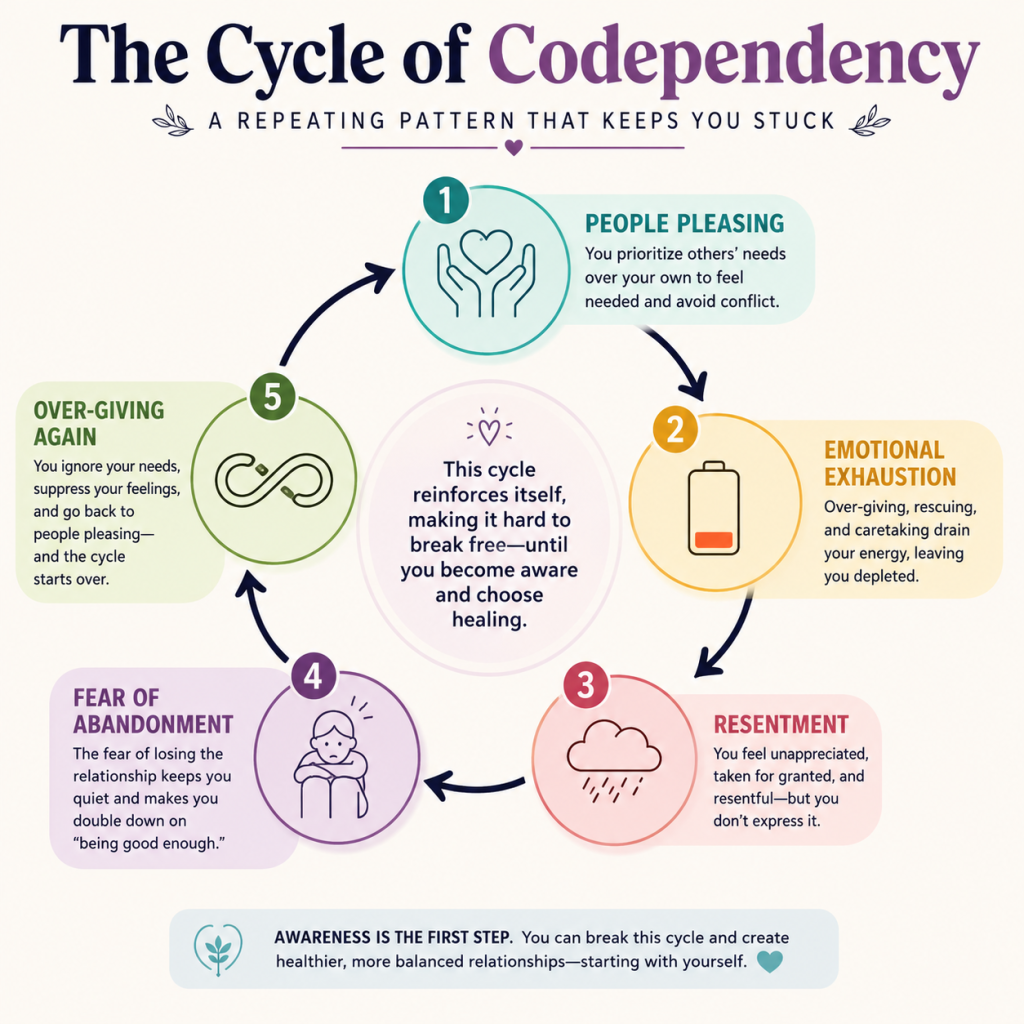
Signs of a Codependent Relationship
Codependency comes in a small and subtle way. These can be everyday behaviors that seem normal at first, but become a problem as time goes on. Here is what it can look like:
- Feeling the need to fix, rescue, or change your partner repeatedly.
- Focusing more on your partner’s problems than your own well-being.
- Sacrificing your needs and later feeling frustrated or resentful.
- Taking responsibility for your partner’s moods, choices, or outcomes.
- Having a hard time expressing, identifying, or putting your own needs first.
- Blurred emotional boundaries between you and your partner.
- Staying in unhealthy cycles even when wanting change.
- Pushing the relationship to go forward faster than you or your partner is ready.
Even though these patterns can feel like commitment or care, they can lead to imbalance, a loss of self, and emotional strain.
Losing Who You Are in the Relationship
One big characteristic of codependency is that you slowly start losing your personal identity. You might start putting your self-worth, emotional stability, and happiness in your partner. Whatever mood they have becomes your mood; whatever their problems are becomes your responsibility; and their approval becomes your validation.
As time goes on, this situation creates emotional instability because your well-being is no longer about who you are. It depends on something you can’t control: your partner’s emotions, behavior, or choices.
Why Codependency Happens
Codependency isn’t a weakness or a flaw, but it’s a learned survival guide. Many people develop these patterns early in their childhood as a way to avoid conflict, keep a connection, or feel safe when they are in unpredictable environments. If emotional stability depended on keeping others calm or happy, for example, you might have learned to put other people’s needs above your own.
This strategy might have been necessary at the time, and it may have helped create connections and lessen tension. As an adult, though, the same behaviors can lead to emotional exhaustion and imbalance.
Upbringing and Social Expectations
Family influences and culture play a big role in shaping codependent tendencies. You may have received messages such as:
- It’s your job to take care of others.
- Putting yourself first is selfish.
- Love means making sacrifices.
Sometimes people are encouraged, directly or indirectly, to take on caregiving roles even from a young age. As time goes on, this creates a belief that their value is based on how much they give instead of who they are.
These patterns can be reinforced by society’s expectations, especially when it comes to family dynamics, gender roles, and emotional expression.
The Need for Connection
Codependency is driven by a fundamental human need for connection. People are wired to make attachments and feel close to others and to belong. When this kind of connection feels unstable or uncertain, it’s natural to try to make it secure in any way possible.
For some, this means being overly aware of other people’s emotions, needs, and reactions. Even though this can create closeness at first, it can lead to imbalance and emotional strain over time.
Why Codependency Starts to Feel Like a Problem
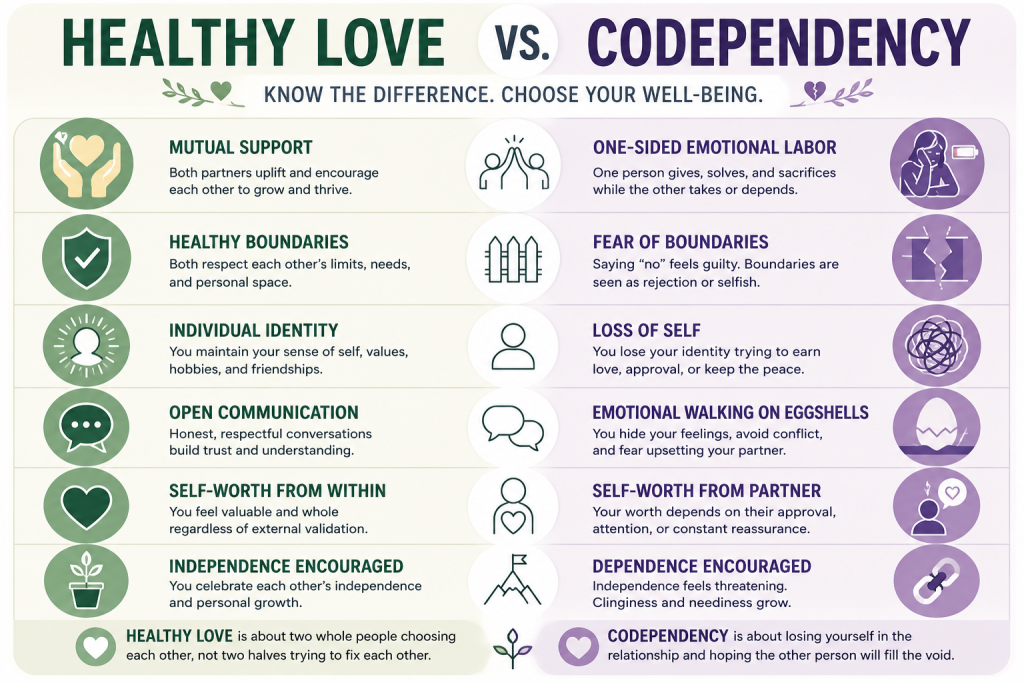
At first, some of these patterns can feel like love or closeness. But over time, they can start to wear on both people in the relationship. Codependency often leads to things like:
- Feeling resentful because your own needs aren’t being met.
- Emotional exhaustion from always giving more than you’re getting.
- Losing confidence and feeling unsure of who you are.
- Increased stress, anxiety, or feeling overwhelmed.
- Struggling to set or keep boundaries.
- Having the same arguments over and over without real resolution.
After a while, the relationship can start to feel more like a responsibility than a connection. What once felt close can begin to feel heavy or draining.
At the center of it is an imbalance. When one person is always giving, and the other is always receiving, the relationship can’t stay healthy long-term.
Changing the Patterns Together
Healing doesn’t mean everything has to change overnight. It usually starts with small, intentional shifts.
From Control to Awareness
When things feel tense, try pausing before reacting. Ask yourself these things:
- Am I trying to control this situation right now?
- What part of this is actually mine to handle?
This helps you step out of automatic reactions and respond more thoughtfully.
Saying What You Need
Instead of focusing on what your partner is doing wrong, bring the focus back to what you’re feeling. Clear communication:
- Reduces confusion.
- Helps your partner understand you better.
- Creates a chance for a more supportive response.
Setting Boundaries
Boundaries aren’t a bad thing, but they’re what keep relationships balanced. They help define things like:
- What you’re responsible for.
- What your partner is responsible for.
- Where your limits are.
Learning to say no when you need to and respecting each other’s space creates mutual respect.
Supporting Each Other without Taking Over
You can care about someone deeply without carrying everything for them. That means:
- Being there for them.
- Offering support when they need it.
- Letting them handle their own emotions and decisions.
This creates growth for both people instead of dependency.
Create a Place for Conversation
Instead of trying to fix everything, focus on understanding each other. You can ask things like:
- What are you feeling right now?
- What do you need from me in the moment?
- What feels hardest about this for you?
These kinds of conversations create connection instead of control.
How to Start Healing
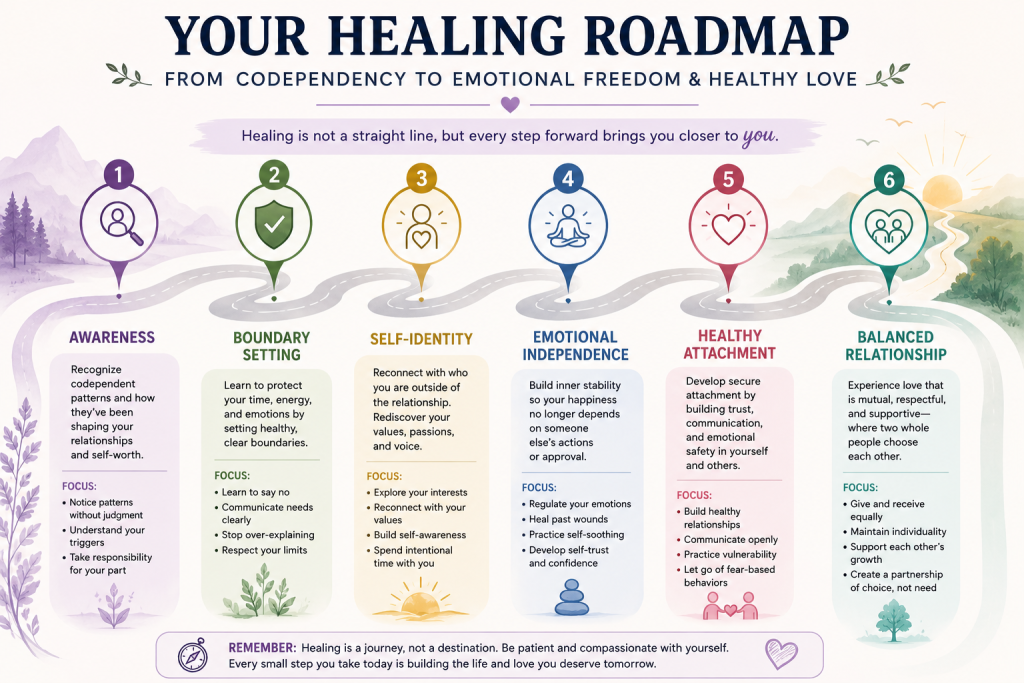
Here are some ways to start healing:
Reconnect With Yourself
One of the biggest parts of healing is remembering who you are outside of the relationship. That can look like:
- Getting back into things you enjoy.
- Spending time on your own without feeling guilty.
- Focusing on your personal goals again.
You are more than just your role in the relationship. Rebuilding that sense of self creates balance and helps you show up in a healthier way.
Putting Your Emotional Well-being First
When you are taking care of yourself, that doesn’t mean you are selfish, but that you are doing what is necessary to be in a healthy relationship. When you have emotional balance, you are able to show up for yourself and for your partner.
Healing Sometimes Requires Professional Support
Healing sometimes requires a different point of view, and this can include things like:
- Therapy.
- Counseling.
- Self-reflection.
- Support groups.
This isn’t about blaming yourself or your partner, but to understand how patterns are created and how to create healthy ones.
Healthy Interdependence
The goal isn’t to get rid of your connections but to change them for the better. Healthy relationships are built on interdependence, such as:
- Both partners are individuals.
- Both are supporting each other.
- Both feeling secure, both independently and together.
This creates a balanced and connected relationship.
Compassion and Healing
In order for there to be real change, there has to be compassion. Most codependent behaviors come from a place of desiring a connection, safety, and love. Instead of just judging yourself, though, you need to look at these patterns with understanding and curiosity.
Growth doesn’t come from being criticized, but it comes when you feel loved and supported.
Final Thoughts: Codependency Doesn’t Mean Shame
Being codependent doesn’t mean you should feel shame, but it’s something you need to understand and work through. By seeing and recognizing these patterns, setting boundaries, and focusing on both you and your partner, you can share growth and create a healthy and balanced relationship.
The goal isn’t to end your relationship, but to build it in a way that supports both you and your partner equally. Real connection happens when two people come together without losing themselves in the process.
Frequently Asked Questions
1. What is a codependent relationship?
A codependent relationship is a relationship where one person often loses their sense of self by focusing too much on another person’s needs, emotions, approval, or problems.
2. What are common signs of codependency?
Common signs include people-pleasing, fear of saying no, difficulty setting boundaries, feeling responsible for someone else’s happiness, and ignoring your own needs to keep peace.
3. Is codependency the same as caring too much?
No. Caring is healthy when it includes respect, balance, and personal boundaries. Codependency happens when caring turns into self-neglect, emotional dependence, or trying to control outcomes.
4. Can codependency happen in romantic relationships only?
No. Codependency can appear in romantic relationships, friendships, family dynamics, work relationships, and caregiver relationships.
5. What causes codependent behavior?
Codependent behavior can develop from childhood experiences, unstable relationships, emotional neglect, family addiction patterns, low self-worth, or learning that love must be earned through sacrifice.
6. Why is it hard to leave a codependent relationship?
It can be hard because the relationship may feel tied to your identity, safety, routine, or self-worth. Fear of abandonment, guilt, and hope that things will change can also keep the pattern going.
7. Can a codependent relationship become healthy?
Yes, it can become healthier if both people are willing to recognize the pattern, respect boundaries, communicate honestly, and take responsibility for their own emotions and choices.
8. What is the first step to healing from codependency?
The first step is awareness. Once you recognize the pattern, you can begin noticing your triggers, emotional habits, and the ways you may be abandoning yourself to keep the relationship stable.
9. How do boundaries help with codependency?
Boundaries help you protect your time, energy, emotions, and identity. They teach others how to treat you and help you stop taking responsibility for things that are not yours to carry.
10. Why do codependent people struggle to say no?
Many codependent people connect saying no with guilt, rejection, conflict, or abandonment. Healing involves learning that saying no can be an act of self-respect, not selfishness.
11. What does healthy love look like?
Healthy love includes mutual respect, emotional safety, honesty, independence, trust, shared effort, and room for both people to grow as individuals.
12. What is the difference between support and rescuing?
Support means caring for someone while allowing them to take responsibility for their own life. Rescuing means taking over, fixing, or sacrificing yourself to manage their emotions or problems.
13. Can codependency affect self-esteem?
Yes. Codependency often makes self-worth depend on being needed, approved of, or chosen by someone else. Healing helps you rebuild value from within.
14. How can I stop people-pleasing?
Start by pausing before saying yes, asking yourself what you truly want, practicing small boundaries, and reminding yourself that disappointing someone does not make you a bad person.
15. Is codependency a form of love addiction?
Codependency and love addiction can overlap, but they are not always the same. Both may involve emotional dependence, fear of abandonment, and difficulty feeling whole outside a relationship.
16. How do I know if I am healing from codependency?
You may notice that you say no more easily, feel less responsible for other people’s emotions, trust yourself more, communicate honestly, and make choices based on your needs instead of fear.
17. Can therapy help with codependency?
Yes. Therapy can help you understand the roots of codependent patterns, build healthier boundaries, improve self-worth, and learn more secure ways to relate to others.
18. What should I do if my partner does not respect my boundaries?
If your partner repeatedly ignores your boundaries, pay attention to their actions. Healthy relationships require respect, accountability, and willingness to change harmful patterns.
19. Can spiritual guidance help with codependency healing?
Spiritual guidance can help some people reflect on patterns, reconnect with intuition, and gain emotional clarity. It should support self-awareness, not replace professional mental health care when needed.
20. What is the goal of codependency recovery?
The goal is not to stop caring. The goal is to care without losing yourself, love without fear controlling you, and build relationships based on balance, respect, and emotional freedom.




Insightful and kind; I appreciated the focus on mutual responsibility rather than blaming one partner. For many couples, learning to name who owns which problem and practicing short, honest conversations about needs makes a surprising difference. The encouragement to pause before reacting and to ask what’s mine versus ours feels like a simple, repeatable habit that can restore balance and reduce resentment over time.
Con, your point about naming ownership of problems is so helpful and grounding. Practicing that language in calm moments can prevent bigger conflicts later and helps both partners feel seen. I’d also add gentle reminders to practice self-care rituals individually so each person keeps their sense of self. Small acts of self-kindness support the whole relationship. 🌷
What a hopeful and warm resource — it reminded me that small daily choices can rebuild balance in a relationship. Even something like scheduling five minutes of solo time or expressing one need clearly can start changing old patterns. The tone here encourages gentleness with yourself while pointing toward real, doable steps. Feeling encouraged to try one small thing today. ☀️
I found this article really eye-opening and comforting at the same time. It made me realize I was often putting someone else first and losing pieces of what I like to do. I plan to try one small personal activity each week and to practice saying a clear, kind no when I need space. It feels hopeful and manageable. 🌞
Reading this made me think about how I said yes to everything and forgot hobbies that mattered to me. It’s encouraging to realize I can practice saying no and schedule small things that are just mine without guilt. The idea of therapy and support groups also sounds like a good next step; I’m ready to try tiny changes and be kinder to myself. 🌱
Love your courage, Squirt — saying no is a real power move and such an act of self-respect. Keep trying those small boundaries and treat each one like practice, not perfection. You’ll find your rhythm and it will improve how you feel in the relationship. Proud of you for taking steps toward your own needs. ✊✨
Squirt, that awareness is huge — well done for noticing and wanting change. Taking tiny, consistent steps really builds confidence: a hobby hour, a boundary script, or a short talk with a therapist can shift things. Celebrate each attempt and reach out when it feels hard; community and gentle accountability help so much. You deserve balance and joy. 💖
This piece captures the developmental origins of codependency beautifully and frames it as adaptive behavior gone awry rather than moral failing. I especially value the practical interventions: increasing self-awareness, restoring boundaries, and seeking therapy or group work. Those approaches foster autonomy while preserving connection, and they encourage a science-informed, compassionate path toward healthier, mutual caregiving. 🌼
Such an important and hopeful read — boundaries can feel scary but they’re actually a loving act that protects both people. I appreciated the reminder that healing is not about blame but about curiosity and compassion, and that healthy interdependence means individuals grow together rather than getting lost. This gives me reassurance and ideas to try in my own relationship. ✨
This helped me notice how I used to make my partner’s mood the center of my day and forgot little things that made me happy. Reading this made me feel hopeful because I can try small steps, like an hour for myself or saying no when I need to. It feels kind to myself and our relationship when I do that. 😊
Carrot, I relate so much to what you described and I’m proud you see the change already. Small rituals like a short walk, journaling, or a phone-free hour helped me reclaim parts of myself too. Keep celebrating tiny wins and don’t hesitate to ask for support when you need it. You’re doing important work. 🌸
Thanks for such a practical overview — it feels like a gentle coaching session. I love the emphasis on pausing, asking what is actually mine, and naming needs aloud. Those tangible skills help people take back agency slowly and kindly. Encouraging couples to practice one small boundary at a time is a realistic way to start rebuilding balance. 🌿
A thoughtful, compassionate guide that balances psychological insight with practical steps. I value the reminder that codependency often arises from protective childhood strategies and that reclaiming identity requires patience, self-compassion, and structured practice. Interventions like boundary setting, reflective pauses, and professional therapy cultivate secure interdependence rather than enmeshment. This perspective honors both healing and relational connection. 🌱
This article lays out codependency in a clear, compassionate way and reminds readers that these patterns are learned responses rather than personal failures. I appreciate the practical steps toward awareness, boundary work, and professional support — small, consistent practices really change relational dynamics over time. Keep sharing resources like this; they make recovery feel possible and dignified. 💪