
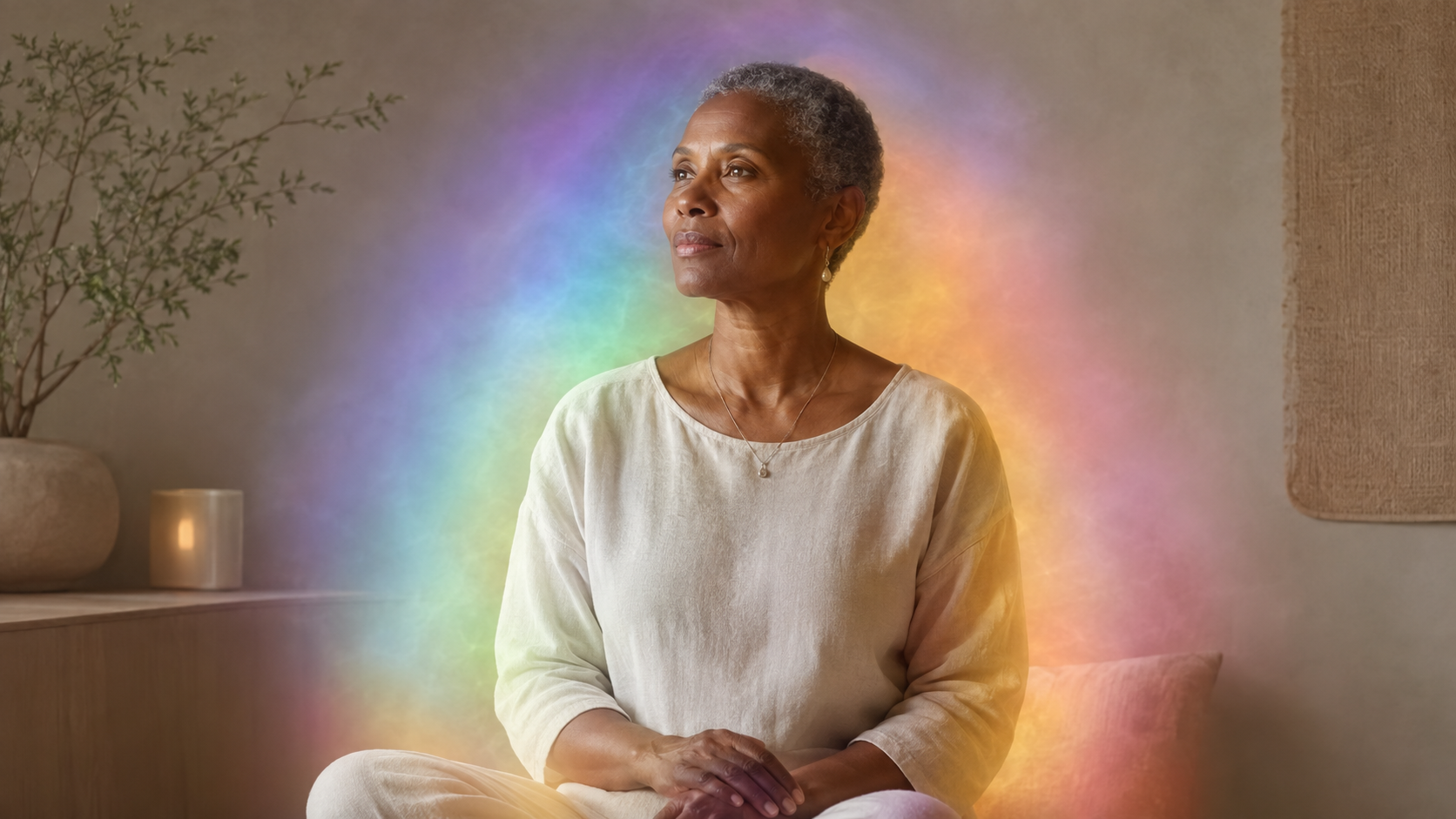
Aura Colors and Their Spiritual Meanings Explained
In the spiritual world, people often talk about auras as a field of energy that surrounds a person. Psychic readers often see the aura in colors, movement, light, or emotional impressions. An aura reading can give clues about someone’s mood, spiritual focus, strengths, and their personal growth.
You shouldn’t treat an aura color as a permanent label, and a person doesn’t have to have a certain color aura forever. Think of the aura as spiritual weather, where it can become softer, brighter, clouded, or layered temporarily as emotions and experiences change.
Why Aura Colors Can Change in People and Things
People often believe that aura colors can change based on your emotional and spiritual state. Things like stress, rest, creativity, relationships, meditation, and other things can influence the energy that others see around you.
One color might represent your underlying nature, while other shades show what’s happening at the moment in time. Someone with a blue aura might have a bright yellow aura when they’re learning something new.
Red Aura Meaning
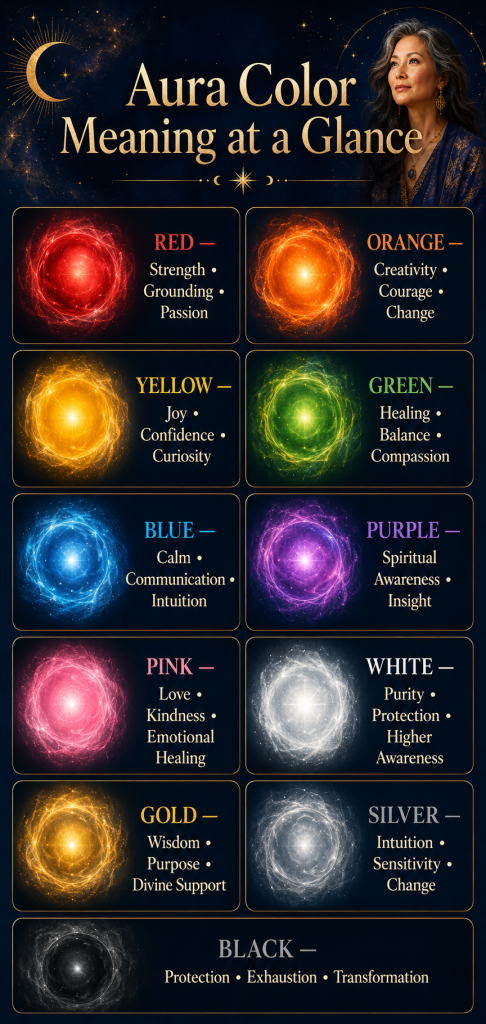
Red is a color that can be connected with energy, courage, determination, and security. A clear red aura can happen around someone who is ready to protect what matters most to them. A darker red aura doesn’t mean anger, but it can mean pressure, impatience, or a need to slow down and to be grounded. Taking time in nature, resting, and setting up routines can help to settle red energy.
Orange Aura Meaning
The color orange represents creativity, pleasure, emotional expression, and openness. It can be seen around people who start a new project, open up a talent, or become more confident.
A cloudy orange aura can mean creative frustration or mixed emotions. The message might be telling you to enjoy the process instead of trying to control everything.
Yellow Aura Meaning
The color yellow can represent positivity, curiosity, learning, and confidence. It might be around people who are teaching, studying, solving problems, or finding a stronger sense of their own identity.
A pale-yellow aura can mean a new beginning is starting to happen, while golden yellow can be seen as mature wisdom. If the yellow is intense, it can mean an overactive mind that needs to have some rest and quiet time.
Green Aura Meaning
The color green is often associated with growth, compassion, and balance. It can be around people who support others and are going through an important time of renewal.
A bright green aura can suggest generosity and stability, while a heavy green might mean jealousy, over giving, or having a hard time accepting change. The spiritual lesson is to take care of yourself as you care for others.
According to the Cleveland Clinic’s overview of chakras, it talks about how there are chakra teachings that make a connection between colors, emotions, and energy centers. This overview offers good background on these cultural ideas.
Blue Aura Meaning
The color blue is often associated with calmness, truth, sensitivity, and clear communication. Blue can show people who are counselors, teachers, listeners, and people who want to speak the truth.
If you see the color sky blue, it can mean openness and gentle expression. Deep blue can mean intuition and inner work. A dull blue color can mean unspoken feelings or a need for emotional rest.
Purple Aura Meaning
Purple is often associated with spiritual insight, change, and higher awareness. Indigo is often associated with deep intuition, inner perception, and the ability to recognize patterns under the surface.
These colors might show up more during meditation, spiritual study, or a meaningful life change. Of course, you shouldn’t treat these as proof that someone has more spiritual value than anyone else.
Pink Aura Meaning
Pink is a color that’s associated with compassion, tenderness, care, and emotional honesty. This color can show up when someone is developing more kindness towards other people and towards themselves.
A bright pink color can mean happiness and affection, but a pale pink can mean emotional sensitivity. If pink and green show up together, it can show balance between giving love and having healthy boundaries.
White, Gold, and Silver Aura Meanings
The color white is usually associated with purification, clarity, or peace. Gold can symbolize spiritual wisdom, protection, and confidence. Silver is often connected with intuition and change in possibilities.
These colors are sometimes described as highlights instead of a person’s main aura color. Having gold around your head can be interpreted as focus and inspiration, but silver near the hands can symbolize an idea that’s taking form.
Black, Gray, and Brown Aura Meanings
If you see dark aura colors, they’re often misunderstood. Black doesn’t always mean danger, and gray doesn’t always mean negative energy.
- Black can represent things like privacy, protection, grief, or things in life that haven’t been understood yet.
- Gray can mean exhaustion or uncertainty.
- Brown can show stability and practicality, but a dark brown can show being stuck in a certain routine.
Instead of asking if the color is bad, find out what the energy is protecting, asking, or processing.
Reading Aura Colors
When people talk about auras, most of them have more than one color. The brightness and position of each shade can add meaning to your aura.
Having green near the heart, for example, and blue around the throat might mean that you’re having compassionate communication. If you have yellow or something with orange in it, it can mean a new idea that’s going to be a creative project. Purple that’s above your head and red near your feet can symbolize spiritual guidance that needs more attention and action.
By approaching the aura colors this way, it’s more meaningful than just giving one simple definition to an entire person.
Aura Colors in Dreams
Dreams can show aura colors symbolically, even if you don’t normally see auras when you’re awake.
- A blue aura might mean trust or a message that needs to be said.
- A green aura around their house could mean emotional renewal in their family.
- Purple can mean intuition, growth, or unexplored spiritual paths.
When looking at an aura dream, take time to write down the color, brightness, movement, people, and location. You should also write down your feelings, because your emotions can give more meaning than just a color chart.
Reflecting on Auras
Start with an observation and then ask yourself these things:
- Was the color clear, pale, dark, or shifting?
- Where did it appear around the person or object?
- What emotion did you feel immediately?
- What was happening before the color appeared?
- Does the color have a personal meaning for you?
The first impression you have can be more useful than trying to force each shade into a chart. Interpretation works best as a reflection and a guide, not as a way to diagnose, rank, or judge others.
According to the National Center for Complementary and Integrative Health, it talks about how science hasn’t confirmed the kind of energy that is seen in energy healing traditions. Aura colors should be used for reflection, intuition, and spiritual exploration and not for health diagnosis.
According to the American Academy of Ophthalmology, if you see flashes of light, colored patterns, or changes in your vision, get a medical exam. Visual effects can have physical causes that can require an exam.
Final Thoughts: Seeing Aura Colors
Aura colors can help you to look at emotions, relationships, dreams, and spiritual growth. The definitions shouldn’t just be remembered, but you should look at movement, combinations, context, and how you feel.
Look at auras with curiosity instead of fear because the color isn’t about your future or character but is part of your energy that tells you to notice what is going on, what is changing, and what kind of care you might need.
Frequently Asked Questions About Aura Colors
1. What is an aura?
In spiritual traditions, an aura is described as an energetic field surrounding a person. Those who practice aura reading may perceive it through colors, light, sensations or intuitive impressions.
2. What do different aura colors mean?
Different aura colors are traditionally associated with different qualities. For example, red may represent strength and grounding, blue may suggest calm communication, and purple is often connected with intuition and spiritual awareness.
3. Can a person have more than one aura color?
Yes. Many aura readers believe people can display several colors at the same time. One color may appear dominant while other shades reflect emotions, relationships, creativity or current life experiences.
4. Can your aura color change?
Yes. Aura colors are often believed to change as your emotional state, energy, priorities and experiences change. Some shifts may be temporary, while others may develop gradually during periods of personal growth.
5. What does a red aura mean?
A red aura is commonly associated with strength, passion, determination, physical energy and grounding. Its meaning can also depend on the other colors and qualities perceived around it.
6. What does an orange aura mean?
Orange is often connected with creativity, courage, enthusiasm and change. An orange aura may be noticed during a period when someone is exploring new possibilities or expressing themselves more freely.
7. What does a yellow aura mean?
A yellow aura is traditionally linked with optimism, confidence, curiosity and mental energy. It may symbolize a period of learning, creativity or renewed enthusiasm.
8. What does a green aura mean?
Green is frequently associated with healing, balance, growth and compassion. Aura readers may connect green energy with someone who is nurturing themselves, helping others or moving through personal growth.
9. What does a blue aura mean?
A blue aura is often associated with calmness, communication, sensitivity and intuition. Different shades of blue may be interpreted differently depending on the person and the circumstances surrounding the reading.
10. What does a purple aura mean?
Purple is commonly associated with intuition, spiritual awareness, imagination and inner insight. It may appear especially significant to people exploring meditation or spiritual development.
11. What does a pink aura mean?
A pink aura is traditionally associated with kindness, affection, compassion and emotional healing. It may reflect gentle energy or a period of greater openness toward yourself and others.
12. What does a white aura mean?
White is often interpreted as a symbol of clarity, spiritual awareness, protection and purity of intention. Some readers also associate it with periods of heightened spiritual sensitivity.
13. What does a gold aura mean?
A gold aura is commonly connected with wisdom, purpose, spiritual development and divine support. Some traditions view gold as an indication of someone becoming more aligned with their values or sense of purpose.
14. What does a silver aura mean?
Silver is often associated with sensitivity, intuition, transition and new possibilities. It may be interpreted as energy connected with an important period of personal or spiritual change.
15. What does a black aura mean?
A black aura does not automatically mean something negative. Spiritual interpretations may associate darker energy with protection, exhaustion, withdrawal or transformation, suggesting that a person may need rest, reflection or energetic renewal.
16. What is the rarest aura color?
There is no universally accepted rarest aura color. Different spiritual traditions and aura readers use different systems, so claims that one particular color is always the rarest should be treated as interpretations rather than fixed rules.
17. Does everyone have an aura?
Within many spiritual traditions, every person is believed to have an energetic field or aura. People who practice aura reading may perceive this energy in different ways rather than literally seeing the same colors.
18. How can I find out my aura color?
People interested in their aura may try quiet observation, meditation, journaling or an aura reading. Instead of concentrating only on one color, it can be useful to notice recurring emotions, intuitive impressions and energetic patterns.
19. Can meditation change your aura?
Some spiritual practitioners believe meditation can influence how an aura feels or appears because meditation may create a calmer and more centered energetic state. Any perceived changes can vary from person to person.
20. Can stress affect your aura color?
In spiritual interpretations, stress may temporarily influence the brightness, movement or colors perceived in an aura. This is one reason aura readers generally avoid treating a single reading as a permanent description of someone.
21. Can relationships affect your aura?
Many aura readers believe relationships can temporarily influence someone’s energy. Strong emotional connections, conflict, support or new relationships may correspond with changes in the colors or energetic qualities a reader perceives.
22. Can your aura become brighter?
Spiritual practitioners sometimes describe an aura as becoming brighter when a person feels energized, peaceful, inspired or emotionally balanced. Brightness is usually interpreted together with color, movement and the overall impression of the aura.
23. Does a dark aura mean something bad?
Not necessarily. Darker colors may be interpreted as signs of protection, tiredness, inward focus or transition. Aura colors are better considered in context instead of being divided into simply good and bad colors.
24. Are some aura colors better than others?
No aura color needs to be considered better than another. Each color can represent different strengths, emotions or stages of development, and even the same color may have different meanings in different circumstances.
25. What is a dominant aura color?
A dominant aura color is the color an aura reader perceives most strongly around someone. It may be interpreted as representing an important quality or energetic theme, while secondary colors can add more detail to the reading.
26. What do multiple aura colors mean?
Multiple colors may suggest that several energetic themes are present at once. For example, green and blue together might be interpreted as combining compassionate or healing energy with calm communication and intuition.
27. Do aura colors have different shades?
Yes. Aura readers may distinguish between light, bright, muted and deep versions of a color. The shade, intensity and surrounding colors may all influence how the overall aura is interpreted.
28. Can you see another person’s aura?
Some people who practice aura reading report perceiving another person’s energy through color, light or intuitive impressions. Others describe sensing an aura emotionally rather than seeing a visible field around the person.
29. Can aura colors reveal your personality?
Aura colors may be used as a spiritual tool for reflecting on personality traits and current energy, but they should not be treated as permanent personality labels. People and their emotional states are much more complex than a single color.
30. How often should you check your aura color?
There is no required schedule. If aura work is part of your spiritual practice, checking periodically or during meaningful life changes may be more useful than constantly looking for changes from day to day.



I found the metaphor of aura as spiritual weather both elegant and useful; it reframes dynamic aspects of human experience without reifying personality. Highlighting nuance — brightness, position, overlay — invites mindful observation and prevents reductive labeling. This is an excellent primer for contemplative practice. 🌿
Wow, I loved learning that auras can change like weather. That idea makes me feel free to explore new things without being stuck. I especially liked the color meanings for joy, rest, and creativity. I will pay more attention now. 🌞
Such a clear, friendly explanation of aura colors! I loved the practical reflections section — asking about clarity, position, and emotion is a helpful way to interpret what you notice. The reminder to avoid judging people based on color was especially important. 😊
Agree! The practice of noting color, movement, and feeling can turn aura observation into a gentle mindfulness tool. I keep a small dream-and-aura notebook now and it’s helped me notice patterns without harsh self-judgment. Thanks for pointing out the reflections section! 🌸
I really like this article about auras. It makes me feel calm and curious. The color meanings are easy to understand and remind me to notice my feelings and take care of myself. I will try to observe more. 😊
This article warmed my heart and made me curious to learn more about my own colors. The advice to care for yourself while helping others, especially with green energy, felt kind and practical. I will try some grounding and note how I feel. 💖
The overview balances spiritual curiosity with practical caution admirably. I especially liked references to clinical perspectives that remind readers to seek medical advice for visual disturbances. Interpreting aura colors as invitations for reflection rather than judgments makes this a compassionate, empowering read. ✨
Nice overview! I liked how the article linked aura interpretations with self-care actions like grounding and rest. The caution about medical causes for visual phenomena was responsible and helpful. This is a great starting point for people curious about energetic self-reflection. ✨
This article strikes a lovely balance between encouraging curiosity and offering concrete guidance. I appreciated the emphasis on context — how brightness, location, and combinations of colors convey different messages — and the suggestion to journal dreams as an interpretive practice. Very useful and kind. 🌺
I like how the article describes auras as temporary and changing; it takes pressure off having a single label and encourages self-compassion. The practical tips about grounding, rest, and observing dream colors are especially useful and feel doable. Thank you for this thoughtful guide. 🙏
This piece on aura colors was gentle and inspiring. I appreciated the comparison to spiritual weather — that idea helped me stop labeling people and instead observe change. I plan to journal my dreams and notice shifts in color and mood. 🌈