

Watching a partner become distant can be painful. Texts may become shorter, affection may decrease or conversations may feel more superficial. It is easy to move from noticing the change to trying to explain it: “Did I do something wrong?” “Is he losing feelings?” “Is there someone else?”
Those are possibilities, not conclusions. Emotional withdrawal can happen for many reasons, and most of them are not unique to men.
“Men Pull Away” Is a Search Phrase, Not a Universal Rule
Some men withdraw under stress. Some talk more. The same variation exists among women and people of other genders. Attachment patterns, personality, family learning, culture, stress and the specific relationship all matter.
This guide keeps the common question—why men pull away—but avoids treating all men as emotionally identical.
Start With What Has Actually Changed
Before guessing at motive, list what you can observe:
- Fewer plans.
- Less affectionate contact.
- Shorter or less frequent messages.
- Less willingness to discuss feelings.
- More time spent away from the relationship.
- Repeated avoidance after conflict.
Then ask whether the shift is brief, situation-specific or part of a longer pattern.
Preserved Guide: The Pull-Away Cycle
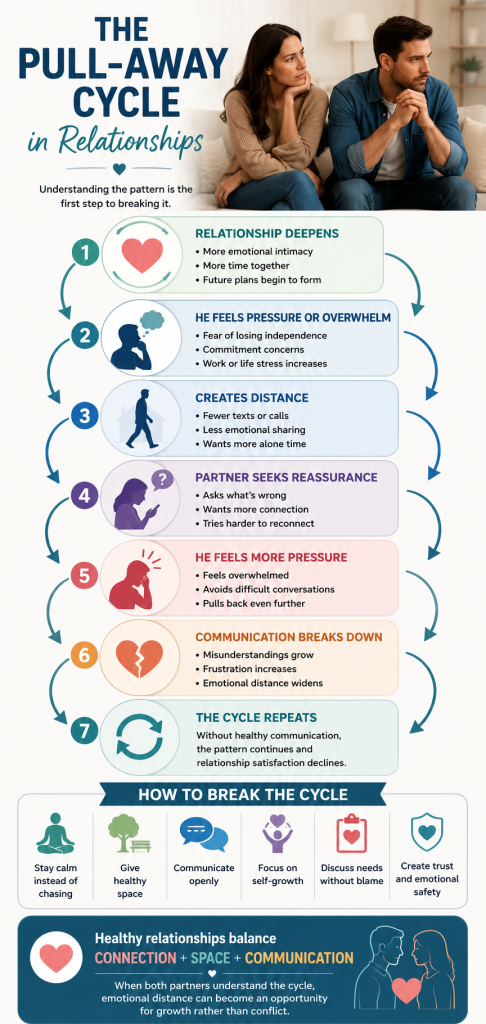
This cycle can happen when one person notices distance and increases pursuit, while the other experiences that pursuit as pressure and withdraws further. The pattern is not proof of a particular attachment style, and it is not always the explanation, but it can be useful to notice.
Possible Reason 1: Stress Outside the Relationship
Work pressure, finances, caregiving, grief, health concerns or family problems can reduce emotional availability temporarily.
Do not automatically make the distance about you. At the same time, external stress does not excuse indefinite silence or disrespect. A partner can say, “I am overwhelmed and need a quieter week,” instead of leaving you to guess.
Possible Reason 2: Conflict Has Become Hard to Discuss
If conversations repeatedly end in insults, defensiveness, contempt or shutdown, one or both partners may begin avoiding vulnerable topics.
Emotional safety does not mean never hearing criticism. It means concerns can be raised without humiliation, threats or punishment.
Possible Reason 3: They Feel Unappreciated
Feeling taken for granted can contribute to distance in any partner. Appreciation works best when it is specific and genuine rather than used as a tactic to keep someone from leaving.
Try: “I appreciated that you handled dinner when I was overwhelmed,” rather than generic praise designed to manage their mood.
Possible Reason 4: They Need More Space
Some people need more solitude or independent time than others. A request for space is not automatically rejection.
The key is whether the request has boundaries. “I need tonight to decompress; can we talk tomorrow?” is very different from disappearing indefinitely and expecting you to wait.
Possible Reason 5: They Are Uncertain About the Relationship
Sometimes distance does mean uncertainty, reduced interest or incompatibility. Understanding someone’s stress or attachment pattern should not become a way to explain away clear disengagement.
If a partner repeatedly avoids commitment, stops investing or says they do not want the relationship, take that information seriously.
Possible Reason 6: They Are Avoiding Accountability
Not every withdrawal is vulnerable self-protection. Some people go silent to avoid difficult questions, consequences or responsibility.
If distance appears every time you raise a reasonable concern, the issue may be avoidance rather than your communication style.
Possible Reason 7: The Relationship Is Changing
Relationships can become less intense over time without becoming unhealthy. The early stage of constant messaging and novelty is not a permanent standard.
Ask whether closeness has changed form or whether genuine connection, affection and effort have disappeared.
What Chasing Can and Cannot Do
Sending repeated messages, demanding constant reassurance or revisiting the same conversation every hour can increase pressure. But the solution is not to become strategically unavailable so the other person “misses you.”
Give space when it is genuinely needed, and communicate why:
“I notice we have felt distant. I’m going to give us some breathing room tonight, but I would like to talk tomorrow about what is happening.”
Ask Directly
A useful conversation can be simple:
“I’ve noticed we are talking less and spending less time together. Is something going on for you, or has something changed in how you feel about the relationship?”
Then listen to the answer and compare it with behavior over time. If you find yourself repeatedly decoding texts, pauses or small signals instead of asking directly, see Stop Overanalyzing His Behavior: Facts vs. Assumptions.
Do Not Over-Diagnose Attachment
The internet often labels anyone who needs space as “avoidant” and anyone who wants reassurance as “anxious.” Attachment anxiety and avoidance can be useful research concepts, but they are dimensions rather than destiny labels. A review of adult attachment, stress and romantic relationships describes anxiety and avoidance as distinct orientations linked with different responses to stressful situations—not as fixed verdicts about a person.
See our guide to attachment styles in relationships for a more careful explanation.
Your Needs Still Matter
Understanding why a partner withdraws does not require accepting a relationship that leaves you chronically anxious or emotionally starved.
Ask yourself:
- Can we talk about the distance?
- Does my partner make an effort to reconnect?
- Are my needs always framed as a problem?
- Can I ask for clarity without being punished?
- Is this a short difficult period or the normal state of the relationship?
When Distance Is a Warning Sign
Take the pattern more seriously when emotional withdrawal comes with threats, coercion, monitoring or other efforts to gain power and control. The relationship-education organization love is respect explains common types and warning signs of abuse. In this relationship, watch for:
- Repeated lying.
- Contempt or insults.
- Threats.
- Sexual or financial coercion.
- Monitoring or control.
- Long silent punishments.
- Refusal to discuss basic relationship expectations.
These are not problems to solve by becoming more attractive, calmer or more appreciative.
When a Relationship Can Reconnect
Reconnection is more likely when both people can name the problem and participate in repair. Helpful signs include:
- Honest explanations.
- Specific requests.
- Respect during disagreement.
- Follow-through.
- Willingness to adjust patterns on both sides.
Couples counseling may be useful when both partners want to improve the relationship but keep returning to the same cycle.
Do Not Use a Psychic Reading to Verify Private Motives
A psychic or tarot reading may help you reflect on your own fears, hopes and boundaries. It cannot independently prove why a partner is pulling away, whether they are cheating or what they secretly think.
For private motives, direct communication and observable behavior are more reliable.
Final Thoughts
When a man pulls away, there is no universal male explanation. Stress, conflict, need for space, uncertainty, avoidance or changing feelings may all play a role.
Do not chase harder, and do not play disappearance games. Name the change, ask directly, allow reasonable space and watch the pattern. A healthy relationship needs room for both independence and reliable connection.
Frequently Asked Questions
Does a man pulling away mean he lost interest?
Not necessarily. Stress, conflict or a need for space can also cause distance. Look at the whole pattern and ask directly.
Should I stop texting when he pulls away?
Avoid repeated reassurance-seeking, but do not use silence as a manipulation tactic. One clear message and a reasonable amount of space may be enough.
How much space should I give?
There is no universal number of days. Clear communication is better than an undefined waiting game.
Do men need space more than women?
Individuals differ. Gender alone is not a reliable way to predict someone’s need for solitude or emotional processing.
Can appreciation make him come back?
Genuine appreciation can support a relationship, but it cannot force someone to reconnect or commit.
What if he refuses to explain the distance?
You cannot force disclosure. Decide whether the level of communication being offered is acceptable to you.
Can a psychic tell me why he is pulling away?
A reading can support reflection, but it cannot verify another person’s private motives. Use direct communication and behavior as your main evidence.


