
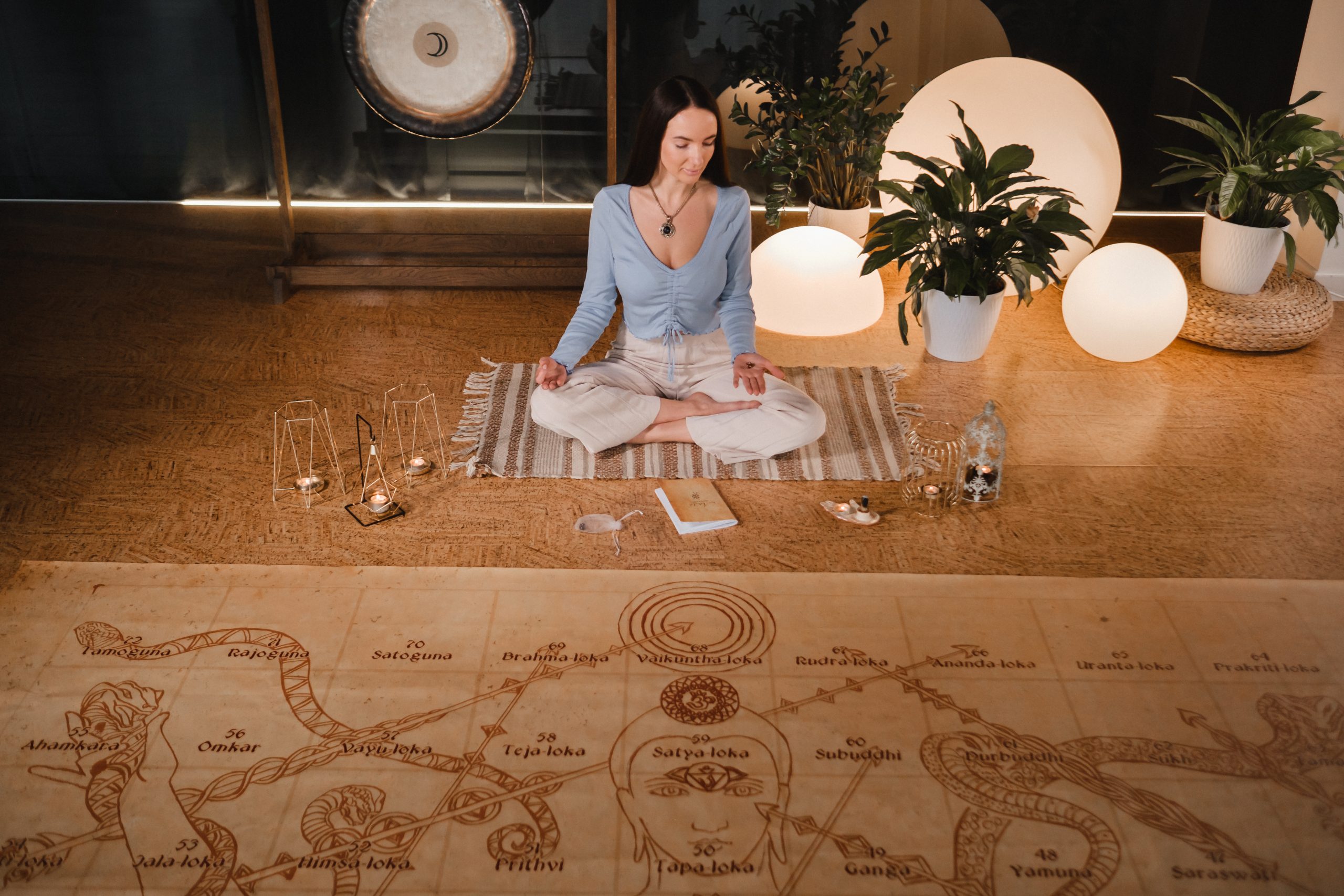
A journal opened at a familiar chair can be enough to begin. Your sacred space can hold a prayer, a memory or a question without looking like anyone else’s altar. Start with a place you can actually use and a practice that feels meaningful to you.
What Is a Sacred Space?
A sacred space is a place you intentionally set aside for reflection, prayer, meditation, yoga, journaling or another spiritual practice. It can be an entire room, one corner of a bedroom, a garden seat or a small portable setup you use while traveling.
The word “sacred” does not require a particular religion or belief. The value of the space can come from attention, routine and personal meaning rather than from assuming the room contains a measurable spiritual energy.
Start With the Practice, Not the Objects
Before buying candles, crystals or décor, decide what you actually want to do there.
- Make a comfortable pause before work, with meditation only if wanted.
- Pray or read a sacred text.
- Journal at the end of the day.
- Practice gentle yoga or breathing exercises.
- Use tarot or oracle cards for reflection.
- Remember a loved one.
- Have a quiet place without phones or work tasks.
Your purpose should shape the space.
Choose a Location You Can Use Consistently
A sacred space does not need to be large or private enough for a permanent altar. Useful options include:
- a chair beside a window;
- a small table in a bedroom;
- a corner separated by a screen;
- a shelf with a few meaningful objects;
- an outdoor bench or garden area;
- a portable box or cloth for travel.
Choose somewhere reasonably comfortable and unlikely to be interrupted during the time you plan to use it.
Decide What “Sacred” Means to You
For one person, sacred may mean religious prayer. For another, it may mean silence, family memory, nature, creativity or simply uninterrupted reflection.
Ask:
- What helps me slow down?
- Which practices genuinely matter to me?
- Do I want the space to feel minimal or visually rich?
- Is this space private or shared with family?
- Which objects have personal or cultural meaning?
Meaningful Objects You Might Include
There is no required list. Depending on your beliefs and practice, you might use:
- family photographs;
- artwork;
- religious or spiritual texts;
- a journal;
- a meditation cushion or chair;
- plants or flowers;
- stones or crystals used symbolically;
- tarot or oracle cards;
- a meaningful keepsake;
- music or a small instrument;
- a flameless candle or suitable lamp;
- fabric, a cloth or an altar surface.
An object does not need to emit special energy to be useful. It can function as a reminder of an intention, memory or value.
Use Crystals and Talismans as Symbols
If crystals, talismans or protective symbols are part of your practice, choose them for their personal or traditional meaning. They should not be treated as medical treatments, guarantees of protection or tools that force an outcome.
For example, a stone associated with calm can remind you to pause before reacting. A family heirloom may help you reflect on continuity or gratitude.
Candles, Incense and Smoke Safety
Fire and smoke need ordinary safety rules even inside a spiritual ritual.
- Keep candles on stable, heat-resistant surfaces.
- Never leave a flame unattended.
- Keep flames away from fabric, paper, pets and children.
- Follow building rules and consider everyone who shares the space. Ventilation does not make smoke suitable for every person or setting.
- A smoke-free and scent-free setup is a simple default, especially in shared, sleeping or travel spaces.
Use a flameless light in bedrooms, bathrooms and sleeping areas; the USFA advises against lit candles in those spaces. A ritual does not become less meaningful because you choose the safer version. The U.S. Fire Administration recommends stable holders, keeping candles at least 12 inches from anything combustible, extinguishing them before leaving or sleeping, and considering flameless alternatives.
A Free Sacred-Space Plan Using What You Have
Describe the practice first, then choose the smallest arrangement that supports it. Buying objects is optional.
| Plan the practical detail | One possible answer |
|---|---|
| What I want to do | Write a private reflection after the day’s responsibilities. |
| Where I can sit comfortably | An existing chair with a clear place for the notebook and suitable light. |
| What has meaning | A small family photograph already owned; no special purchase. |
| What others need | Agree on a suitable quiet time and keep shared surfaces and walkways usable. |
| How I will finish | Close the notebook, put private items away and return the shared area to ordinary use. |
Read your result: you have a usable place, a chosen practice and a way to finish. It is not an energy rating or a guarantee of calm. Try the arrangement and notice whether it is comfortable and easy to use; change anything that distracts, excludes someone or creates a hazard.
A portable version can be just the notebook and one meaningful item in a bag. In a hotel or rental, follow the property’s rules and use a smoke-free, flameless setup. Do not cover alarms, obstruct exits or leave fabrics near a heat source.
Objects borrowed from a living religious or cultural tradition deserve context and respect. Use symbols that belong to your practice or learn about their meaning rather than treating every sacred item as interchangeable decoration.
Keep the Space Comfortable
Comfort can make it easier to return to the practice. Consider:
- lighting;
- temperature;
- seating;
- noise;
- storage;
- accessibility;
- whether the space becomes cluttered over time.
A sacred space that is difficult to use is less helpful than a simple space you return to regularly.
Seasonal and Life-Transition Uses
You can change the space for seasons, anniversaries or major transitions. Examples include:
- a remembrance candle on an anniversary;
- a journal for a career transition;
- flowers for a seasonal observance;
- a photo or object connected with a new beginning;
- a short gratitude ritual after reaching a goal.
These changes can mark a transition without implying that the universe is directing the event.
Using Intuition Without Treating It as a Command
You may have an immediate preference for where an object belongs or how the space should feel. That is fine. Treat the impression as part of your creative process rather than as an external instruction that must be obeyed.
If an item feels distracting or uncomfortable, move it. If a simpler arrangement helps you focus, simplify it.
A Sacred Space for Decision Reflection
A quiet environment can help you think through a difficult choice, but the space itself does not reveal the correct answer. Use it to reduce distraction while you consider facts, tradeoffs and values.
For a practical decision framework, see How to Make a Hard Decision Without Chasing Certainty.
Keep the Practice Flexible
Your space can change as your beliefs and needs change. You are not required to preserve an altar forever, replace objects on a schedule or interpret every change in mood as an energy message.
What matters is whether the space helps you practice intentionally.
Related Ritual Safety Guide
If your sacred space includes candles, see Candle Rituals and Spiritual Meanings: A Safe Burning Guide for practical fire-safety rules and grounded flame symbolism.
Final Thoughts
A sacred space can be as simple as a chair, a journal and a pause that fits your day. Build it around the practice you actually value, not around a checklist of supposedly powerful objects.
Use symbolism freely, keep fire and smoke safety practical, and let the space support reflection rather than become another source of rules or certainty.
Frequently Asked Questions
1. Do I need a whole room for a sacred space?
No. A shelf, chair, small table or portable setup can be enough.
2. Do I need crystals or an altar?
No. Include only objects that have meaning or practical value for your practice.
3. Can I create a sacred space in a hotel?
Yes, where the property permits it. A journal or photo can create a familiar setup; keep it smoke-free and flameless, with exits and alarms unobstructed.
4. Do sacred objects contain energy?
That is a spiritual belief rather than an established measurement. Objects can still carry personal and cultural symbolism.
5. Is incense necessary?
No. If smoke is unsafe or uncomfortable, use a smoke-free alternative.
6. Can a sacred space help me make decisions?
It can reduce distraction and support reflection, but the decision should still rely on your values, evidence and circumstances.
Optional Meditation Practice
If you want a simple visualization to use in a quiet reflection space, see Golden Light Meditation: A Symbolic Visualization Practice.
Smoke-Free Comfort Ritual
If you prefer a simple non-smoke sensory ritual, see Tea for Comfort and Ritual: Recipes, Caffeine and Safety.


