
Quick answer: Humor can ease tension and evoke powerful memories during mediumship readings. Learn why laughter can matter without treating jokes or coincidences as proof of spirit contact.
Grief and laughter can exist in the same room. During a mediumship reading, a private joke, nickname or familiar style of teasing may trigger a strong emotional response because humor is closely tied to personality, memory and family relationships.
That does not mean a joke automatically proves a deceased person is communicating. Humor can make a reading feel personal and memorable while the source of the information remains uncertain.
Why Humor Can Matter During Grief
People sometimes feel guilty for laughing after a death, as though joy disrespects the person they lost. In reality, humor can be part of remembrance. Remembering someone’s ridiculous sayings, bad puns or family jokes can temporarily soften grief without erasing it.
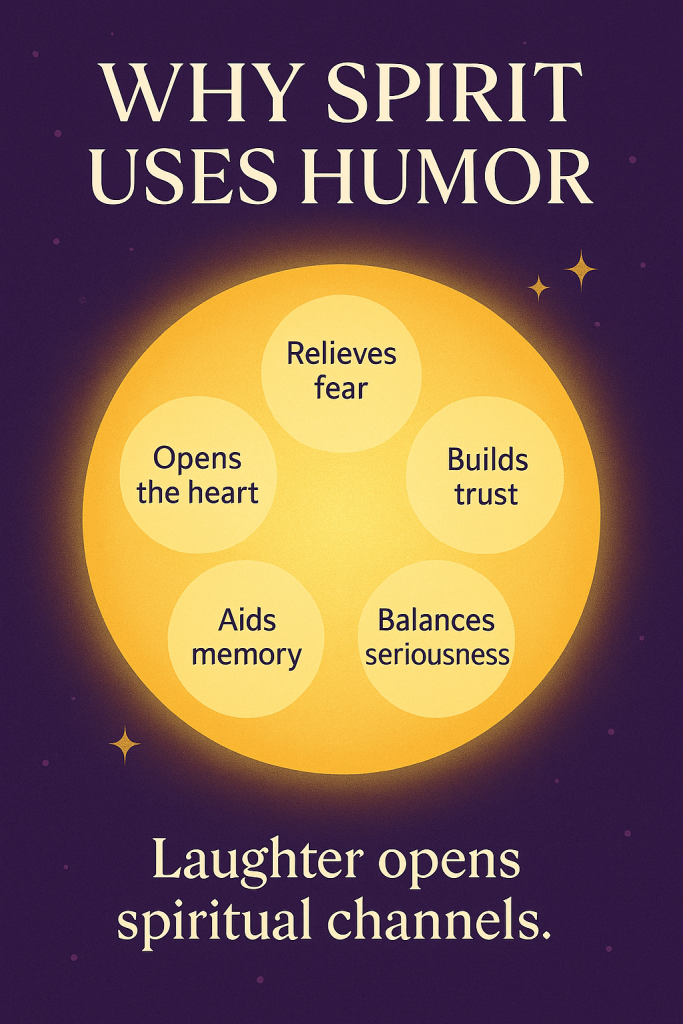
Laughter may also reduce immediate tension and help people reconnect socially. It should not be described as raising a measurable spiritual vibration or opening a verified communication channel.
Research specific to bereavement humor is still limited. A 2022 scoping review found only 11 relevant English-language studies and concluded that bereaved people do use humor for varied reasons, while more research—especially across cultures—is needed before treating it as a consistently safe or effective support technique.
Humor as a Memory Cue
A joke can carry a large amount of personal history. One short phrase may remind you of holidays, arguments, routines and affection all at once.
This is one reason humorous details in readings can feel especially compelling. Emotional specificity matters, but emotional recognition is not the same as scientific proof of a source.
Private Jokes and Specificity
If a reader mentions an unusual nickname or joke that fits, it is reasonable to note that as a specific statement. Keep the original wording and evaluate it as you would any other reading detail.
Avoid turning every broad humorous comment into a “hit.” “He liked to joke” is very different from a highly specific phrase documented before the client supplied the information.
Humor Should Never Be Used to Manipulate
Humor becomes unethical when it is used to:
- mock grief;
- pressure a client to agree;
- hide a failed statement;
- make a medical or safety warning seem divinely authoritative;
- push the client toward a financial or relationship decision;
- encourage dependence on the reader.
Consent and Cultural Context
Families differ in how they use humor. Teasing that feels affectionate in one family may feel cruel in another. A reader should pay attention to the client’s reaction and be willing to stop.
Humor also varies across languages, cultures, religions and generations. It should not be used as a stereotype.
Can a Joke Prove Identity?
No single joke can conclusively prove who produced an impression. A highly specific reference can be personally meaningful and worth documenting, but alternative explanations still need to remain possible.
Readers should not tell clients that laughter itself is proof, that “the spirit made you laugh,” or that a funny coincidence confirms afterlife contact.
Funny Coincidences After a Loss
A ridiculous license plate, a familiar phrase, a pet doing something funny or a perfectly timed song can feel as though the deceased person’s personality just reappeared for a moment.
You can enjoy that connection as a memory without insisting that the event was physically caused by a spirit.
For the broader grief framework, see Signs After a Loss: Dreams, Memories and Spiritual Interpretations.
Flickering Lights and Moving Objects
Lights flicker because of bulbs, wiring, power fluctuations and electronics. Objects move because of vibration, uneven surfaces, airflow and ordinary physical causes.
Do not treat a flicker or moving mug as evidence simply because it occurs during an emotional conversation. Check the environment first.
Humor Should Not Deliver Medical Instructions
A medium should never use a joking “message” to tell someone they need a scan, have a disease, should change medication or can safely ignore symptoms.
If a comment prompts a health concern, the appropriate next step is ordinary healthcare—not belief that a deceased person issued a diagnosis.
Humor and Grief Support
Humor can make a grief conversation more human, but a mediumship reading is not grief therapy. If someone is persistently unable to function, severely depressed, panicked or overwhelmed after a loss, professional grief or mental-health support is appropriate.
How a Reader Can Use Humor Ethically
- Let humor arise naturally rather than performing for effect.
- Check whether the tone feels appropriate.
- Keep the client’s dignity intact.
- Do not overstate what a joke proves.
- Return to the client’s actual question.
- Never use humor to minimize trauma or safety concerns.
How a Client Can Evaluate a Humorous Detail
- Write down the exact statement.
- Ask whether it was specific or broadly applicable.
- Note what information the reader already had.
- Do not supply extra details until the initial impression is complete.
- Keep room for coincidence, inference and memory.
Inviting Joy Without “Inviting a Spirit”
If you miss someone’s humor, you can create remembrance rituals without trying to provoke supernatural contact. Watch their favorite comedy, retell family jokes, keep a funny object, cook something they loved or write down stories that still make you laugh.
These practices preserve personality and connection in memory without requiring a claim that a spirit is actively producing signs.
Frequently Asked Questions
Can humor be helpful during grief?
Yes. Remembering funny moments can provide relief, connection and a fuller picture of the person who died.
Does a private joke prove spirit contact?
No. It can be a specific and meaningful reading detail, but it does not conclusively establish the source.
Is it disrespectful to laugh during a mediumship reading?
No. Grief can include laughter as well as sadness.
Can flickering lights be a spirit joke?
Electrical causes should be checked first. A meaningful coincidence can remain personally symbolic without being proof.
Should a medium joke about trauma?
Only with great care and clear client comfort; humor should never minimize harm or distress.
Can a humorous message give medical advice?
No. Mediumship should not diagnose or direct medical care.
How should I evaluate a specific joke in a reading?
Keep the exact wording, consider what information was available and avoid turning broad comments into specific confirmations.
How can I remember someone’s humor without seeking signs?
Share stories, save favorite jokes, revisit funny memories and create rituals that keep their personality present in family life.