Quick answer: Your Rising Sign, or Ascendant, is the zodiac sign on the eastern horizon at your birth time and place. Astrologers use it for presentation, beginnings and house layout; it can change with birth time, and its interpretations are symbolic rather than scientifically validated.
The Rising Sign, also called the Ascendant, is the zodiac sign appearing on the eastern horizon at the time and place of birth. In many forms of Western astrology, it marks the beginning of the first house and helps determine the arrangement of the remaining houses.
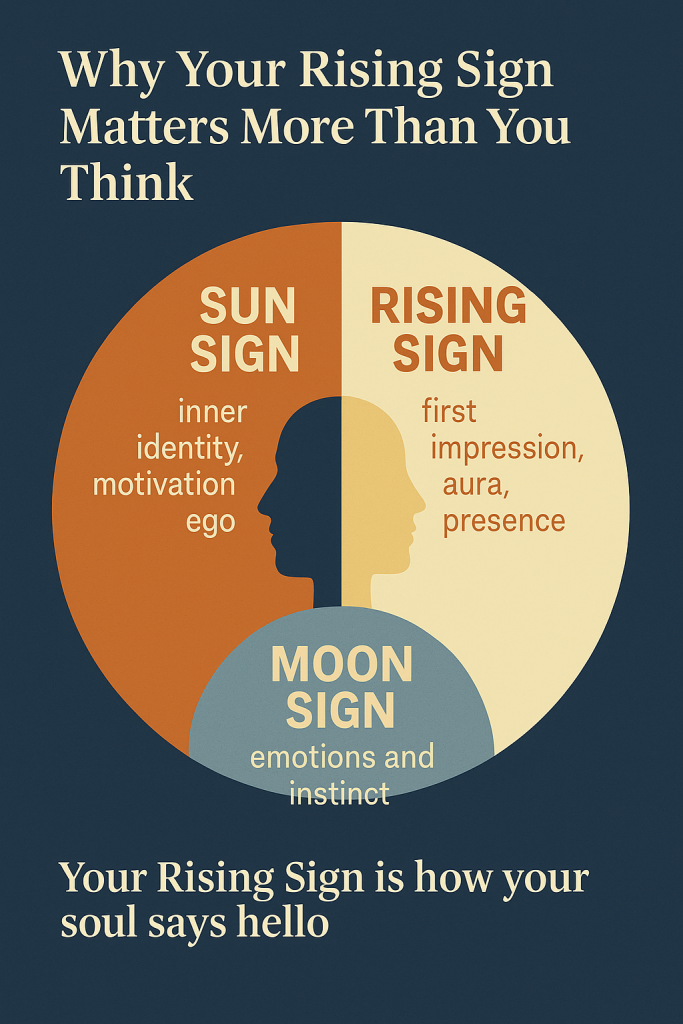
Astrologers traditionally associate the Ascendant with presentation, beginnings and how a person approaches the world. Those meanings are symbolic. A Rising Sign does not scientifically determine appearance, personality, aura color, compatibility or destiny.
Why Is Your Rising Sign Important in Astrology?
In Western astrology, the Rising Sign is important because it sets the first house and helps determine the layout of the remaining houses. Astrologers also use it symbolically for presentation, first impressions and how someone approaches new situations. Those interpretations are astrological, not scientifically verified personality measures.
Can Your Rising Sign Change?
Your calculated natal Rising Sign does not change after birth because it is based on that fixed birth time and location. A corrected birth record can change the calculation, and a few minutes may matter near a sign boundary. Transits change over time, but they do not replace the natal Ascendant.
Why Birth Time Matters
The Ascendant depends on date, exact time and geographic location. Because Earth rotates continuously, the sign on the eastern horizon changes throughout the day.
A small difference in birth time can change the degree of the Ascendant and, near a sign boundary, may change the sign itself. That is an astronomical calculation. The personality meanings assigned to the result belong to astrology.
How to Find Your Rising Sign
To calculate it, you need:
- date of birth,
- birth time, ideally from a reliable record, and
- birth city or coordinates.
A reputable birth-chart calculator can determine the Ascendant mathematically. If your birth time is unknown, treat any Rising Sign result as uncertain. Chart rectification is an astrological estimation method, not a way to recover a historically verified birth time.
What the Ascendant Means in Astrology
Traditional astrologers often use it to discuss:
- first-house themes,
- how someone initiates or approaches situations,
- self-presentation,
- the structure of the houses, and
- the planet that becomes the chart ruler.
This does not mean the Ascendant literally controls posture, clothing, facial expression or how strangers perceive you.
Rising Sign Archetypes
These are brief traditional themes, not personality verdicts:
- Aries Rising: initiative and directness.
- Taurus Rising: steadiness and values.
- Gemini Rising: curiosity and communication.
- Cancer Rising: care and security.
- Leo Rising: expression and visibility.
- Virgo Rising: analysis and refinement.
- Libra Rising: relationship and balance.
- Scorpio Rising: privacy and transformation.
- Sagittarius Rising: exploration and perspective.
- Capricorn Rising: structure and responsibility.
- Aquarius Rising: independence and groups.
- Pisces Rising: imagination and sensitivity.
What Is a Chart Ruler?
The chart ruler is the planet associated with the Rising Sign in the astrological system being used. Common modern/traditional rulerships include:
- Aries → Mars
- Taurus → Venus
- Gemini → Mercury
- Cancer → Moon
- Leo → Sun
- Virgo → Mercury
- Libra → Venus
- Scorpio → Mars or Pluto depending on the system
- Sagittarius → Jupiter
- Capricorn → Saturn
- Aquarius → Saturn or Uranus depending on the system
- Pisces → Jupiter or Neptune depending on the system
Astrologers interpret the ruler’s sign and house as another layer of symbolism. It does not objectively reveal where your destiny must unfold.
Rising Sign and First Impressions
Astrology commonly associates the Ascendant with first impressions. Psychology also studies how quickly people form first impressions—but that research does not validate Rising Signs as their cause.
Real first impressions are influenced by expression, body language, voice, clothing, context, stereotypes and prior expectations. Astrology can offer a reflection prompt about presentation without claiming to explain those processes scientifically.
Rising Sign and Aura Claims
Some modern spiritual writers connect Ascendants with aura colors or “front energy.” There is no established aura color produced by a Rising Sign, and a psychic cannot verify someone’s Ascendant simply by sensing an energy field.
If you enjoy color symbolism, use it creatively rather than diagnostically.
Rising Sign and Compatibility
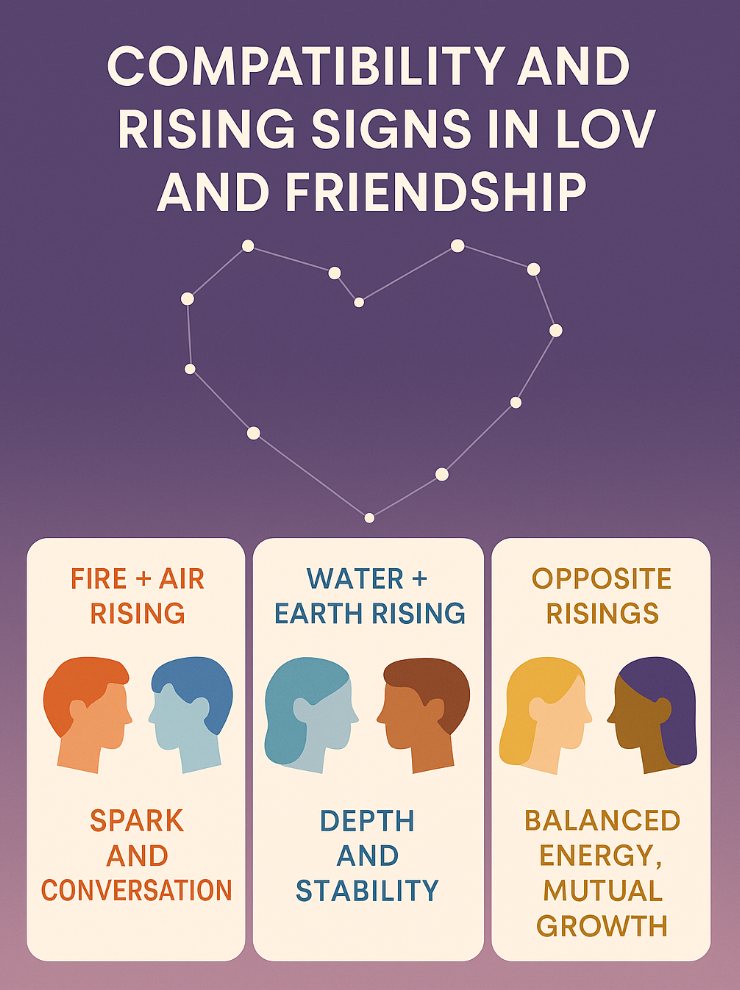
Synastry compares placements and aspects between two charts. Astrologers may describe trines or sextiles as easier and squares or oppositions as more challenging.
These patterns do not determine whether two people will be attracted, loyal or compatible. Real relationship information includes communication, trust, consent, shared values, conflict behavior and reliability.
In a double-blind comparison of natal charts and personality profiles, participants could not identify the genuine astrological summaries better than chance. Use Rising Sign compatibility as conversation material, not a validated relationship test.
Rising Sign and Manifestation
The Ascendant does not control how effectively someone “manifests” money, love or opportunities. If elemental prompts help you plan goals, they can be used symbolically:
- Fire: identify an action.
- Earth: build a practical plan.
- Air: gather information or communicate.
- Water: reflect on feelings and values.
Those steps can be useful for anyone, regardless of Rising Sign.
Can the Ascendant Predict Career or Life Changes?
Astrologers interpret transits to the Ascendant and chart ruler as symbolic timing themes. They cannot reliably predict a promotion, move, breakup, financial event or “destiny shift.”
Use transits as reflection prompts, not as reasons to delay or accelerate major decisions without practical evidence.
Celebrity Rising Signs

Celebrity charts are often used as astrology examples, but two cautions matter:
- Birth times published online can be uncertain or disputed.
- A chart should not be used to claim knowledge of a real person’s private motives, trauma, spirituality or destiny.
Public behavior can be compared with astrological archetypes as a cultural exercise, but it does not prove the archetype caused the behavior.
AI and Rising Sign Calculations
Software can calculate an Ascendant quickly from astronomical data. AI can also summarize traditional interpretations. That improves calculation convenience, not scientific validation of astrological personality claims.
Heart rate, voice analysis, photographs or other biometric data should not be presented as a way to verify someone’s aura or astrological “frequency.”
How to Use Your Rising Sign Constructively
Try questions such as:
- Which parts of this archetype feel familiar?
- Which parts clearly do not?
- How do I want to come across in new situations?
- What habits help me communicate authentically?
- Am I using astrology to reflect—or to avoid making a decision?
Frequently Asked Questions
What is a Rising Sign?
It is the zodiac sign on the eastern horizon at the time and place of birth, used as the Ascendant in many astrological systems.
How accurate does my birth time need to be?
The closer to the recorded time the better, especially near a sign boundary. An uncertain birth time makes the Ascendant less certain.
Does my Rising Sign determine my personality?
No. Astrology gives it symbolic personality themes, but it is not a validated personality measurement.
Does the Rising Sign determine my aura?
No. There is no established aura color or energy frequency caused by an Ascendant.
Can Rising Signs predict compatibility?
No. Astrological synastry is symbolic and cannot establish whether a relationship will be healthy or lasting.
Can Ascendant transits predict major life events?
Astrologers interpret them as timing themes, but they do not reliably predict specific events.
What is a chart ruler?
It is the planet associated with the Rising Sign within a particular astrological rulership system.
How should I use my Rising Sign?
Use it as a reflection tool alongside the rest of the chart, while keeping important decisions grounded in real-world information.
Related Birth Chart Guides
For more chart context, see Natal Chart Basics and Descendant Sign Meaning: Partnership Archetypes.
Also useful: Birth Chart Reading: What to Expect and How to Prepare — for placing the Ascendant within a complete chart-reading process.